PROFILES
Threat Groups
From LockBit and Conti to Akira and Cl0p, anatomies of the operations behind the headlines.
Anatomies of the operations behind the headlines: how each ransomware crew works, who it hits, how it makes money, and how it ends. The catalogue below tracks close to 400 operations from live leak-site data, and the profiles go deeper on the groups that matter. Start with LockBit, Conti and Medusa, follow live activity on the Ransomtracker, see who posted victims in the last 24 hours on ransomware attacks today, and compare operators across the year on the 2026 archive.
Start here
- LockBit: the brand that redefined the industry
- Conti: anatomy of a ransomware corporation
- Medusa: victims, tactics and defence
- INC Ransom: winning by mastering the basics
- RansomHub: the post-LockBit consolidator
- Scattered Spider: still the SIM-swap kings
Latest profiles
- Medusa ransomware: victims, tactics, and how to defend in 2026
 Medusa is a ransomware-as-a-service crew active since 2021, with 300+ claimed victims and 161 confirmed by Ransomnews. Its targets, tactics, biggest breaches and the defences that stop it.
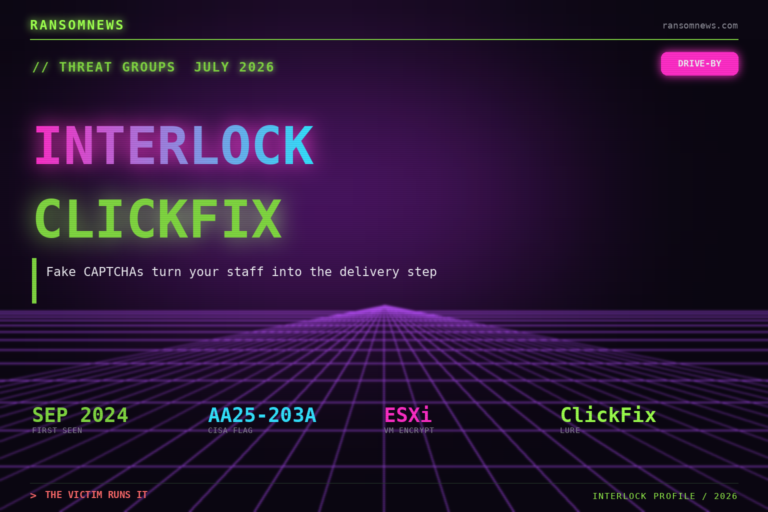
 - Interlock: the drive-by ransomware crew CISA flaggedInterlock breaks the ransomware playbook, entering through compromised websites and fake CAPTCHAs. A joint CISA-FBI advisory mapped its TTPs. Here is the profile.
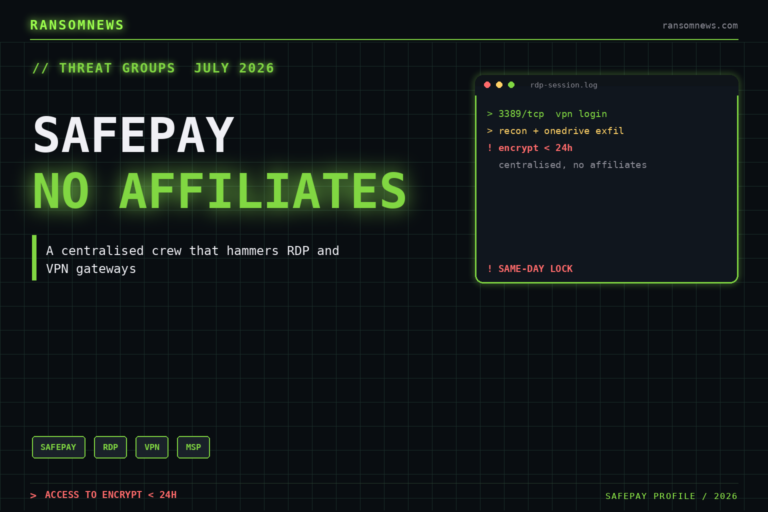
- SafePay: the centralised crew that skipped affiliatesSafePay went from unknown to one of the busiest ransomware crews in under a year by ditching affiliates and hammering RDP and VPN gateways. Here is how it works.
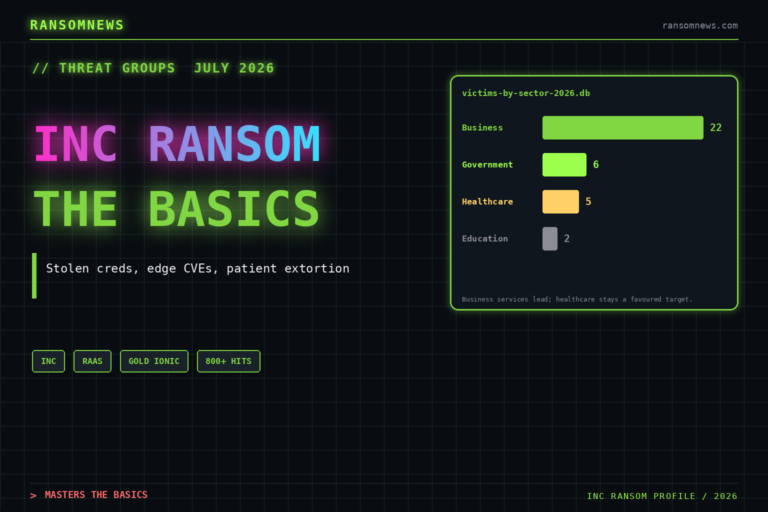
- INC Ransom: the RaaS that wins by mastering the basicsINC Ransom has claimed 800-plus victims since 2023 using stolen credentials, edge-device flaws and double extortion. Here is how the RaaS operates in 2026.
- LockBit, 2 years after Operation Cronos: where are they now?
 A 2026 retrospective on the international takedown that displaced LockBit at the top of the ransomware ecosystem: what stuck, what reverted, where the affiliate workforce migrated, and what the next coordinated action should learn from the playbook.
 - Ransomware attribution 2026: TTPs, notes, fingerprintsA 2026 attribution playbook for ransomware investigations, combining TTP fingerprinting against MITRE ATT&CK, ransom-note artifact analysis, leak-site monitoring, and the open-source intelligence pivots that hold up under scrutiny.
- Active Directory hardening 2026: Tier 0, DSRM, PRT theftA 2026 practitioner walkthrough of Active Directory hardening against the lateral-movement, credential-theft, and persistence techniques that modern ransomware operators rely on: Tier 0 isolation, DSRM rotation, PRT theft mitigation, and AD audit baselines.
- How to build a threat actor profile from public sources: MITRE ATT&CK + Mandiant + Malpedia tutorialA practitioner’s tutorial for assembling a working threat-actor profile from public sources: MITRE ATT&CK for TTPs, Mandiant and CrowdStrike for attribution context, Malpedia for malware lineage, plus a clean note-taking template.
- Tracking ransomware affiliates across rebrands with VirusTotal, MalwareBazaar, and YARAA 2026 tutorial for tracking individual ransomware affiliates across operator rebrands using VirusTotal Intelligence, abuse.ch’s MalwareBazaar, and YARA rules. Code reuse, builder fingerprints, and TTP continuity reveal the same crews under new names.
- Lumma vs RedLine vs Vidar in 2026: market share by infectionsA 2026 comparative profile of the three dominant infostealer families: capabilities, distribution channels, market share by observed infections, and where each is heading after the 2024 takedown actions.
- The new mid-tier RaaS contenders: Qilin, Medusa, EmbargoThree mid-tier ransomware operators have built sustained victim claim counts in 2025-2026. Profiles of Qilin, Medusa, and Embargo: what’s distinctive about each, and what the rise of the mid-tier means for defenders.
- Lapsus$ revival rumors in 2026: what we know and what we don’tPersistent rumors point to a Lapsus$ revival operating under new branding in 2026. Sorting the credible signal from the Telegram noise, and what defenders should make of it.
- Akira’s pivot to extortion-only: a 2026 group profileAkira began as a classic encrypt-and-extort operation but has been quietly drifting toward data-theft-only attacks across 2025-2026. A profile of where they came from, where they are now, and why the model is working.
- RansomHub explained: the post-LockBit consolidatorRansomHub became the largest active RaaS by claim count in 2025 by absorbing experienced affiliates from the LockBit and ALPHV exits. A 2026 profile of the operator, their tooling, and their structural position.
- Scattered Spider in 2026: still the SIM-swap kingsScattered Spider (UNC3944, Octo Tempest) survived the 2024 arrests and remains one of the most operationally aggressive English-speaking threat groups. Their 2026 playbook, capabilities, and how they keep getting in.
- Ransomware Q1 2026 leaderboard: who’s claiming the most victimsA 2026 Q1 ransomware leaderboard built from leak-site claims, with the structural changes shaping the operator pool: RansomHub at the top, a long mid-tier, and the takedown ripples still propagating through the ecosystem.
- The pivot from encryption to data theft: pure-extortion gangs in 2026A new generation of operators has dropped encryption entirely: they steal the data and threaten to leak it without ever locking a single file. Here’s why that model is winning.
- Play: the closed-shop ransomware brand quietly hitting cities, schools, and critical infrastructurePlay (also known as PlayCrypt) does not run an open RaaS. It runs a closed shop with vetted affiliates, an unusual aesthetic, and a steady cadence of attacks against cities, schools, and managed service providers. Quietly, it has become one of the most prolific operators of the post-LockBit era.
- Hive: the ransomware operation the FBI spent seven months insideHive was a top-tier RaaS that hit hospitals, schools, and Costa Rica’s public sector, until the FBI quietly infiltrated its infrastructure for seven months, harvested decryption keys, and dismantled the operation in January 2023.
- DarkSide: Colonial Pipeline, the pseudo-code-of-conduct, and the rebrand to BlackMatterDarkSide ran for less than a year before its attack on Colonial Pipeline rewrote the politics of ransomware in May 2021. Then it disappeared, rebranded as BlackMatter, and seeded what would eventually become BlackCat/ALPHV. A short, consequential life.
- Akira: the retro-themed ransomware operation quietly eating mid-market enterpriseAkira launched in March 2023 with a 1980s green-screen aesthetic and rapidly became one of the most active ransomware operations in the world, riding waves of Cisco VPN exploitation and a steady stream of mid-market victims. Here is what makes it distinctive.
- Black Basta: Conti’s most successful successor and its healthcare specialismBlack Basta walked out of the Conti collapse in 2022 and rapidly became one of the top RaaS programs in the world, with a particular taste for healthcare and critical infrastructure. Then internal chats leaked again, and the playbook started looking familiar.
- Ryuk: the big-game hunter that made ransomware a boardroom problemRyuk was the Russian-speaking operation that proved you could ransom a Fortune 500 company for tens of millions of dollars and get away with it. It is also the operation whose people went on to run Conti, and, by extension, half the modern ransomware ecosystem.
- Cl0p: the mass-exploitation specialists behind Accellion, GoAnywhere, and MOVEitCl0p turned ransomware into a zero-day data-extortion business. Three sweeping campaigns against file-transfer software (Accellion, GoAnywhere, and MOVEit) produced thousands of victims and billions in damages, with little encryption and a lot of stolen data.







Every ransomware group profile
Our editorial profiles of individual ransomware operations, newest first.
- Medusa ransomware: victims, tactics, and how to defend in 2026
- Interlock: the drive-by ransomware crew CISA flagged
- SafePay: the centralised crew that skipped affiliates
- INC Ransom: the RaaS that wins by mastering the basics
- LockBit, 2 years after Operation Cronos: where are they now?
- Ransomware attribution 2026: TTPs, notes, fingerprints
- Active Directory hardening 2026: Tier 0, DSRM, PRT theft
- How to build a threat actor profile from public sources: MITRE ATT&CK + Mandiant + Malpedia tutorial
- Tracking ransomware affiliates across rebrands with VirusTotal, MalwareBazaar, and YARA
- Lumma vs RedLine vs Vidar in 2026: market share by infections
- The new mid-tier RaaS contenders: Qilin, Medusa, Embargo
- Lapsus$ revival rumors in 2026: what we know and what we don’t
- Akira’s pivot to extortion-only: a 2026 group profile
- RansomHub explained: the post-LockBit consolidator
- Scattered Spider in 2026: still the SIM-swap kings
- Ransomware Q1 2026 leaderboard: who’s claiming the most victims
- The pivot from encryption to data theft: pure-extortion gangs in 2026
- Play: the closed-shop ransomware brand quietly hitting cities, schools, and critical infrastructure
- Hive: the ransomware operation the FBI spent seven months inside
- DarkSide: Colonial Pipeline, the pseudo-code-of-conduct, and the rebrand to BlackMatter
- Akira: the retro-themed ransomware operation quietly eating mid-market enterprise
- Black Basta: Conti’s most successful successor and its healthcare specialism
- Ryuk: the big-game hunter that made ransomware a boardroom problem
- Cl0p: the mass-exploitation specialists behind Accellion, GoAnywhere, and MOVEit
- BlackCat / ALPHV: the Rust-powered RaaS that ended in an exit scam
- REvil / Sodinokibi: the big-game hunters who hit Kaseya, JBS, and then disappeared twice
- Conti: anatomy of a ransomware corporation, and how it imploded
- LockBit: the ransomware brand that redefined the industry, and got taken down
Operator interviews
The Danchev Interviews: rare on-record conversations with the people running these operations.
Tracked ransomware operators
400 ransomware operations currently profiled, accounting for 31,160 claimed victims between them. Each profile lists victims, leak-site mirror status, and first and most recent listing dates, rebuilt continuously from leak-site monitoring.
A
B
- B0 Group
- Babuk (Bjorka)
- Babuk Locker
- Babylockerkz
- Backmydata
- Balletspistol
- Barracuda
- Bavacai
- Beast
- Belsen Group
- Benzona
- Bert
- BianLian
- Bidon
- Bitransomware
- Bjorka
- Black Nevas
- BlackSuit
- Black X
- Black Basta
- BlackBerserk
- Blackbit
- BlackByte
- BlackByte Crux
- Blackhunt
- Blacklocks
- Blackmatter
- Blackout
- Blackshadow
- Blackshrantac
- Blacksnake
- Blacktor
- Blackwater
- Bluebox
- Bluesky
- Bonacigroup
- Booba Team
- BQTLock
- Br0k3r
- Brain Cipher
- Bravox
- Brotherhood
- Byod
C
- C3rb3r
- Cactus
- Catb
- Cephalus
- Cerberimposter
- Cerbersyslock
- Chaos
- Cheers
- Chilelocker
- Chort
- Cicada3301
- Ciphbit
- Cipherforce
- Cloak
- Cl0p
- Cl0p (torrents)
- CMD Organization
- Coinbase Cartel
- Colossus
- Contfr
- Conti
- Cooming
- Core
- Crazyhunter Team
- Crosslock
- Crpx0
- Cry0
- Cryakl
- Crylock
- Crynox
- Cryp70n1c0d3
- Cryptbb
- Cryptedpay
- Cryptnet
- Crypto24
- Cryptxxx
- Crysis
- CS-137
- Ctblocker
- Cuba
- Cyberleek
- Cyclops