
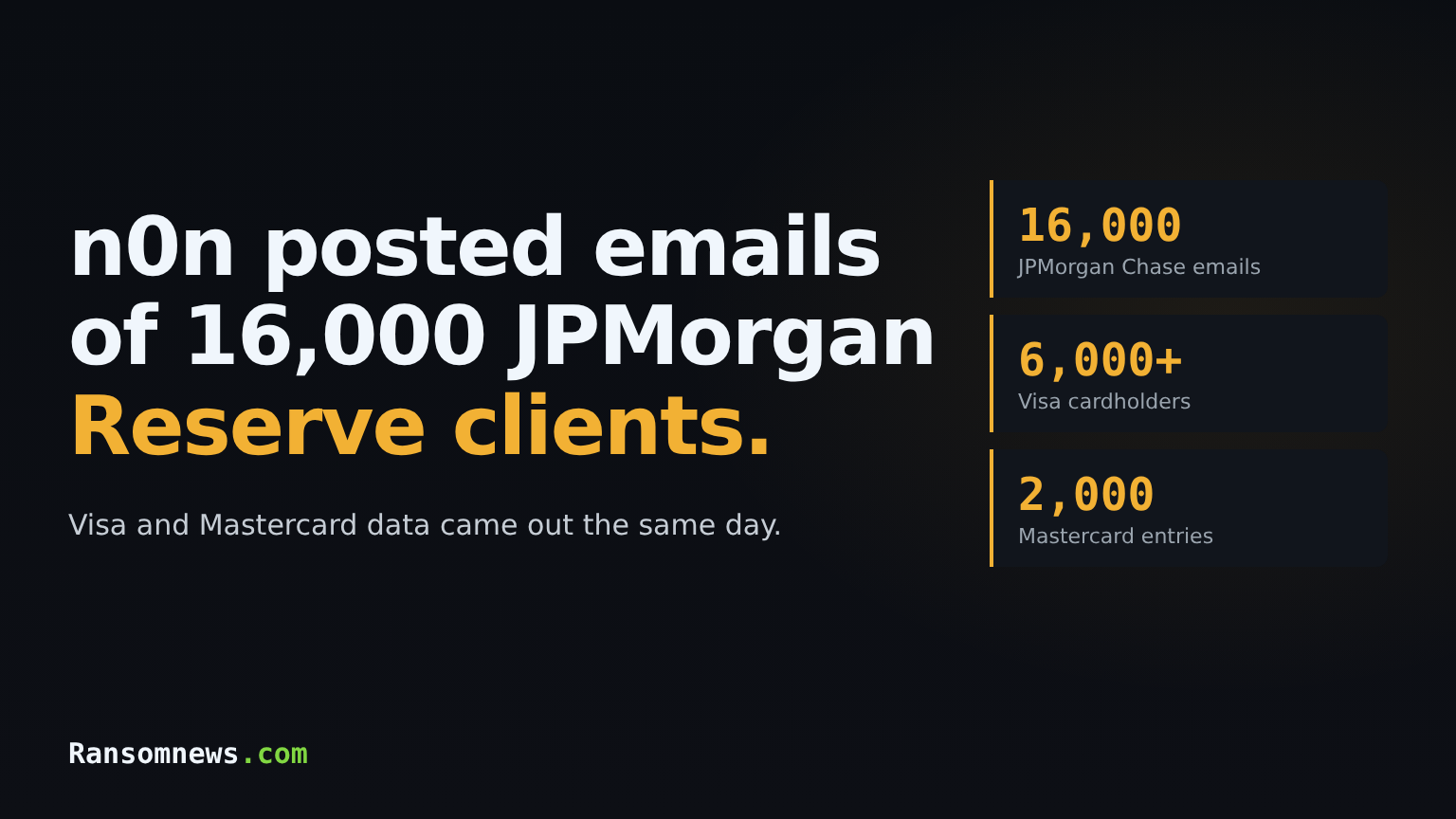
The extortion group n0n published marketing records on customers of Visa, Mastercard and JPMorgan Chase on 19 November 2026, after a 48-hour deadline ran out. The JPMorgan file holds about 16,000 customer email addresses from the bank’s invitation-only Reserve card, according to Cybernews. All three companies say the data breach happened at outside providers and that no card numbers or payment systems were affected.
In brief
- n0n published about 16,000 JPMorgan Chase customer emails, records on more than 6,000 premium Visa cardholders in Asia Pacific, and about 2,000 Mastercard entries that Cybernews researchers say may be test data.
- None of the published reviews of the files reports card numbers, passwords or account balances.
- All three companies say outside providers were breached, and none has named one. A Cybernews researcher says the three sets look like they came from the same third party.
- Stealer logs already hold 126,660 saved user logins for chase.com, visa.com, mastercard.com and jpmorganchase.com, by our count on 19 November. Of those, 106,128 are for chase.com.
- The Ransomtracker has logged 393 n0n entries since 18 September, and 25 new numbered placeholders appeared the evening before the leak.
What did n0n publish on 19 November?
n0n published three sets of marketing records, one for each company. The Ransomtracker logged the Visa, Mastercard and JPMorgan Chase entries at 16:27 UTC on 16 November, and the group gave the companies 48 hours to negotiate. Cybernews and Reuters have each gone through the files.
| Company | Cybernews count | Reuters review |
|---|---|---|
| JPMorgan Chase | About 16,000 customer emails, some with phone numbers and account IDs, in a 502 KB file. All appear to be Reserve cardholders. | More than 16,000 customer emails, some with phone numbers and postal codes, and about 124 bank employee emails. |
| Visa | More than 6,000 premium cardholders, apparently from a marketing platform for dining programmes. | Several spreadsheets of customer emails, phone numbers and campaign data from Hong Kong, Taiwan, Korea, Japan, the Philippines, Singapore, Malaysia, Australia and Macau. |
| Mastercard | About 2,000 entries, badly formatted. They may be test data. | Marketing information on customers in North America, the Middle East and Africa, and a small number of Mastercard employee emails. |
Reserve is an invitation-only Visa credit card that JPMorgan usually offers to clients with at least $10 million in assets at the bank, Newsweek reports, so the file is a contact list for some of the bank’s wealthiest clients.
n0n may hold more than it published. On 16 November it said it had hundreds of thousands of campaign interactions for tens of thousands of cardmember email addresses, according to a screenshot of the listing captured by eCrime.ch and cited by Reuters, and the JPMorgan file Cybernews examined is 502 KB. Reuters said it could not verify that the data is authentic.
What have Visa, Mastercard and JPMorgan Chase said?
All three have confirmed an incident at an outside provider and deny that their own systems were breached.
- JPMorgan Chase said on 19 November that third parties providing services to the bank were the target of a cyberattack. “We believe the attackers accessed certain marketing data held by those vendors,” a spokesperson said. The data may include some customer names and email addresses. The bank said it will contact affected customers directly and offer free credit monitoring, and that the attack has no connection to the Chase outage of 16 November. It declined to comment on the published files, Reuters reports.
- Visa said the claims relate to an incident at a third-party service provider in Asia Pacific. “Visa’s systems were not involved and were not impacted,” a spokesperson told Cybernews on 17 November. Visa says no payment data such as card numbers was affected.
- Mastercard said it had been told of an incident at a third-party provider that exposed “a limited amount of information from a subset of cardholders” in one benefit programme, Cybernews reports. It told Reuters the exposed information was email addresses and other non-payment data, and that its payment network was not affected.
None of the three has named a provider or said how many customers it will notify.
Did one supplier breach expose all three?
The three leaks probably came from one supplier, though no company has confirmed it. Cybernews researcher Aras Nazarovas found the same file layouts and formatting in all three datasets and said they look like they were taken from the same third party, Stock Analysis reports. Visa points to a single provider in Asia Pacific. JPMorgan refers to third parties in the plural.
The three card entries n0n posted on 16 November, when it named 59 organisations, all described cardmember marketing profiles and campaign records, with no mention of card numbers. The JPMorgan Chase entry had been on the site since 9 November as a numbered placeholder, “Company #150”, a week before n0n attached the bank’s name to it.
Expedia, which n0n listed on 9 November, told Skift three days later that attackers had compromised a third-party data platform provider. Bitdefender, working from data on the group’s own file server, says n0n targeted just over 20 victims while listing about 150 in October. Our reading is that n0n breaches one supplier and then lists each of that supplier’s clients as a separate victim.
How many Chase, Visa and Mastercard logins are already in stealer logs?
Stealer logs hold 126,660 saved user logins for the four main domains of the three companies, and 4,662 of them were added in the past 30 days. We ran the domains through StealerCheck at about 18:00 UTC on 19 November. The figures are aggregate counts, and we did not view any credential.
Free tool
How does your own site score?
Run the same forty passive checks against your own domain: TLS and certificates, security headers, SPF and DMARC, cookies before consent, and what your stack quietly reveals. A grade out of 100 in about fifteen seconds.
No signup. Nothing installed. We only request what your site already serves publicly.
| Domain | User logins in stealer logs | Added in 30 days | Staff logins in stealer logs | Session cookies |
|---|---|---|---|---|
| chase.com | 106,128 | 3,674 | 57 | 198,634 |
| visa.com | 13,328 | 603 | 103 | 226,353 |
| mastercard.com | 6,312 | 345 | 125 | 235,248 |
| jpmorganchase.com | 892 | 40 | 590 | 27,240 |
| Total | 126,660 | 4,662 | 875 | 687,475 |
A user login is a username and password that infostealer malware copied from a browser where someone had saved it for a page on that domain. Chase customers sign in to online banking at chase.com. A staff login is one where the username is an email address on the company’s own domain. The numbers count records, so one person can appear more than once. For scale, the 1 November snapshot of our infostealer dataset has 60,578 user logins for americanexpress.com, 56,728 for wellsfargo.com and 52,843 for bankofamerica.com.
Nothing shows that stealer logs were the way into the provider behind this leak. Stolen logins are how n0n usually gets in, though. SOCRadar, which analysed a server the group left exposed, found no exploited software vulnerability in any intrusion it documented. Every one relied on weak or stolen credentials, including stolen administrator browser credentials and exposed cloud access keys. Company email addresses at Visa appear in stealer logs with logins for eight outside services, and Mastercard addresses for 11, among them marketing, events and recruitment tools. None of those accounts has been connected to this breach.
The leak also makes logins that were already stolen easier to use. Anyone holding the 16,000 Reserve email addresses can search stealer logs for the same addresses and pick out the cardholders whose chase.com password or session cookie is already in a stealer log. A phishing message to that person can then quote a real card programme and a real phone number.
Who is n0n?
n0n is a data-theft extortion group that began listing victims on 18 September 2026. The Ransomtracker has logged 393 n0n entries since then, 193 of them numbered placeholders with no company name. So far in November the group accounts for 225 of the 877 entries logged across all groups, about a quarter. At 21:17 UTC on 18 November, the evening before the card data came out, it added 25 more placeholders, “Company #217” to “Company #241”.
SOCRadar found that the operator used an open-source AI coding agent to write and debug hundreds of attack scripts, and had spent more than $7,216 on model access by 22 October. It describes n0n as a human-directed operation supported by AI and saw no autonomous attack system. The same server held source code for a file encryptor.
What should cardholders and the companies do?
- Reserve and premium cardholders should expect targeted phishing. A message that names your card or quotes your mobile number is not proof that it comes from the bank. JPMorgan says it will contact affected customers directly. Call the number on the back of the card, or open the app yourself.
- Change the password if a browser ever saved it. If the computer was infected, the password and the session went with it. Sign out of all devices after changing it, because a new password does not end a stolen session.
- Companies should ask their marketing and loyalty vendors directly whether they were breached in October or November, and remove access that former vendors still hold.
- Check staff addresses against stealer logs. Reset any that appear and revoke their sessions, starting with accounts on supplier platforms.
Frequently asked questions
Were Visa, Mastercard and JPMorgan Chase hacked?
All three say their own systems were not breached. Each has confirmed an incident at an outside provider that held marketing data about some of its customers. None has named the provider.
Were card numbers leaked in the n0n data?
No card numbers have been reported in the files. Reviews by Cybernews and Reuters describe email addresses, phone numbers, postal codes, account IDs and marketing campaign records. Visa and Mastercard both say payment data was not affected.
What is the JPMorgan Reserve card leak?
n0n published a file of about 16,000 customer email addresses on 19 November 2026, some with phone numbers and account IDs. Cybernews says they appear to belong to holders of the JPMorgan Reserve card, an invitation-only card for clients who usually have at least $10 million with the bank.
Is the leak linked to the Chase outage on 16 November?
JPMorgan Chase says the two are not connected. The bank blames the outage of 16 November on a software bug.
Did Visa, Mastercard or JPMorgan Chase pay a ransom?
None of the three has said it paid or negotiated. n0n marked all three entries as unpaid when it named them on 16 November 2026, and it published the data once its 48-hour deadline had passed.
Did n0n use AI in the attack?
No published report says AI was used in this incident. SOCRadar found that n0n’s operator used an AI coding agent to write attack scripts in September and October 2026, under human direction.
How many Chase logins are in stealer logs?
Ransomnews counted 106,128 saved user logins for chase.com in stealer logs on 19 November 2026, with 3,674 added in the previous 30 days. These come from malware on users’ own computers, not from a breach of the bank.
Sources and further reading
- Ransomnews Ransomtracker, n0n operator profile, entries recorded 18 September to 19 November 2026
- Ransomnews StealerCheck, domain counts taken at about 18:00 UTC on 19 November 2026
- Ransomnews, n0n lists Eli Lilly, Visa and JPMorgan: Visa blames supplier
- Cybernews, Visa confirms cyberattack as hackers claim JPMorgan was hit too
- Cybernews, Mastercard data leak: hackers publish alleged customer data
- Reuters, via Devdiscourse, JPMorgan, Visa, Mastercard say third-party vendors targeted in cyberattack
- Newsweek, Hackers leak data on thousands of JPMorgan Chase’s richest customers
- Stock Analysis, Hackers leak data on thousands of Visa, Mastercard and JPMorgan Chase customers after attacks on vendors
- SOCRadar, n0n ransomware: inside an AI-assisted extortion operation
- Skift, Expedia confirms cyberattack through third-party vendor
- Bitdefender, Threat Debrief, November 2026
Reporting by the Ransomnews Research Team. Ransomnews did not access the leak site or the published files. File contents are as described by Cybernews and Reuters. Stealer-log figures are aggregate counts from the Alerts.bar index behind StealerCheck. No leak-site content is linked.
The Ransomnews Monthly
One email a month. Original leak-site data, victim census updates, and the findings that did not make the articles. No spam, unsubscribe any time.
Double opt-in. We store your email, signup time, and IP for consent records (GDPR Art. 7). See our privacy policy.