
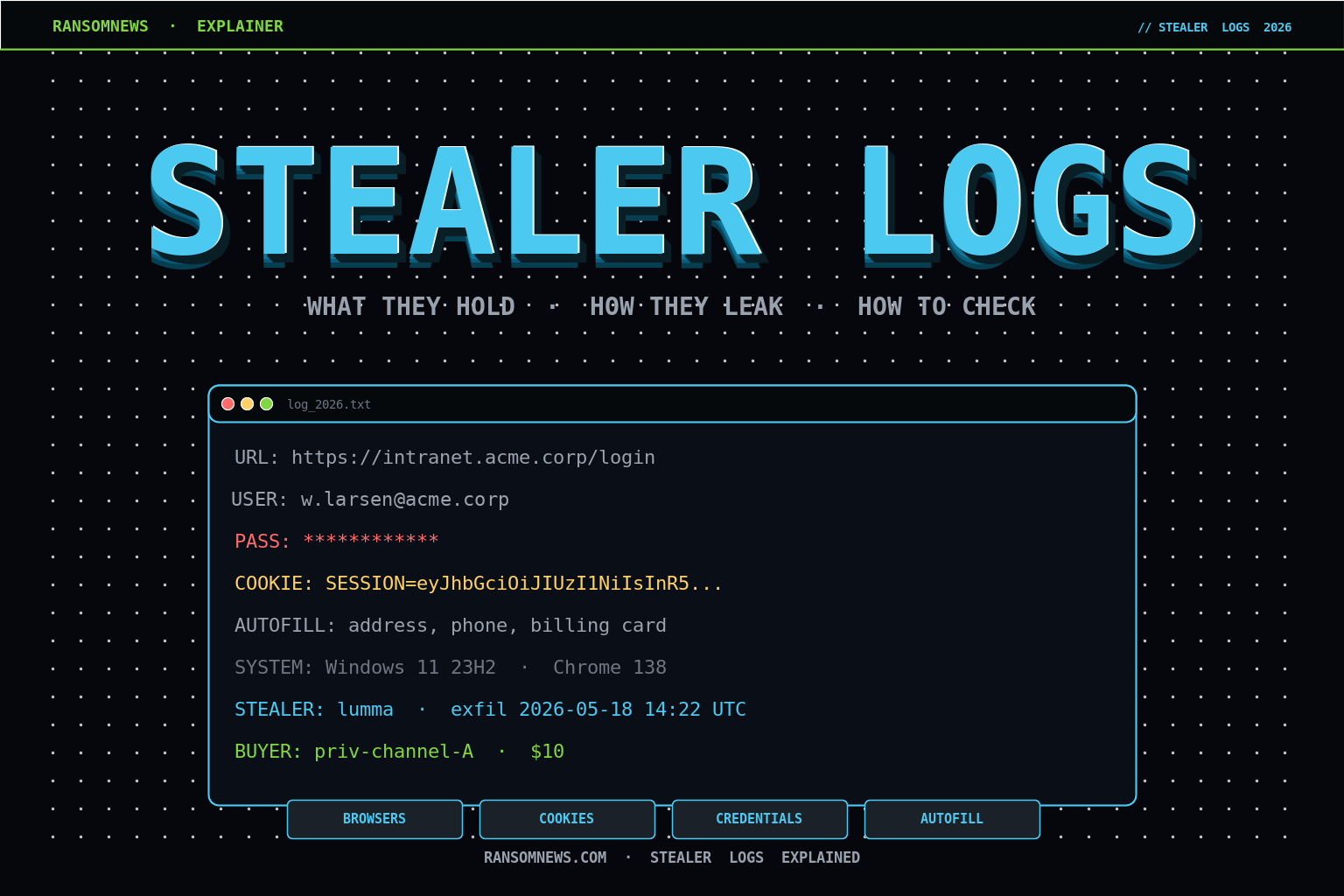
A stealer log is the data dump that an infostealer malware produces after it compromises a device. It typically contains every saved browser password, every active session cookie, autofill data, system details, and in some families, screenshots and clipboard history. Stealer logs feed account takeover, ransomware initial access, and corporate breach pipelines. This explainer covers what a 2026 stealer log actually holds, how devices end up in one, how the logs are sold, and how anyone can check whether their data is in the ecosystem.
Ransomnews Research Team. Updated June 2026.
What is a stealer log?
A stealer log is a structured archive of credentials, session tokens, and metadata that an infostealer malware exfiltrates from an infected device. The malware typically runs once, harvests everything reachable in the browser and operating system, packs it into a compressed archive, and sends that archive back to the operator. From there the archive is either sold individually, batched into combolists, or used directly to compromise accounts and corporate networks.
The term “stealer log” refers to the artifact, not the malware. The malware itself is the infostealer (sometimes called info-stealer, infostealer trojan, or credential stealer). Major families in 2026 include Lumma, RedLine, Vidar, StealC, Atomic, ACR, and Meduza. Each produces a slightly different log format, but the contents overlap heavily.
What does a stealer log actually contain?
A typical 2026 stealer log archive contains the following:
- All saved browser passwords. Chromium-based browsers (Chrome, Edge, Brave, Opera) store passwords in an SQLite database that infostealers decrypt using locally-stored keys. Firefox uses a different format that most major families also support. The dump usually contains hundreds of credentials per device.
- Active session cookies. The most valuable item in modern logs. Session cookies grant the holder authenticated access to whatever service the cookie was issued for, frequently bypassing MFA entirely. We covered the mechanics of session cookie theft and MFA bypass in more detail in a dedicated piece.
- Autofill data. Names, addresses, phone numbers, and stored payment card details. Most browsers store credit card numbers separately and require additional decryption, but the rest of the autofill profile is grabbed by default.
- System metadata. Operating system version, locale, time zone, IP address, hostname, list of installed programs, and active processes. This metadata is what buyers use to target high-value devices.
- Cryptocurrency wallet files. Local wallet files for Bitcoin, Ethereum, Monero, and roughly two dozen other wallets. Browser extension wallets (MetaMask, Phantom, Coinbase Wallet) are dumped as encrypted state plus any cached seed phrases or unlocked balances.
- Screenshots and clipboard. Higher-end families (Lumma, ACR, Meduza) include a screenshot of the desktop at the moment of execution and the recent clipboard contents. The clipboard often contains the last copied password or seed phrase.
- Telegram, Steam, Discord tokens. Application tokens that allow the buyer to hijack each account. The Telegram and Discord tokens in particular are widely traded.
How do devices end up in a stealer log?
Infostealers reach victim devices through a handful of repeat-customer distribution channels in 2026:
- Malvertising and SEO poisoning. Sponsored search ads for popular software (Notepad++, Putty, Zoom, OBS) leading to fake download pages that serve the infostealer. SEO poisoning works similarly through compromised WordPress sites and freshly registered lookalike domains.
- Cracked software and game cheats. The single largest distribution channel by volume. Cracked Photoshop, leaked games, cheat loaders, and KMS activators are heavy infostealer carriers. Users who run cracks are also less likely to have endpoint protection enabled.
- ClickFix and fake captchas. A 2024 to 2025 surge in attacks that show a fake captcha or browser-error page instructing the user to press Win+R and paste a command. The pasted command downloads and executes the stealer. Lumma in particular leaned on this technique heavily through 2025.
- Pirated YouTube content and Telegram channels. Description-link malware, drag-and-drop bundles in Telegram, and “free tool” packages.
- Phishing attachments and BEC payload swaps. Less common than the above but still occurs in targeted enterprise campaigns.
The common denominator is that the user runs the infostealer themselves, usually thinking it is something else. Modern infostealers do not require any zero-day or privilege escalation. They harvest what the user can already access, which is enough for most account-takeover purposes.
How are stealer logs sold and distributed?
The stealer-log marketplace runs primarily on Telegram channels and Russian-speaking forums. The economics roughly look like this:
- Cloud logs (free or pennies per device). Mass-batch dumps of low-value devices, posted in public or low-tier Telegram channels. Often used as marketing for the higher-tier offerings.
- Filtered logs ($1 to $50 per device). Devices filtered by country, by installed software, by browser, or by presence of specific cookies (banking sites, crypto exchanges, corporate SaaS). Sold in paid channels or marketplace forums.
- Corporate logs ($100 to $5,000 per device). Single high-value devices with corporate SSO cookies, enterprise admin access, or VPN credentials. Sold to initial access brokers who then resell to ransomware affiliates.
- Combolists (essentially free). Aggregated username and password pairs extracted from millions of logs, sold in giant text dumps. Used for credential stuffing across mainstream consumer sites.
The ecosystem is professional and persistent. Operation Endgame in 2024 and Operation Magnus in late 2024 took down significant infrastructure (notably RedLine and META), but the model itself was uninterrupted. New families filled the gap within weeks.
Why are corporate credentials in stealer logs so dangerous?
The single most important fact about the stealer-log ecosystem is that infostealers are now the dominant ransomware initial-access vector. A device infected with Lumma on an employee’s home laptop frequently contains the active session cookie for the corporate VPN, the bookmarked link to the SSO portal, and a saved Slack token. An initial access broker buys that log, validates the access, packages it, and resells it to a ransomware affiliate. The affiliate logs in directly, moves laterally, and the company finds out a week later when the encryption hits.
The scale is measurable. In the October 2026 snapshot of our infostealer statistics, 89.4% of 1,856 large organisations across 36 countries had employee credentials in stealer logs, a median of 31 per organisation, and half of them had gained new ones in the previous 30 days; the per-country pages show where the exposure concentrates, from the United States (98.6% exposed) to Estonia (67.7%).
Free tool
How does your own site score?
Run the same forty passive checks against your own domain: TLS and certificates, security headers, SPF and DMARC, cookies before consent, and what your stack quietly reveals. A grade out of 100 in about fifteen seconds.
No signup. Nothing installed. We only request what your site already serves publicly.
Most of the high-profile 2025 and 2026 ransomware incidents trace back to stealer logs at the entry point. The Snowflake-credential breaches of 2024 are a clean example: the AWS, Azure, and Snowflake credentials sold to the attackers came overwhelmingly from infostealer logs harvested over the previous twelve months from contractor and developer laptops.
How do you check if your data is in a stealer log?
Three checks, in order of effort:
- Stealercheck. Our free tool at ransomnews.com/stealercheck shows how many corporate credentials, session cookies, and infostealer-derived records exist in the stealer-log ecosystem for any given domain. Built on the Alerts.bar API.
- Have I Been Pwned. The general-purpose breach checker. HIBP now ingests stealer-log data from several sources, so email addresses found in logs typically appear there within weeks.
- Hudson Rock Cavalier or SpyCloud individual reports. Free email-based lookups against their stealer-log corpora. Useful as a third opinion if the first two return nothing.
None of these tools will tell you exactly which credentials, cookies, or autofill data leaked. They will tell you that your email or your domain shows up in the corpus, which is enough to act on.
What should you do if you find your data in a stealer log?
Treat the device as compromised, not just the credentials. The stealer ran on a real device that exfiltrated everything reachable. Rotating one password is not enough.
- Wipe and reimage the suspected device. Backups of personal files only, not application state. Infostealers can persist in places ordinary cleanup misses.
- Rotate all saved browser passwords. Not just the obvious ones. The infostealer took every saved credential, including any you had forgotten about. A password manager makes this less painful.
- Invalidate active sessions on every important service. Most major SaaS (Google, Microsoft, GitHub, Slack, Atlassian) offer a “sign out of all sessions” or “revoke all tokens” option. Use it.
- Enable phishing-resistant MFA where available. Passkeys, FIDO2 hardware keys, platform authenticators. Push notifications and SMS codes do not survive cookie theft.
- If corporate device, escalate to the security team immediately. The window between compromise and ransomware deployment can be days. Do not wait.
Frequently asked questions
What is a stealer log in simple terms?
It is the data file that an infostealer malware produces after it compromises a device. The file typically contains every saved browser password, every session cookie, autofill data, system details, and sometimes screenshots and clipboard history.
How is a stealer log different from a regular data breach?
A breach is one company losing one specific database. A stealer log is one device losing everything the user had saved across every service. The two often combine: stealer logs feed credential stuffing against breached databases.
Can stealer logs bypass multi-factor authentication?
Yes, very often. Active session cookies in the log carry an already-authenticated session, so the attacker does not need to log in again. Push and SMS MFA are bypassed entirely. FIDO2 passkeys and hardware keys are resistant.
Where can I check if my email is in a stealer log?
Free options include Ransomnews Stealercheck (domain-based), Have I Been Pwned (email-based), Hudson Rock Cavalier (individual lookup), and SpyCloud (individual lookup).
How long do stealer logs stay active in the marketplace?
Indefinitely. A log harvested in 2022 may still be on sale in 2026, and the passwords inside it may still work if the user has not rotated them. Session cookies eventually expire, but stored credentials and autofill data do not.
What is the most dangerous content in a stealer log?
Active session cookies for high-value services (corporate SSO, cloud admin consoles, financial accounts) and any corporate VPN configuration. Cookies often outlive password rotations.
Are infostealers and ransomware the same thing?
No, but they are increasingly part of the same supply chain. Infostealers compromise devices and produce logs. Initial access brokers buy the logs and resell access to ransomware affiliates, who deploy the ransomware. The Snowflake-credential incidents of 2024 are the canonical example of this pipeline in action.
Related Ransomnews coverage
- Top infostealer families in 2026, who is producing the logs that fuel the ecosystem.
- Stealercheck, our free domain-exposure lookup tool.
- Infostealer statistics, monthly stealer-log exposure by family, country and sector, with a page for every country and sector in the panel.
- Session cookie theft and MFA bypass, the mechanics of how stealer logs walk past MFA.
- Initial access brokers in 2026, the supply chain that buys stealer logs and resells to ransomware affiliates.
- Alerts.bar review, the platform that powers Stealercheck.
- Best dark-web monitoring, enterprise-grade breach intelligence options.
- About the Ransomnews Research Team.
- Ransomware attacks today and the 2026 year archive: where stolen sessions and credentials end up, as leak-site listings.
Keywords: stealer logs explained, what are stealer logs, infostealer logs 2026, stealer log contents, how to check stealer logs, browser password theft, session cookie hijack, infostealer malware, Lumma stealer, RedLine stealer, ransomware initial access, corporate stealer logs, MFA bypass, dark web monitoring, Ransomnews Research Team.
This explainer was researched and written by the Ransomnews Research Team. Information reflects the infostealer ecosystem as of June 2026, including the post-Operation-Magnus and post-Operation-Endgame landscape. Names of specific marketplaces and Telegram channels are intentionally omitted to avoid amplification.
The Ransomnews Monthly
One email a month. Original leak-site data, victim census updates, and the findings that did not make the articles. No spam, unsubscribe any time.
Double opt-in. We store your email, signup time, and IP for consent records (GDPR Art. 7). See our privacy policy.