
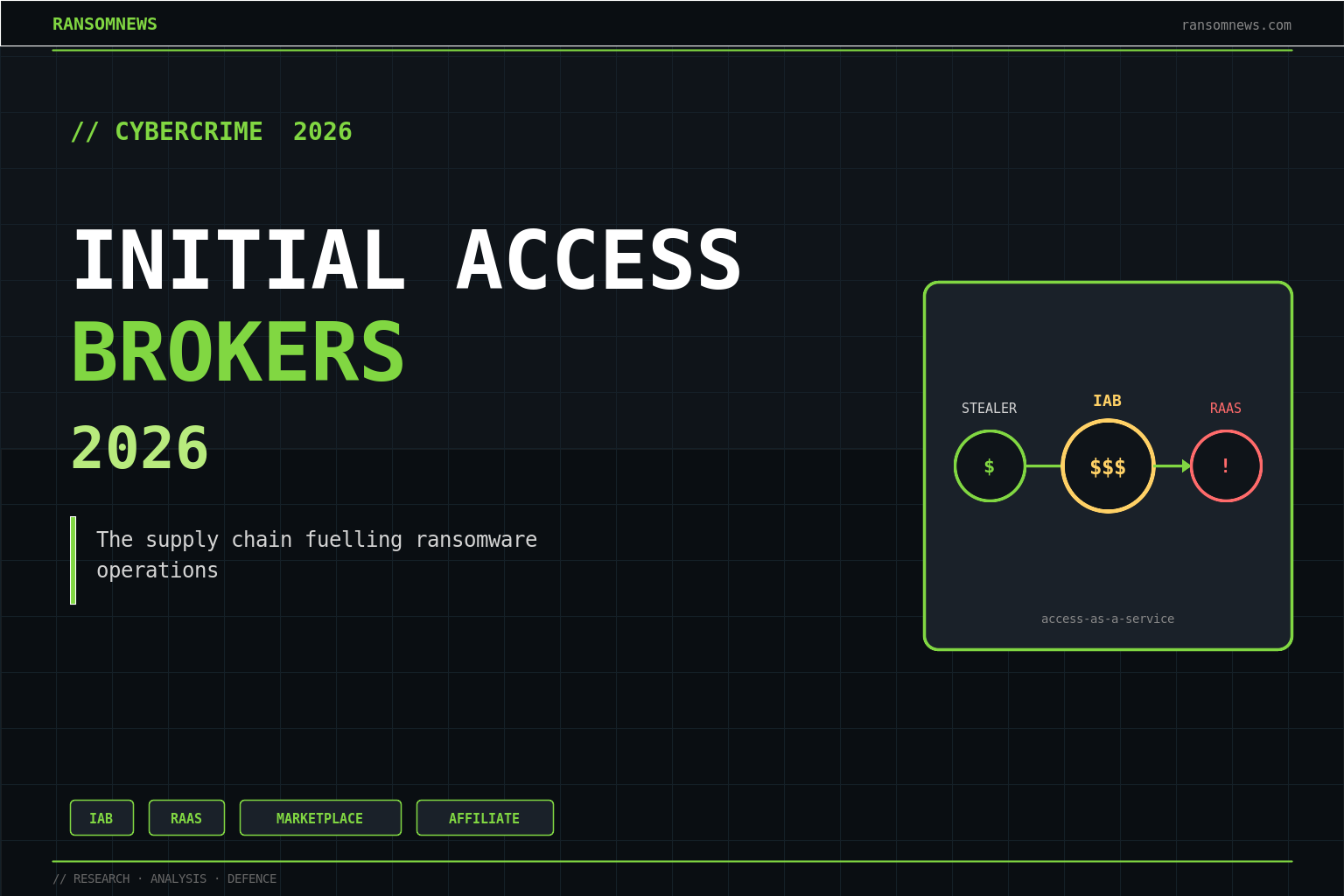
The single most important shift in ransomware’s evolution in the last decade is not the encryption malware itself. It is the emergence of Initial Access Brokers, a specialised criminal class whose entire business is breaking into corporate networks and reselling that foothold to other adversaries. The same way SaaS, marketplaces, and gig-economy platforms unbundled work in the legitimate economy, IAB unbundled the ransomware kill chain. The result: a faster, more efficient, more accessible criminal supply chain than the industry has ever faced.
Understanding the IAB market is the difference between “we’ll get to ransomware preparation eventually” and knowing your specific exposure right now. This is a practitioner’s guide to the 2026 IAB ecosystem, who sells what, what it costs, where it’s traded, and the controls that disrupt the chain before a ransomware affiliate ever sees your environment.
How the modern ransomware supply chain works
Twenty years ago, a ransomware operation was a vertically integrated thing, a small group that found the target, broke in, encrypted, demanded payment, ran the leak site, all themselves. By 2026, vertical integration is the exception. The default is the four-player chain above: infostealer operators harvest credentials, IABs validate and sell access, ransomware affiliates buy access and escalate, RaaS operators provide the encryption malware and leak-site infrastructure. Each player keeps a cut. Each is replaceable. The whole system is anti-fragile.
What an IAB listing actually looks like
An IAB listing on a Russian-speaking dark forum like XSS or Exploit (those names rotate as forums get seized, by 2026 the active venues are different but the format is identical) reads like a clinical product description. Industry, country, employee count, revenue band, type of access (VPN credential, RDP, Citrix, Cisco AnyConnect, Fortinet SSL VPN, exposed admin panel), level of privilege (“domain user,” “local admin,” “domain admin”), notes on EDR (“CrowdStrike installed, evaded successfully”), and a starting price.
The cleanest analogue in legitimate commerce is a B2B SaaS listing on AppExchange, same standardised fields, same vendor reputation system, same auction-style or buy-it-now pricing. The forums even have escrow services. The professionalism is what makes the market fast.
2026 IAB pricing tiers
The economics matter for two reasons. First, an attacker who buys domain-admin access to your company for $30,000 expects to extract at least 10x that in ransom, meaning your business has been valued, in advance, at $300,000+ of paying capacity. Second, the price your access trades at is a real-world proxy for how attractive a target you are. Boring mid-market companies with mediocre security are routinely worth more on this market than fashionable startups, because they’re more likely to pay.
Where access actually comes from
- Infostealer logs (≈55% of 2026 listings). The dominant supply. A Redline / Lumma / Vidar / Stealc / Raccoon log harvested from a compromised employee laptop is converted to “VPN credential + MFA cookie” by an IAB who validated it works.
- Exposed admin panels (≈15%). Citrix, Confluence, Jira, GitLab, Fortinet, Cisco, Pulse, anything reachable from the open internet with a known CVE or a default credential.
- Phishing harvest (≈15%). Bulk credential phishing campaigns that yield enterprise credentials with valid MFA-bypass cookies. The cookie-theft economy dominates this category.
- Insider sale (≈8%). Disgruntled or financially-stressed employees selling their own access. Common pattern in low-pay industries, call centres, MSPs, payroll firms.
- Direct compromise (≈7%). Bespoke intrusions targeting a specific organisation. Higher-skilled, higher-priced, lower volume.
How to disrupt the chain at your end
You can’t take down the marketplaces. You can make your own organisation a bad listing. Five practical interventions, ranked by impact-per-effort:
Free tool
How does your own site score?
Run the same forty passive checks against your own domain: TLS and certificates, security headers, SPF and DMARC, cookies before consent, and what your stack quietly reveals. A grade out of 100 in about fifteen seconds.
No signup. Nothing installed. We only request what your site already serves publicly.
- Monitor for your domain in stealer-log indexes. If your domain shows fresh staff credentials in Stealercheck, you have a window, between when the log was sold and when an IAB has validated it, to force-rotate the affected accounts. The window is typically 1–14 days.
- Phishing-resistant MFA on every admin and VPN account. An IAB listing reads “VPN credential, MFA bypassed via cookie.” If the MFA is FIDO2/passkey with token binding, the cookie-bypass strategy doesn’t work and the listing’s value collapses.
- Patch the perimeter on a 30-day SLA. The “exposed admin panel” category of IAB listings is almost entirely 12+ month-old CVEs. A real 30-day patching discipline takes you out of that bucket.
- Audit external-facing services quarterly. Citrix instances, Fortinet appliances, Cisco devices, exposed RDP, every one of these has been the entry point for a high-profile ransomware case in the last 24 months. A quarterly review against your asset register catches most of the drift.
- Watch your own listing. Threat-intel vendors (or your own analysts) can monitor IAB forums for posts that mention your industry, country, or specific tells. A pre-purchase notification gives you 48–72 hours to harden before a buyer commits.
The legal and disruption picture
2024–2025 saw meaningful law-enforcement action against the marketplaces themselves, operations like the Cronos takedown of LockBit, the seizure of XSS in late 2024, and the disruption of multiple stealer-log Telegram channels. Each action produced a measurable but short-lived dip. By Q2 2026 the volume of IAB listings has fully recovered, redistributed across new venues. The market is structurally resilient.
This isn’t a counsel of despair. It means defence cannot wait for law enforcement to solve the problem. Defence is exposure reduction on your own attack surface.
FAQ
Who are the most active IABs in 2026?
The active names rotate as actors get burned or move on. As of mid-2026, persistent broker handles include those operating under aliases like Bassterlord, Tankcat, and several Russian-speaking actors associated with the LockBit affiliate ecosystem. By the time a name has news coverage, the actor has usually rebranded. We track these for the Threat Groups index, see the per-actor pages.
What’s the typical time from access purchase to ransomware deployment?
Median: 8–14 days. Fastest case we’ve seen in IR work: under 24 hours. Slowest: 6+ months. The variance comes from how much escalation the buyer needs to do, if they bought domain-admin already, deployment is fast; if they bought a workstation foothold, they need time to escalate.
Can you buy access to your own organisation?
Functionally yes, ethically and legally complicated. Some commercial threat-intel firms do this on behalf of clients as a service, you authorise them in writing to acquire listings related to your domain and report them to you. Doing it yourself in an unstructured way exposes you to laws against purchasing stolen data.
How does this connect to the leak sites?
The ransomware operator at the end of the chain runs the leak site where un-paid victim names get posted. Our Ransomtracker indexes those, so if an IAB-purchased intrusion ends in a non-paying victim, the company name appears in our dataset within hours. That’s a useful feedback loop: by industry / country / size, you can see which IAB-fed campaigns are converting at what rate.
Is this just a Russia problem?
Most IAB activity is Russian-speaking, historically forum-based, and culturally insulated. But the buyers and ultimate ransomware operators include actors from many jurisdictions. Calling it “a Russia problem” is partially true, and a poor strategy for defenders to rely on, because the supply chain doesn’t care where the participants live.
Related Ransomnews coverage
- Ransomtracker, live index of active ransomware operators and victim leaks.
- Threat Groups, operator profiles for LockBit, Conti, Akira, Cl0p, Black Basta, and 24 more.
- Stealercheck, domain exposure check against the stealer-log economy that feeds IAB.
- Session cookie theft is the new password theft, how IABs bypass MFA at scale.
- The 2026 RDP attack landscape, RDP is the most-traded access type in IAB listings.
- Ransomware attacks today: the organisations listed on leak sites in the last 24 hours, where the access sold on these forums ends up.
- Ransomware attacks in 2026: every leak-site listing of the year by month, operator and country.
Keywords: initial access brokers 2026, IAB ransomware supply chain, ransomware-as-a-service IAB, dark web access marketplace, LockBit affiliate network, IAB pricing tiers, ransomware affiliate program, broker forums XSS Exploit, RaaS operator economics, ransomware kill chain unbundled.
The Ransomnews Monthly
One email a month. Original leak-site data, victim census updates, and the findings that did not make the articles. No spam, unsubscribe any time.
Double opt-in. We store your email, signup time, and IP for consent records (GDPR Art. 7). See our privacy policy.