
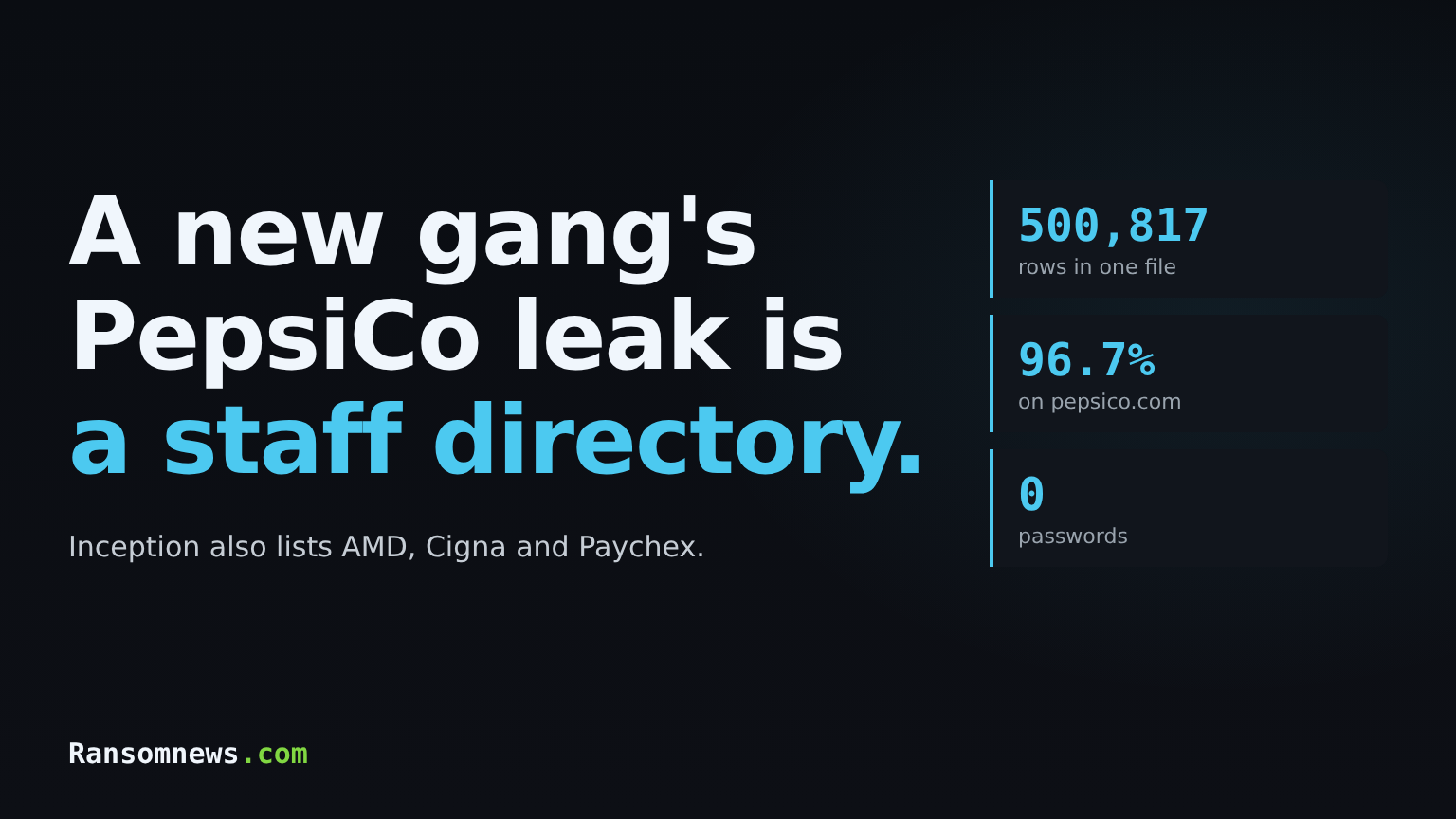
A new extortion brand calling itself Inception published data on 17 November 2026 that it says came from AMD, Cigna Healthcare, Henry Schein, Paychex and PepsiCo. Ransomnews examined two of the files. The Cigna file holds 421,661 IT service desk tickets dated up to 31 October 2026. The PepsiCo file is a staff directory of 500,817 rows. None of the five companies has confirmed a breach.
Update, 07:40 UTC on 17 November 2026: Ransomnews has now examined the Cigna file, which holds 421,661 IT service desk tickets.
In brief
- Who is named: AMD, Cigna Healthcare, Henry Schein, Paychex and PepsiCo, all marked “Leaked” on a site titled “Inception, Chapter 1”.
- The Cigna file: 421,661 tickets from Cigna’s ServiceNow service desk, nearly all opened in the two years to 31 October 2026, with 1.56 million comments and work notes.
- What the tickets hold: callers’ names and callback numbers, internal IP addresses and device names. A small share mention member IDs, dates of birth or numbers in Social Security format.
- The PepsiCo file: 500,817 rows of names, job titles and work emails, with no passwords or phone numbers.
- The risk: both files help a scammer pose as staff, in emails to colleagues and partners and in calls to the help desk.
- Not checked: the AMD, Henry Schein and Paychex files.
What is Inception and who did it name?
The leak site is titled “Inception”, with the subtitle “Chapter 1”. On 17 November 2026 it listed five US companies: Advanced Micro Devices (AMD), Cigna Healthcare, Henry Schein, Paychex and PepsiCo. Each was marked “Leaked”. The PepsiCo entry offered one 72 MB file for download and showed its deadline as expired.
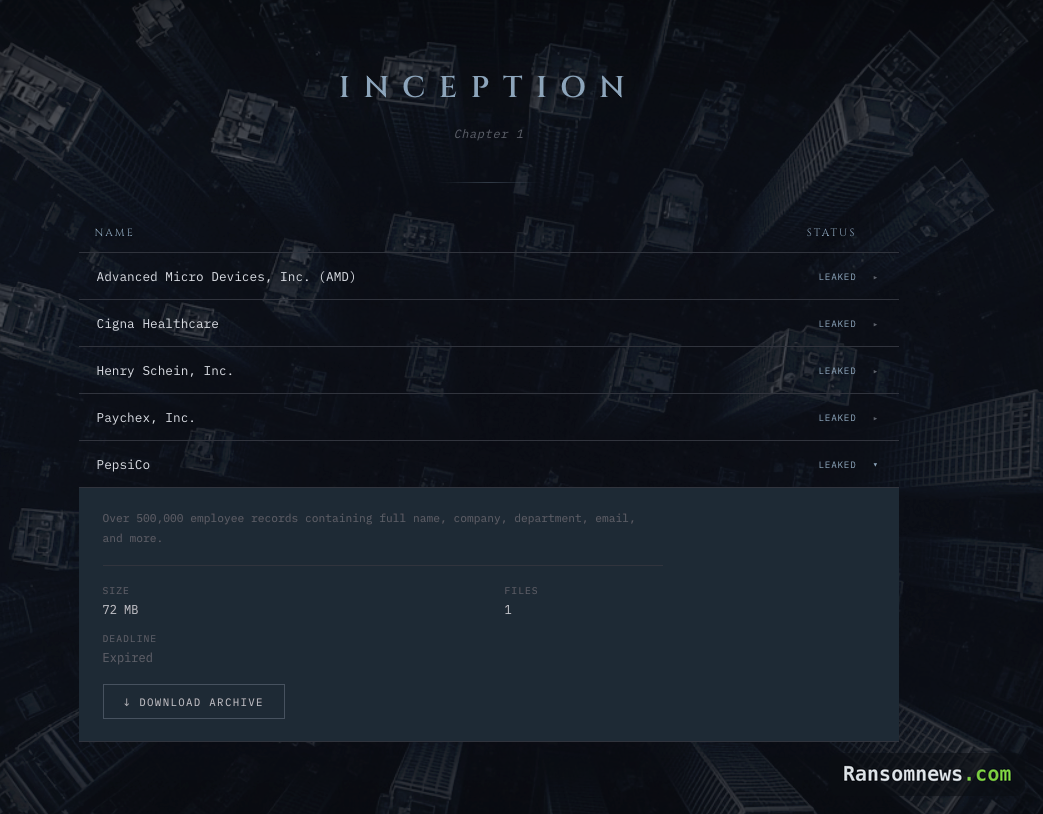
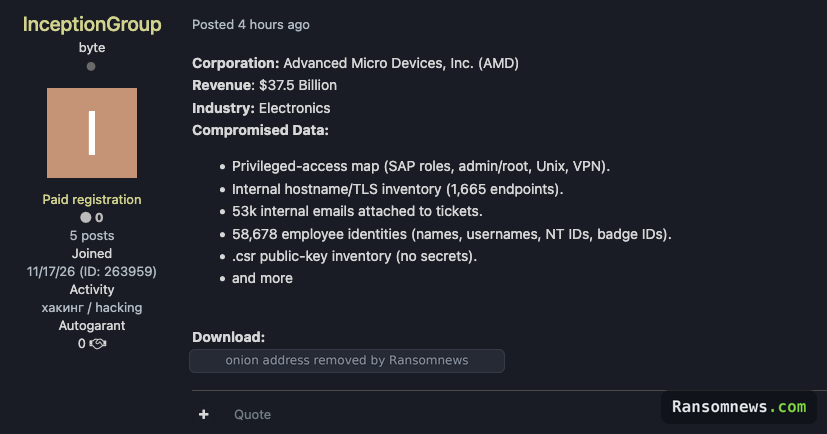
The same day, an account called InceptionGroup advertised the data on Exploit, a Russian-language cybercrime forum. Its profile shows a paid registration dated 17 November 2026, five posts and no completed escrow deals. Ransomnews found no earlier activity under the Inception name, and the Ransomtracker had no record of it.
The forum post about AMD lists what Inception says it holds: a map of privileged access covering SAP roles, admin and root accounts, Unix and VPN; an inventory of 1,665 internal hostnames with TLS details; about 53,000 internal emails attached to tickets; and 58,678 employee identities with names, usernames, NT IDs and badge IDs. Those are the seller’s descriptions, and Ransomnews has not examined the AMD data.
What is in the Cigna file?
The Cigna archive is 279 MB and unpacks to one 9.7 GB file named incidents.jsonl, in a folder called servicenow_export. It contains 421,661 incident tickets. Each ticket has about 240 fields in the layout of ServiceNow’s incident table, and its internal links point to cigna.service-now.com. Ransomnews counted values across the file and ran pattern searches. We did not read or extract individual tickets.
| Measure | Count |
|---|---|
| Incident tickets | 421,661 |
| Opened since October 2024 | 421,463 (99.95%) |
| Newest ticket | 31 October 2026 |
| Comments and work notes | 1,556,879 |
| People recorded as the caller | 84,398 |
| Tickets with a callback phone number | 306,089 (73%) |
| Tickets raised by monitoring alerts | 144,399 (34%) |
| Tickets flagged as restricted | 31,242 |
| Distinct email addresses in ticket text | 31,593 |
| Distinct internal IP addresses in ticket text | 7,791 |
Most of the file is routine IT support: login failures, application faults, password resets and automated alerts. The email addresses in the text sit mainly on Cigna Group domains, led by Evernorth, Cigna Healthcare, Cigna, Express Scripts and eviCore. A client field is filled on about 6,600 tickets and holds more than 1,100 client names.
Pattern searches across the ticket text found the following.
| Pattern | Tickets |
|---|---|
| The word “password” | 40,837 |
| Text shaped like a written-out password | 2,808 |
| A member or subscriber ID reference | 5,120 |
| A claim number reference | 2,552 |
| “DOB” or “date of birth” | 2,289 |
| A number in Social Security format | 503 |
These are counts of matches. They show that a ticket mentions the term or contains the pattern, and we cannot say how many hold a real password, a real Social Security number or a member’s health information.
Each ticket carries a list named fetch_errors, left by the tool that made the export. In 647 of the last 684 tickets, that list holds messages showing ServiceNow answering “Unauthorized” when the exporter asked for comments, work notes and attachments. The messages follow the format of the Python requests library. That points to a script pulling tickets through ServiceNow’s web API with a working login, until the login stopped being accepted. The newest ticket update is dated 31 October 2026, which rules out an old leak being recycled. The file captured no attachments.
Ransomnews found no public statement from Cigna about the listing as of 17 November 2026.
What is in the PepsiCo file?
The archive holds a single CSV file with 500,817 rows and 15 columns. Ransomnews analysed it in aggregate, counting values column by column, and did not extract or publish any individual record.
| Measure | Count |
|---|---|
| Rows | 500,817 |
| Rows with a job title | 417,887 (83%) |
| Rows with a department | 25,303 (5%) |
| Distinct email addresses | 348,770 |
| Rows sharing one placeholder address | 147,418 |
| Rows on pepsico.com addresses | 484,078 (96.7%) |
| Rows on other domains | 16,739, across 2,962 domains |
Almost every row gives a full name, a work email address and a reference to a profile picture. Most rows add a job title, and one in twenty adds a department. The file contains no passwords, phone numbers, home addresses, dates of birth, ID numbers or pay details, and four of its columns are empty in every row.
The contents look genuine. The most common job titles are merchandisers, warehouse workers, sales representatives and drivers, which fits a company that delivers snacks and drinks to shops. Department values carry internal job-function codes. One placeholder address is shared by 147,418 rows, probably staff who have no company mailbox.
Free tool
How does your own site score?
Run the same forty passive checks against your own domain: TLS and certificates, security headers, SPF and DMARC, cookies before consent, and what your stack quietly reveals. A grade out of 100 in about fifteen seconds.
No signup. Nothing installed. We only request what your site already serves publicly.
PepsiCo reported approximately 306,000 employees worldwide at the end of 2025. The file holds more than 422,000 different full names, so it probably includes people who have left and contractors as well as current staff. Nothing in it is dated, and we cannot tell when it was taken.
Where did the PepsiCo data come from?
The column names are those of a workplace app. They include checkedInCampus, isFavorite and skills, which belong to software for booking desks and finding colleagues. An HR or payroll export would carry employee numbers, hire dates or pay grades, and this file has none of them.
PepsiCo’s office app, PEP@Work, is published on Apple’s App Store by CXApp US, Inc. CXApp sells workplace software for booking desks and rooms and for finding colleagues. In the file’s company column, which is blank on all but 62 rows, 33 rows carry the names CXApp, CXAI, Inpixon or Design Reactor. CXAI is CXApp’s Nasdaq ticker, Inpixon owned the business until March 2023, and Design Reactor is CXApp’s operating subsidiary, according to the company’s SEC filings.
The isFavorite field is set to false on every row. A favourite is something one user marks for themselves, so the file reads like the directory as the app served it to a single logged-in account. That is our reading of the format, and it does not show that PepsiCo’s or CXApp’s systems were broken into. A working login to the app may be all it takes to read the directory, and corporate logins are sold in bulk in stealer logs. We do not know how Inception obtained the file.
Ransomnews found no public statement about the listing from PepsiCo or CXApp as of 17 November 2026.
How could the Cigna and PepsiCo data be used?
The PepsiCo file tells a scammer who works at PepsiCo, in what job, and at which address. The Cigna file holds what a help desk knows: who called, from which number and about which device.
- Targeted phishing. PepsiCo’s department codes mark out about 3,700 people in finance, 3,000 in IT and 870 in procurement, and job titles cover 83% of the file. A phishing email can be aimed at the people who approve payments or reset passwords.
- Invoice fraud against partners. The PepsiCo file includes staff at independent bottlers and suppliers, identified by email domain: Pepsi Bottling Ventures (646 rows), G&J Pepsi (361), Buffalo Rock (289) and Admiral Beverage (209) among bottlers, and IFF (124), Givaudan (116), Symrise (101) and Kerry (89) among flavour and ingredient suppliers. A fraudster can write to them as a named PepsiCo contact and ask for a payment or a change of bank details. Business email compromise cost victims more than $3 billion in 2025, according to the FBI’s Internet Crime Complaint Center.
- Help-desk calls. CISA’s advisory on Scattered Spider, AA23-320A, describes attackers posing as employees to get IT help desks to reset passwords and move multi-factor authentication (MFA) to a new device. A caller who can give a real name, job title and email address is harder to turn away, and the Cigna tickets add real ticket numbers, callback numbers and device names.
- Network mapping. The Cigna tickets contain 7,791 internal IP addresses, about 43,000 device identifiers and links to monitoring and identity tools. They show an intruder which systems exist and which teams run them.
Were AMD, Henry Schein and Paychex breached?
That has not been established, and Ransomnews has not examined those three files. Inception’s description of the AMD data (access roles, hostnames, ticket emails, badge IDs) reads like the same kind of service-desk and identity export as the Cigna file.
The two files we examined came from different systems: a workplace app at PepsiCo and ServiceNow at Cigna. Both read like exports taken through an application’s own interface with a working login. That is our reading of the files, and it says nothing certain about how the logins were obtained.
Two of the five have been named by extortionists before. IntelBroker offered AMD data for sale in June 2024, including an employee database, and the BlackCat group listed Henry Schein in 2023. We do not know whether any of Inception’s material overlaps with those leaks. The day before, n0n named Eli Lilly, Visa and JPMorgan Chase on its own leak site, and our reading of those listings was that the data came from suppliers.
What should staff at the listed companies do?
- Expect emails that use real names and job titles. A sender who knows your name, title and team may have read them in these files. Check unusual requests on a second channel.
- Confirm payment changes by phone. Bottlers and suppliers should call a number they already hold before acting on new bank details.
- Raise the bar at the help desk. A name, job title, email address or real ticket number should not be enough for a password or MFA reset.
- Change any password that was written into a ticket. Cigna staff and contractors who have had a password typed into a service desk ticket should treat it as exposed.
- Check who can export in bulk. Companies should review which accounts can pull a whole staff directory or ticket table through an API, and alert on large exports.
The PepsiCo file holds no passwords, so there is nothing to reset because of it.
Frequently asked questions
Was Cigna hacked by Inception?
Cigna has not confirmed a breach. The file Inception published holds 421,661 IT service desk tickets whose internal links point to Cigna’s ServiceNow address, the newest dated 31 October 2026. Its contents are consistent with a real export.
Does the Cigna leak include member health data?
Most tickets are IT faults and access requests. Pattern searches found a member or subscriber ID reference in 5,120 tickets, a date-of-birth reference in 2,289 and a number in Social Security format in 503. Ransomnews did not read the tickets and cannot say how much health information they hold.
Was PepsiCo hacked by Inception?
PepsiCo has not confirmed a breach. The file Inception published is a 500,817-row staff directory in the format of a workplace app. It holds names, job titles and work email addresses, and its format does not show how it was obtained.
Does the PepsiCo leak include passwords?
No. The file holds names, job titles, work email addresses and, for 5% of rows, a department. It contains no passwords, phone numbers, home addresses, ID numbers or pay details.
Who is the Inception group?
Inception is an extortion brand first seen on 17 November 2026. It runs a leak site titled “Inception, Chapter 1” and an account on the Exploit forum registered the same day. Ransomnews found no earlier activity under the name.
Is this related to the Inception vulnerability in AMD processors?
No. Inception is also the name researchers at ETH Zurich gave in 2023 to a side-channel attack on AMD Zen processors. The leak site uses the same word and happens to list AMD.
Is Inception a ransomware group?
Nothing published so far shows Inception encrypting systems. Its site offers stolen data for download, which is the data-theft half of double extortion.
Sources and further reading
- Ransomnews analysis of the Cigna and PepsiCo files published by Inception, 17 November 2026 (aggregate counts only)
- PepsiCo, Form 10-K for fiscal year 2025
- Apple App Store, PEP@Work listing
- CXApp Inc., Form S-1/A, corporate history
- CISA, AA23-320A: Scattered Spider
- The Record, FBI Internet Crime Complaint Center figures for 2025
- BleepingComputer, AMD investigates breach after data for sale on hacking forum
- BleepingComputer, BlackCat ransomware claims breach of healthcare giant Henry Schein
The Cigna and PepsiCo files were analysed in aggregate only and no personal record is reproduced here. No leak-site or onion address is linked. Details of the other three listings are Inception’s own descriptions.
The Ransomnews Monthly
One email a month. Original leak-site data, victim census updates, and the findings that did not make the articles. No spam, unsubscribe any time.
Double opt-in. We store your email, signup time, and IP for consent records (GDPR Art. 7). See our privacy policy.