FOCUS
Ransomware
The defining cybercrime of the decade. How it works, who runs it, and where the money goes.
Ransomware is the defining cybercrime of the decade. This section covers how attacks actually work, the ransomware-as-a-service economy that industrialised them, profiles of the major operators, and the hard numbers behind the headlines. Start with the plain-English guide to what ransomware is, then the full attack lifecycle and how RaaS turned it into a franchise model.
For live and verified data rather than operator claims, use the Ransomtracker for active leak sites, the confirmed ransomware statistics updated monthly, the confirmed attacks index by sector, country and year, and the ransomware payment rate analysis.
Start here
- What is ransomware? A plain-English guide
- How ransomware works: the full attack lifecycle
- Ransomware-as-a-service (RaaS), explained
- What is double extortion ransomware?
- LockBit: the brand that redefined the industry
- Conti: anatomy of a ransomware corporation
Latest ransomware coverage
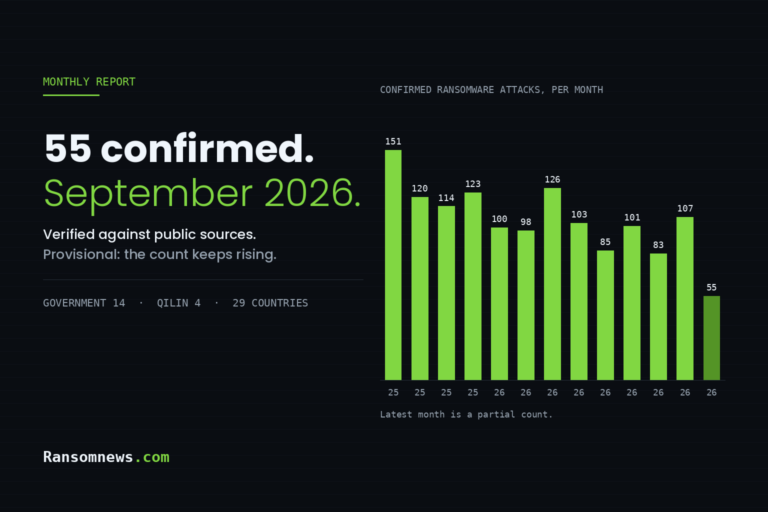
- Confirmed ransomware attacks, September 2026: 55 verified so far, Qilin and The Gentlemen lead
 Ransomnews has confirmed 55 ransomware attacks in September 2026, against 107 in August and 151 a year earlier. Provisional. Government led the sectors, Qilin and The Gentlemen the groups.
 - Is it illegal to pay a ransomware ransom in 2026?Paying a ransomware ransom is usually legal, but sanctions can make it a crime, and 2026 rules are tightening fast. The law in the US, UK, EU and Australia, and what paying still does not buy.
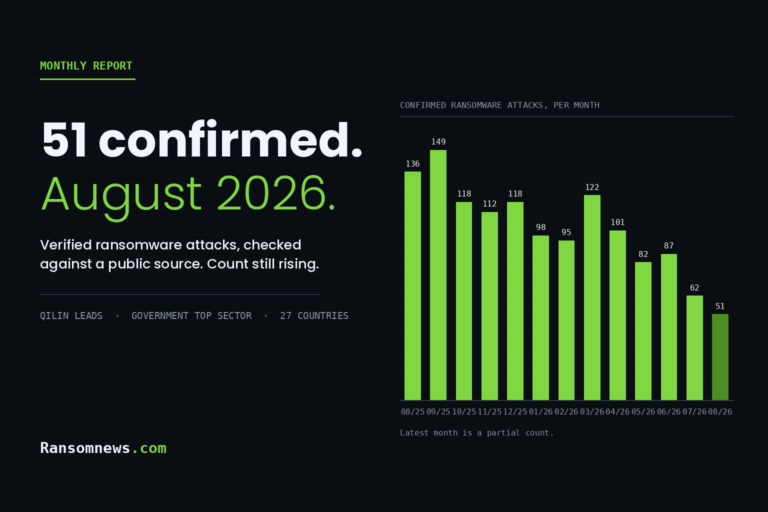
- Confirmed ransomware attacks, August 2026: 51 verified so far, Qilin leadsRansomnews confirmed 51 ransomware attacks in August 2026, down from 62 in July and 136 a year earlier. Qilin led with nine victims and government was the most affected sector.
- ESXi ransomware in 2026: one host, the whole datacenter
 ESXi ransomware encrypts every VM on a hypervisor at once. Here is why VMware ESXi became ransomware’s highest-value target in 2026, and how to defend it.
 - MSPs: ransomware’s #1 target of 2026 [Field Report]
 Managed service providers entered 2026 as the single highest-leverage target class in the ransomware economy. Why the channel is now the front line, which TTPs operators are running against MSPs specifically, and what the better-run shops have already changed.
 - LockBit, 2 years after Operation Cronos: where are they now?A 2026 retrospective on the international takedown that displaced LockBit at the top of the ransomware ecosystem: what stuck, what reverted, where the affiliate workforce migrated, and what the next coordinated action should learn from the playbook.
- 2026 ransomware victim toll: countries, sectors, operatorsA data-led snapshot of who’s actually being ransomed in 2026: which sectors are losing ground, which operators are pulling away from the pack, and which national-level patterns the leak-site economy reveals.
- Ransomware attribution 2026: TTPs, notes, fingerprintsA 2026 attribution playbook for ransomware investigations, combining TTP fingerprinting against MITRE ATT&CK, ransom-note artifact analysis, leak-site monitoring, and the open-source intelligence pivots that hold up under scrutiny.
- Ransomware IR runbook 2026: NIST 800-61 r3 + CISA templatesA practitioner walkthrough of building a ransomware-specific incident response runbook in 2026, combining NIST SP 800-61 r3, CISA’s #StopRansomware playbook, and the lessons from named incidents on the Ransomtracker leak feed.
- What is double extortion ransomware? An explainer for non-technical executives in 2026An executive-level explainer of double extortion (the dominant ransomware playbook in 2026) covering how it works, why backups don’t fully defeat it, and the policy choices boards now have to make in the first hour of an incident.
- How initial access brokers price corporate access in 2026: an explainer for defendersA field guide to the 2026 initial-access-broker market: how IABs source access, how they price it, who buys, and what the listings look like under the hood.
- Tracing crypto laundering: tutorial with Chainabuse, OXT, Walletexplorer, and EtherscanA 2026 tutorial for following ransomware and fraud proceeds across the blockchain using free tools: Chainabuse for tagged wallets, OXT for BTC clusters, Walletexplorer for entity heuristics, and Etherscan for ETH/USDT.
- How to set up a malware analysis sandbox at home: FlareVM, REMnux, and Cuckoo tutorialA step-by-step tutorial for building a free malware analysis sandbox at home: Windows reverse-engineering with FlareVM, Linux analysis with REMnux, and automated detonation with Cuckoo.
- How to verify a ransom payment on-chain: tutorial with Mempool, OXT, and Ransomwhe.reA practitioner’s tutorial for verifying (or refuting) a claimed ransom payment on the Bitcoin blockchain using free tools. Useful for journalists, IR teams, and victims dealing with secondary-extortion claims.
- Tracking ransomware affiliates across rebrands with VirusTotal, MalwareBazaar, and YARAA 2026 tutorial for tracking individual ransomware affiliates across operator rebrands using VirusTotal Intelligence, abuse.ch’s MalwareBazaar, and YARA rules. Code reuse, builder fingerprints, and TTP continuity reveal the same crews under new names.
- The new mid-tier RaaS contenders: Qilin, Medusa, EmbargoThree mid-tier ransomware operators have built sustained victim claim counts in 2025-2026. Profiles of Qilin, Medusa, and Embargo: what’s distinctive about each, and what the rise of the mid-tier means for defenders.
- Akira’s pivot to extortion-only: a 2026 group profileAkira began as a classic encrypt-and-extort operation but has been quietly drifting toward data-theft-only attacks across 2025-2026. A profile of where they came from, where they are now, and why the model is working.
- RansomHub explained: the post-LockBit consolidatorRansomHub became the largest active RaaS by claim count in 2025 by absorbing experienced affiliates from the LockBit and ALPHV exits. A 2026 profile of the operator, their tooling, and their structural position.
- Why double extortion isn’t enough anymore: the rise of triple and quadruple extortionEncrypt the data, leak the data: that’s not enough leverage anymore. A 2026 look at how operators stack additional extortion vectors when the basic playbook stops getting paid.
- Ransomware Q1 2026 leaderboard: who’s claiming the most victimsA 2026 Q1 ransomware leaderboard built from leak-site claims, with the structural changes shaping the operator pool: RansomHub at the top, a long mid-tier, and the takedown ripples still propagating through the ecosystem.
- Why hospital ransomware attacks keep getting worseHospitals have been the worst ransomware targets for half a decade and the attacks keep getting worse, not better. A practitioner’s look at why the sector remains uniquely vulnerable and what’s finally starting to help.
- BEC vs ransomware: which is more profitable per attack in 2026?A side-by-side look at the per-attack economics of business email compromise vs ransomware in 2026. Hint: the louder threat isn’t the bigger one.
- The pivot from encryption to data theft: pure-extortion gangs in 2026A new generation of operators has dropped encryption entirely: they steal the data and threaten to leak it without ever locking a single file. Here’s why that model is winning.
- Ransomware negotiation tactics that actually work in 2026A practitioner’s guide to ransomware negotiation in 2026: what professional negotiators do, what amateurs get wrong, and how the conversation has changed since the 2024 takedowns.













Every ransomware article
Every article we have published in this section, newest first.
- Is it illegal to pay a ransomware ransom in 2026?
- Confirmed ransomware attacks, August 2026: 51 verified so far, Qilin leads
- ESXi ransomware in 2026: one host, the whole datacenter
- MSPs: ransomware’s #1 target of 2026 [Field Report]
- LockBit, 2 years after Operation Cronos: where are they now?
- 2026 ransomware victim toll: countries, sectors, operators
- Ransomware attribution 2026: TTPs, notes, fingerprints
- Ransomware IR runbook 2026: NIST 800-61 r3 + CISA templates
- What is double extortion ransomware? An explainer for non-technical executives in 2026
- How initial access brokers price corporate access in 2026: an explainer for defenders
- Tracing crypto laundering: tutorial with Chainabuse, OXT, Walletexplorer, and Etherscan
- How to set up a malware analysis sandbox at home: FlareVM, REMnux, and Cuckoo tutorial
- How to verify a ransom payment on-chain: tutorial with Mempool, OXT, and Ransomwhe.re
- Tracking ransomware affiliates across rebrands with VirusTotal, MalwareBazaar, and YARA
- The new mid-tier RaaS contenders: Qilin, Medusa, Embargo
- Akira’s pivot to extortion-only: a 2026 group profile
- RansomHub explained: the post-LockBit consolidator
- Why double extortion isn’t enough anymore: the rise of triple and quadruple extortion
- Ransomware Q1 2026 leaderboard: who’s claiming the most victims
- Why hospital ransomware attacks keep getting worse
- BEC vs ransomware: which is more profitable per attack in 2026?
- The pivot from encryption to data theft: pure-extortion gangs in 2026
- Ransomware negotiation tactics that actually work in 2026
- Crypto laundering pipelines after the 2025 mixer takedowns
- Tracking ransomware infrastructure: a 2026 OSINT methodology
- Maltego workflows for ransomware research: a 2026 starter pack
- How stealer logs power modern ransomware attacks
- Play: the closed-shop ransomware brand quietly hitting cities, schools, and critical infrastructure
- Hive: the ransomware operation the FBI spent seven months inside
- DarkSide: Colonial Pipeline, the pseudo-code-of-conduct, and the rebrand to BlackMatter
- Akira: the retro-themed ransomware operation quietly eating mid-market enterprise
- Black Basta: Conti’s most successful successor and its healthcare specialism
- Ryuk: the big-game hunter that made ransomware a boardroom problem
- Cl0p: the mass-exploitation specialists behind Accellion, GoAnywhere, and MOVEit
- BlackCat / ALPHV: the Rust-powered RaaS that ended in an exit scam
- REvil / Sodinokibi: the big-game hunters who hit Kaseya, JBS, and then disappeared twice
- Conti: anatomy of a ransomware corporation, and how it imploded
- LockBit: the ransomware brand that redefined the industry, and got taken down
- Ransomware-as-a-service (RaaS): how cybercrime got its franchise model
- The different types of ransomware: from crypto-lockers to triple extortion
- How ransomware works: the full attack lifecycle, step by step
- A brief history of ransomware: from the AIDS Trojan to the RaaS empires
- What is ransomware? A plain-English guide to how it works, who it hits and what it costs