
Doxbin is a website where anyone can post another person’s name, home address, phone number and other private details. Its stated policy, recorded by DarkOwl, is to leave a post up unless it is inaccurate, breaks the site’s rules or a court orders removal. Anyone whose details appear there should save evidence, secure their email, phone and bank accounts, tell the police and ask Google to delist the page.
In brief
- Doxbin displayed 308,681 registered users and 157,225 posts when DarkOwl profiled it in June 2024.
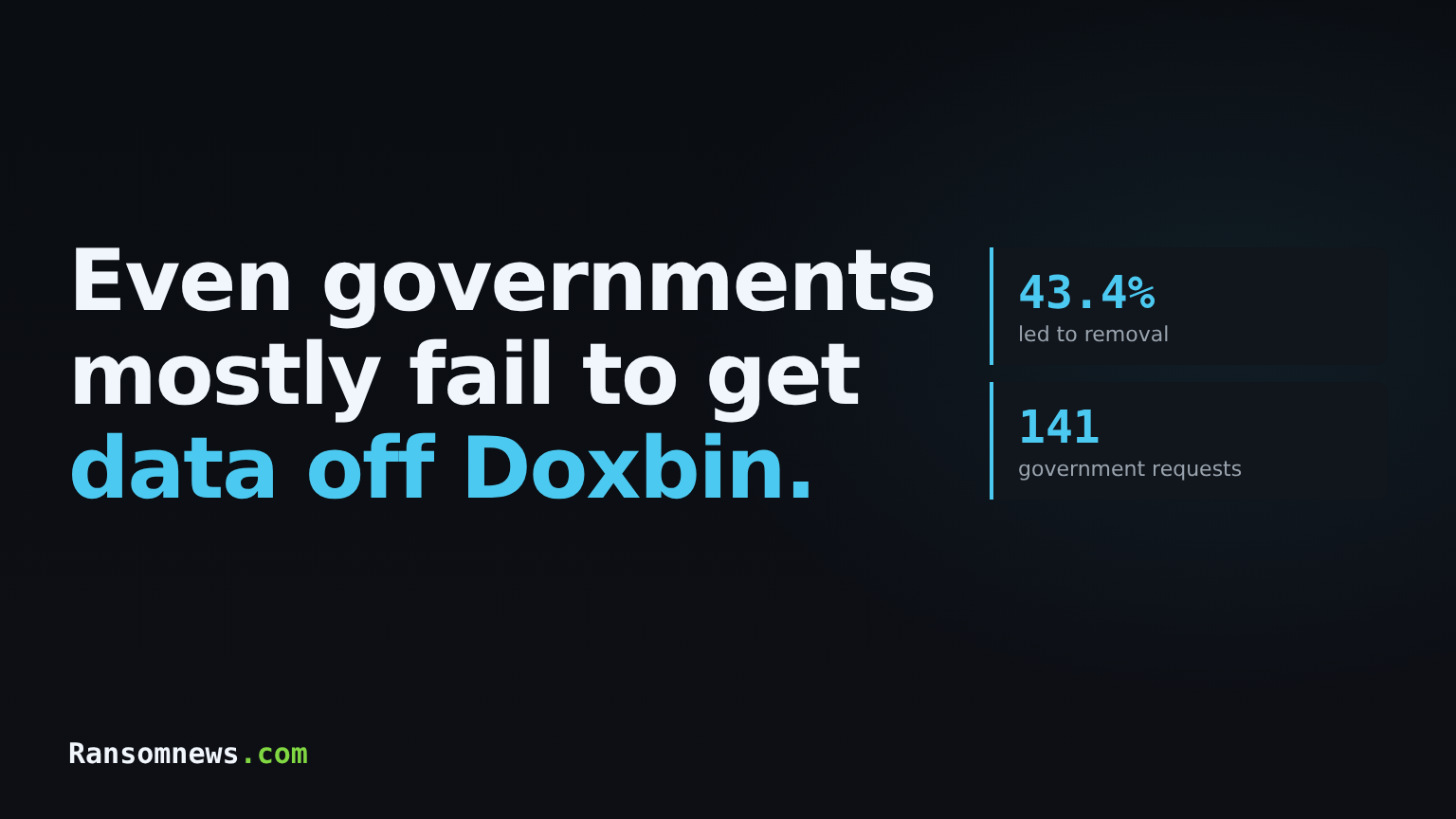
- Doxbin’s own transparency report listed 141 government takedown requests, and 43.4% of them had led to data being removed, The Register reported in August 2024.
- The site once charged victims to take their data down and later dropped the option, according to The Register, and a list of people said to have paid has circulated online.
- The United States has no general federal law against doxing. In England and Wales it can be prosecuted as harassment or as a threatening or malicious communication, and the Netherlands, Germany and France each have a specific offence.
- Ransomnews’s Stealercheck returned 60,630 exposed logins belonging to Doxbin account holders on 29 November 2026, across three web addresses that use the site’s name.
What is Doxbin?
Doxbin is a paste site whose purpose is hosting doxes, collections of a person’s private details published without their consent. Have I Been Pwned, the breach-notification service, says its doxes often included names, home addresses and phone numbers. The FBI defines doxing as obtaining and publishing someone’s personally identifiable information on the internet, usually with malicious intent.
Doxbin displayed 308,681 registered users and 157,225 posts when DarkOwl, a dark web intelligence firm, profiled it in June 2024. The rules DarkOwl found there bar spam, child sexual abuse material, support for terrorism and threats of physical violence.
People listed on Doxbin can quickly become targets of prolonged harassment, account hacking, SIM swapping and swatting, the security journalist Brian Krebs wrote in September 2024. SIM swapping is the theft of a phone number by having it moved to a SIM card the criminal controls. Swatting, as the FBI defines it, is a hoax call or report to the emergency services, typically one that feigns an immediate threat to life. Jacob Larsen, a researcher at the Australian security firm CyberCX who interviewed doxers, describes an online market for extortion in which personal details are published and taken down only if the victim pays.
The details in a dox can come from public records and from stolen data. The FBI’s April 2025 swatting notice says the people behind such calls collect details from many public sources to build profiles of their targets. The US Federal Trade Commission says people-search sites sell reports to anyone willing to pay, and the reports can list current and previous addresses and relatives’ names. The threat intelligence firm Cyble said the files leaked from Doxbin in January 2022 included stealer logs, the saved passwords, cookies and autofill data that infostealer malware copies from an infected device.
What should you do first if your details are on Doxbin?
The first thing to do after finding your details on Doxbin is to call 911 in the United States or 999 in the UK if anyone is in immediate danger, and otherwise to save a record of the post and then secure the email, bank and phone accounts it exposes.
- Take screenshots that show the whole post, its web address, the date and time and any comments, as the UK government’s security guidance advises. Police Scotland asks for them with a report. Do not save the page to a public web archive: the US National Network to End Domestic Violence warns that once an archiving site holds a copy, “it can be difficult to get the copy removed from the Internet”.
- Tell the people who live at the address in the post, and agree what to do if the police arrive unexpectedly, which the FBI suggests for anyone at risk of swatting. Its advice for a household on the receiving end of a hoax call is to “stay calm, listen, and cooperate with responding law enforcement personnel”. If the post names your employer, tell its security team as well, as the UK government guidance advises.
- Do not reply to the poster. The Metropolitan Police says “you must not respond to the message”, because a reply may encourage the sender. If you have already replied, stop and keep the messages.
- Secure your main email account before any other. Give it a new password that is used nowhere else, and add an authenticator app or a passkey, which is unlocked by the fingerprint, face or screen lock on your own device. In a case the consumer group Which? reported in April 2026, fraudsters who had got into a man’s email used it to reset the password on his mobile account and then obtained the code needed to move his number. The UK’s National Cyber Security Centre says passkeys should be the first choice wherever they are offered, and the US agency CISA advises against text-message codes as a second factor.
- Tell your bank if the post includes account or card details. The UK government guidance says to do so immediately. In the United States a credit freeze is free and stops anyone opening new credit in your name, and the Federal Trade Commission says it has to be placed with each of the three credit bureaus, Equifax, Experian and TransUnion. Place one if the post shows a Social Security number.
- Protect your mobile number against a SIM swap, which Ransomnews’s guide to what someone can do with your phone number describes. In the UK, ask the network for an extra PIN or password on sensitive account changes, as Which? advises. In the United States, turn on the network’s free lock: Verizon’s SIM Protection, AT&T’s Wireless Account Lock or T-Mobile’s SIM Protection and Port Out Protection. Federal rules require every US wireless provider to offer a free lock from 17 December 2026 for SIM changes and from 18 December for number transfers.
- If the post shows a password, change it everywhere it was used, from a device you trust. A password in a post may have come from a data breach or from malware on your own device. On some services a stolen login cookie keeps working after the password changes, so use each account’s option to sign out of all sessions, as Ransomnews’s guide to session-cookie theft advises. The FBI recommends multi-factor authentication on all devices and accounts.
- Ask relatives named in the post to ring back on a number they already have before acting on any call that asks for money or login codes. Caller ID can be faked and voices can be cloned from a few seconds of audio, as Ransomnews’s explainer on deepfake voice fraud describes.
- Keep a dated log of anything that follows, with a link where there is one, and report the post to the police and to Google.
How do you report a Doxbin post to the police and to Google?
To report a Doxbin post, give the police, Google or the company carrying the site’s traffic the post’s web address and screenshots of it.
In the United States, a post that comes with threats, extortion or a hoax emergency call is a matter for local police and the FBI. The FBI’s swatting notice of 4 August 2026 tells victims of swatting to report to their local law enforcement agency immediately and to keep the usernames, phone numbers, emails and recordings connected with the incident. It lists tips.fbi.gov, 1-800-CALL-FBI and a complaint at ic3.gov as the routes to the bureau.
In the UK, the government’s advice is to call 101 or report online when there is no emergency. Police Scotland accepts reports about doxing through an online form, by phone or in person, and asks what was posted and when. The Metropolitan Police says harassment requires two or more related incidents, which a dated log can show, and that a single message is unlikely to qualify but could be a malicious communication if it is threatening or grossly offensive.
Google will consider a request to remove a search result in two situations: when a page shows a person’s details alongside threats or calls for others to harm or harass them, and when it holds “a significant amount of aggregated personal info without a legitimate purpose”. The request must give the exact web address of each page, and Google says screenshots help. The policy applies worldwide, and the person concerned or a representative can file, so a parent can act for a child. Google’s Results about you tool, available to adults in some countries, shows whether an address, phone number or email appears in results and takes removal requests. Google says the information stays on the source page after a result is removed.
A report can also go to the company that hosts a site or carries its traffic, where that company can be identified. Cloudflare, which carries traffic for websites hosted elsewhere, says “we cannot remove content from the Internet that we do not host” and that it forwards complaints to the hosting provider and to the website’s operator. For some categories of complaint the reporter can tell Cloudflare not to forward the report to the operator. Choose that option where it is offered.
Where a link to the post is being passed around on a social network or messaging app, report it on that platform too. The Digital Services Act gives users in the EU a right to notify a platform of illegal content and to complain to their national Digital Services Coordinator. In the UK, Report Harmful Content, a national reporting centre operated by SWGfL for the UK Safer Internet Centre, helps people report harassment, threats and impersonation to online platforms. It describes itself as a route for reporting content that is not criminal.
Can you remove yourself from Doxbin?
A private person has little prospect of getting a post removed from Doxbin, and no public source documents a process for doing so. The site’s stated position, quoted by DarkOwl in June 2024, is that a post stays up unless it is inaccurate, breaks the terms of service or is the subject of a court order.
Doxbin’s own transparency report listed 141 government takedown requests, of which 43.4% had led to data being removed, The Register reported in August 2024. Those figures cover requests from governments. Larsen told the publication that Doxbin uses the report to “masquerade as running a legitimate website”. The same article says the site used to charge victims a fee to take their data down and later dropped the option.
The data set leaked from Doxbin in January 2022 contained doxes as well as user accounts, according to Have I Been Pwned, so copies of some posts are held elsewhere. Where Google grants a request in part, the page stops appearing in searches that include the person’s name and may still appear for other searches, Google’s help page says.
What does not work against a Doxbin post?
Paying anyone who offers removal does not protect a person whose details are on Doxbin. The site had dropped its own paid removal option by August 2024, by The Register’s account, and Ransomnews found no source that documents a third party able to make it delete a post.
In the case of a group called ViLE, whose members threatened to post people’s details on a website run by another member of the group, the US Attorney’s Office for the Eastern District of New York said: “Victims could pay to have their information removed from or kept off the website.” Two members were sentenced in 2025 to 25 and 27 months in prison for conspiracy to commit computer intrusion and aggravated identity theft. Prosecutors did not name the website, and Krebs reported that the administrator described in the charges ran Doxbin and that, according to his sources, both men were or had been on its staff.
Free tool
How does your own site score?
Run the same forty passive checks against your own domain: TLS and certificates, security headers, SPF and DMARC, cookies before consent, and what your stack quietly reveals. A grade out of 100 in about fifteen seconds.
No signup. Nothing installed. We only request what your site already serves publicly.
In February 2025 a group calling itself Tooda said it had breached Doxbin and released a file listing people who had allegedly paid to stay off the site, Cybernews and Hackread reported. Cybernews cited sources of vx-underground, which first relayed the claim, as saying the list had been circulating before then, and Cyble had listed blacklist information among the data leaked from the site in January 2022.
Anyone who has already paid should keep the payment records and messages and give them to the police.
How do you reduce what data brokers and people-search sites hold?
People-search sites will stop selling a person’s details on request, and data brokers in California, the UK and the EU can be asked to delete them. The FTC says the opt-outs at people-search sites can be done one at a time for free, and that paid services submit the same opt-outs for a fee. It warns that a listing can reappear when public records change, and recommends checking the sites periodically.
California residents can use the state’s Delete Request and Opt-out Platform, known as DROP, which is free and sends one deletion request to more than 600 registered data brokers. It opened on 1 January 2026, and brokers have had to check it at least every 45 days since 1 August 2026.
In the UK, the open electoral register is sold to anyone who wants to buy a copy, and opting out does not affect the right to vote. The government’s security guidance suggests asking directory sites such as 192.com to remove a listing. Under data protection law in the UK and the EU, a person can ask an organisation to delete their personal data and is owed a reply within a month, though the European Commission notes that the right is not absolute. A refusal can be taken to the Information Commissioner’s Office in the UK or to the national data protection authority in an EU country.
The FBI’s swatting notices recommend reviewing what personal information is visible online and taking care when posting photos and videos. For people at higher risk, Larsen’s advice includes having a home blurred on Google Street View and using a PO box so that letters and parcels do not carry a home address.
Where can victims of doxing get support in the US and UK?
Free support for victims of doxing is available in the US from VictimConnect and in the UK from the National Stalking Helpline and, in England and Wales, Victim Support.
| Organisation | Covers | What it offers | Contact |
|---|---|---|---|
| VictimConnect Resource Center | United States | Emotional support, information and referrals for victims of any crime, run by the National Center for Victims of Crime | Call or text 855-484-2846, or online chat, 24 hours a day |
| CCRI Crisis Helpline | United States | Information, support and referrals where intimate images have been shared without consent or used for sextortion | 844-878-2274, 24 hours a day |
| 988 Suicide & Crisis Lifeline | United States | Free, confidential emotional support | Call or text 988, or online chat |
| National Stalking Helpline | All UK residents, according to the helpline’s own page. Another page on the charity’s site says England and Wales | Practical advice for victims of stalking and for people worried about someone who is being stalked | 0808 802 0300, 09:30 to 20:00 on Monday and Wednesday, 09:30 to 16:00 on Tuesday, Thursday and Friday |
| Victim Support | England and Wales | Support whether or not the crime has been reported to the police | 08 08 16 89 111 or live chat, 24 hours a day |
| Report Harmful Content | UK | Help with reporting harassment, threats and impersonation to online platforms | Report form on its website |
| Samaritans | UK | Someone to talk to at any hour | 116 123, free, 24 hours a day |
Where the person whose details were posted is under 18 and is being threatened or coerced, the FBI asks for a report to its Internet Crime Complaint Center and to the CyberTipline run by the National Center for Missing and Exploited Children, on 1-800-THE-LOST.
Who has run Doxbin, and what has happened to it?
The Doxbin name has been carried by more than one site: “nachash” ran the original on the Tor anonymity network until police took it offline in November 2014, and DarkOwl dates the present open-web site to early 2018. The main events, with the source for each:
| Date | What happened | Source |
|---|---|---|
| May 2011 or May 2012 | The first Doxbin opened as a Tor hidden service run by “nachash”. DarkOwl gives May 2011 and Wikipedia gives 14 May 2012 | DarkOwl, Wikipedia |
| November 2014 | Police took the site down in Operation Onymous, an operation against Tor services in the US and Europe. “nachash” then released the server’s log files so that others could work out how it had been found | The Register |
| Early 2018 | The present site opened on the open web. Its own history page credits “KT” and “Brenton” and says it is no longer affiliated with “nachash”, according to DarkOwl | DarkOwl |
| 2019 to 2020 | Krebs reported that members of a chat channel called Deadnet kept a Tor site called Doxbin, which listed the personal details of more than 400 people and marked those who had been swatted. In January 2020, US prosecutors brought charges over the group’s hoax emergency calls | Krebs, July 2019 and January 2020 |
| Late 2021 to January 2022 | The site was sold, for $75,000 according to Cyble, and went back to its previous owners two to three months later. Before the handover its entire data set, including unpublished drafts, was leaked on Telegram, Krebs reported | Cyble, Krebs |
| March 2023 to June 2025 | US prosecutors charged two members of a group called ViLE, who were later jailed for 25 and 27 months. The group had threatened to post victims’ details on a website run by another member. Krebs reported that this member was Doxbin’s administrator, “KT” | US Attorney’s Office, Krebs |
| May 2024 | The site went offline briefly while images circulated claiming that an owner known as “Operator” had been kidnapped. DarkOwl said it was unclear whether the footage was real, and the site returned | DarkOwl |
| February 2025 | Tooda claimed to have taken over the site and published a list of its users | Cybernews, Hackread |
| July to September 2026 | A 26-year-old man from south Wales was jailed for two years and three months at Cardiff Crown Court for encouraging hoax emergency calls and possessing an article for use in fraud, offences dating from 2018 and 2019. The regional organised crime unit Tarian said he was an administrator of “a dark web platform” called Doxbin with a chat channel called Deadnet. The Court of Appeal upheld the sentence in September | Tarian, The Register, Nation.Cymru |
The reporting does not establish how the Tor site of 2019 and the open-web site are related. Krebs wrote in a comment under his January 2020 article that the Doxbin kept by the Deadnet group had only ever been reachable over Tor, while DarkOwl cites 2019 reports that a white supremacist group controlled the site it profiled.
Has Doxbin’s own data leaked?
Doxbin’s own data has leaked repeatedly, and Have I Been Pwned holds three data sets taken from the site between January 2022 and February 2025.
| Date | What was taken | Size | Source |
|---|---|---|---|
| January 2022 | User accounts with usernames, email addresses, password hashes and browser details, together with doxes | About 370,800 email addresses in Have I Been Pwned. Cyble counted more than 700,000 | Have I Been Pwned, Cyble |
| January 2025 | Email addresses scraped from the site | About 435,800 | Have I Been Pwned |
| February 2025 | Usernames and email addresses published by Tooda | Have I Been Pwned counts about 136,500 addresses, although its written description says 336,000. Hackread reported 136,814 records | Have I Been Pwned, Hackread |
Hackread reported Tooda’s claim that it had wiped user accounts and locked out the administrators. Cybernews cited sources of vx-underground as saying the attackers had obtained only the administrators’ login details and had not compromised the site.
Ransomnews’s Stealercheck, which searches the Alerts.bar index of stealer logs and leaked login lists, returned 60,630 exposed logins and 30,282 session cookies on 29 November 2026 for three web addresses that use the Doxbin name. Of those logins, 722 had been added in the previous month. The logins belong to people who hold accounts on Doxbin, the site’s own users, and the tool returns totals without usernames or passwords.
Is Doxbin illegal?
Whether Doxbin is illegal depends on the country: the United States has no general federal law against publishing someone’s personal details, in England and Wales the conduct can be prosecuted as harassment or as a threatening or malicious communication, and the Netherlands, Germany and France have made doxing a crime in its own right. The main provisions, with the maximum penalty for each:
| Place | Law | What it covers | Maximum penalty |
|---|---|---|---|
| United States, federal | 18 U.S.C. § 119 | Publishing the home address, phone number or Social Security number of people performing certain official duties, jurors, witnesses or informants, with intent to threaten or intimidate | Five years in prison |
| United States, federal | 18 U.S.C. § 2261A | Using an online service in a course of conduct intended to harass or intimidate that puts a person in reasonable fear of death or serious injury, or causes substantial emotional distress | Five years in the basic case, under section 2261(b) |
| United States, federal | 47 U.S.C. § 230 | A website is not treated as the publisher or speaker of information its users provide. Federal criminal law is unaffected | None |
| California and Illinois | California Penal Code § 653.2, as cited by Cornell’s legal encyclopedia, and the Illinois Civil Liability for Doxing Act | California is one of the states with a criminal law specifically against doxing. Illinois lets a victim sue the person responsible and ask a court to order the disclosure stopped | A misdemeanour in California. Damages and legal fees in Illinois |
| England and Wales | Protection from Harassment Act 1997, section 2 | A course of conduct that amounts to harassment | Six months in prison |
| England, Wales and Northern Ireland | Online Safety Act 2023, section 181 | Sending a message that conveys a threat of death or serious harm | Five years in prison |
| UK | Online Safety Act 2023, duties on platforms | Services that let users post content must remove illegal content with an individual victim once it is flagged. The Act covers companies abroad whose services have links to the UK | Fines of up to £18 million or 10% of qualifying worldwide revenue, whichever is greater |
| European Union | General Data Protection Regulation and Digital Services Act | A person can ask an organisation to erase their personal data and can complain to the national data protection authority. Users can notify a platform of illegal content and complain to the national Digital Services Coordinator | Regulatory complaints. The Commission notes that the right to erasure is not absolute |
| Netherlands | Criminal Code doxing offence, in force since 1 January 2024 | Obtaining, distributing or making available someone’s identifying personal data in order to frighten them, seriously disturb their life or hinder their work | Two years in prison or a fine of €22,500, the Dutch government says. The prison term rises by a third where the target is in a named profession, such as politician, judge or journalist |
| Germany | Criminal Code, section 126a | Spreading a person’s data publicly in a way suited and intended to expose them, or someone close to them, to a serious crime | Two years in prison or a fine, or three years where the data was not publicly accessible |
| France | Penal Code, article 223-1-1 | Revealing information that identifies or locates a person in order to expose them or their family to a direct risk of harm | Three years in prison and €45,000, or five years and €75,000 where the victim is a public official, a journalist or a minor |
Cornell Law School’s legal encyclopedia states that “there is currently no comprehensive federal law that makes doxxing someone a crime”. Publishing true information is often protected speech under the First Amendment, and that protection ends at true threats, incitement and harassment, according to an analysis by the Foundation for Individual Rights and Expression. The ViLE defendants were convicted of conspiracy to commit computer intrusion and aggravated identity theft, and the Cardiff defendant of encouraging hoax emergency calls and possessing an article for use in fraud. No charge in either case concerned hosting personal details.
The Crown Prosecution Service’s cybercrime guidance defines doxing as “a form of cyberbullying” and names no offence for it. The government’s explainer on the Online Safety Act says illegal content includes harassment and stalking. Ransomnews found no public record of Ofcom or an EU regulator taking action against Doxbin.
Frequently asked questions
What is Doxbin?
Doxbin is a paste site where anyone can post a named person’s private details, such as a home address and phone number, without that person’s consent. The name has been used by more than one site since about 2011, and the present open-web site dates from early 2018, according to DarkOwl.
Is Doxbin illegal?
Doxbin’s legal position varies by country. The United States has no general federal law against doxing, and Section 230 says a website is not treated as the publisher of what its users post. In England and Wales the conduct can be prosecuted as harassment or as a threatening or malicious communication, and the Netherlands, Germany and France have specific offences.
How do I remove myself from Doxbin?
Getting a post removed from Doxbin is unlikely for a private person, and no public source documents a process for it. The site’s stated policy is to keep a post unless it is inaccurate, breaks its terms or a court orders removal. The steps an individual controls are asking Google to delist the page, reporting to the police and securing the accounts the post exposes.
Should I pay to have a Doxbin post removed?
No. The Register reported in 2024 that the site had dropped its paid removal option. In a US case that Brian Krebs linked to Doxbin, prosecutors said victims could pay an extortion group to have details removed from a website run by one of its members, and two members were jailed. A list of people said to have paid has circulated online.
Can Google remove a Doxbin page from search results?
Google will consider removing a result that shows a person’s details alongside threats or calls to harass them, or that holds a large amount of aggregated personal information with no legitimate purpose. The request needs the page’s exact web address, and the page itself stays online.
Should I report a Doxbin post to the police?
Yes. In the United States, report to local police, and to the FBI through tips.fbi.gov or ic3.gov where there are threats, extortion or a hoax emergency call. Call 911 if anyone is in immediate danger. In the UK, call 101 or report online, and call 999 in an emergency. Have your screenshots and dated log ready.
Who runs Doxbin?
Doxbin’s operators appear in public reporting under handles. Its own history page credits “KT” and “Brenton” with creating the present site in early 2018, according to DarkOwl, and Brian Krebs wrote in 2024 that “KT” had been its administrator for several years. In July 2026 a court in Cardiff jailed a man for offences in 2018 and 2019 whom police identified as an administrator of a dark web platform called Doxbin, and the reporting does not establish how that site relates to the present one.
Sources and further reading
- DarkOwl, Site Spotlight: Doxbin, June 2024
- The Register, Mega money, unfathomable violence pervade thriving underground doxxing scene, 12 August 2024, and Welsh Doxbin admin jailed for egging on swatters from behind a screen, 14 July 2026
- Tarian Regional Organised Crime Unit, Talbot Green man sentenced for offences associated with swatting, 14 July 2026
- US Attorney’s Office, Eastern District of New York, Two Men Sentenced to Prison for Aggravated Identity Theft and Computer Hacking Crimes, 4 June 2025
- Brian Krebs, A Closer Look at the LAPSUS$ Data Extortion Group, 23 March 2022, Two U.S. Men Charged in 2022 Hacking of DEA Portal, 14 March 2023, and The Dark Nexus Between Harm Groups and ‘The Com’, 13 September 2024
- Have I Been Pwned, breach records for Doxbin, Doxbin Scrape and Doxbin (TOoDA)
- Cyble, Sensitive Information Exposed Through Doxbin Data Leak, 13 January 2022
- Cybernews, Hackers clash over Doxbin, February 2025, and Hackread, Doxbin Data Breach: Hackers Leak 136,000+ User Records and Blacklist File, 13 February 2025
- Jacob Larsen, CyberCX, How do you protect yourself against doxing?, 9 August 2024
- FBI Internet Crime Complaint Center, Ongoing Threats of Swatting and Indicators for Community Members, 4 August 2026, Threat Actors Use “Swatting” to Target Victims Nationwide, 29 April 2025, and Violent Online Networks Target Vulnerable and Underage Populations, 6 March 2025
- Google Search Help, Remove my private info from Google Search
- Cloudflare, Abuse approach
- UK Government Security, Doxing, Police Scotland, Doxxing, and Metropolitan Police, I’m being harassed by someone on social media. What can I do?
- National Network to End Domestic Violence, Safety Net Project, Documentation Tips for Survivors
- Federal Trade Commission, What To Know About People Search Sites That Sell Your Information and Credit Freezes and Fraud Alerts
- Cornell Legal Information Institute, Doxxing, reviewed July 2026
- Crown Prosecution Service, Cybercrime prosecution guidance, updated 29 June 2026, and Department for Science, Innovation and Technology, Online Safety Act: explainer
- Government of the Netherlands, Use of personal data for the objective of harassment to become criminal offence, 12 July 2023
- Ransomnews, privacy coverage
The Ransomnews Monthly
One email a month. Original leak-site data, victim census updates, and the findings that did not make the articles. No spam, unsubscribe any time.
Double opt-in. We store your email, signup time, and IP for consent records (GDPR Art. 7). See our privacy policy.