CREDENTIAL ECONOMY
Stealer Logs
Infostealers, credential markets, and the parallel underground economy that fuels nearly every modern breach.
Infostealers quietly harvest the credentials and session cookies that fuel ransomware and account takeover. This section covers what a stealer log holds, the malware families behind them, and how the stolen data is traded. Start with what stealer logs are, the top infostealer families of 2026 and how they power ransomware attacks.
Check whether your domain is exposed with the free Stealercheck lookup.
Start here
- What are stealer logs? A field guide
- Top infostealer families in 2026
- How stealer logs power ransomware attacks
- How session-cookie theft replaced password theft
- How to check if you’re in a stealer log
Latest stealer-log coverage
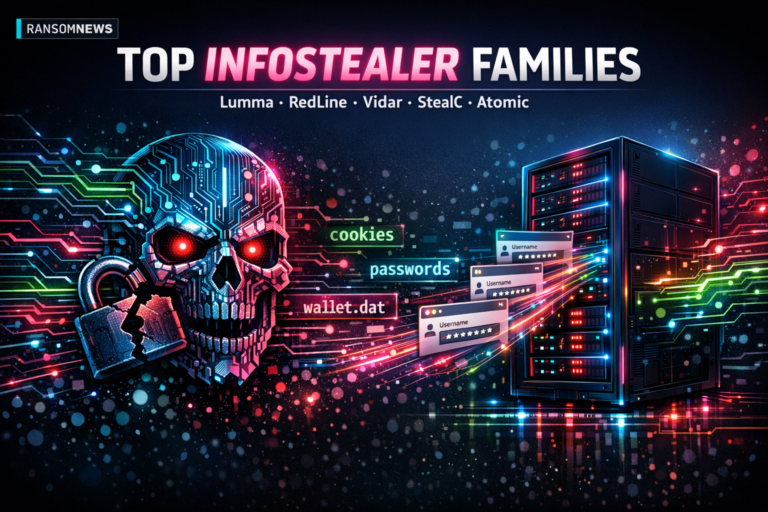
- Top infostealer families in 2026: Lumma, RedLine, Vidar, StealC, and the new entrants
 Lumma now leads the infostealer ecosystem in 2026, after Operation Magnus took out RedLine and META in late
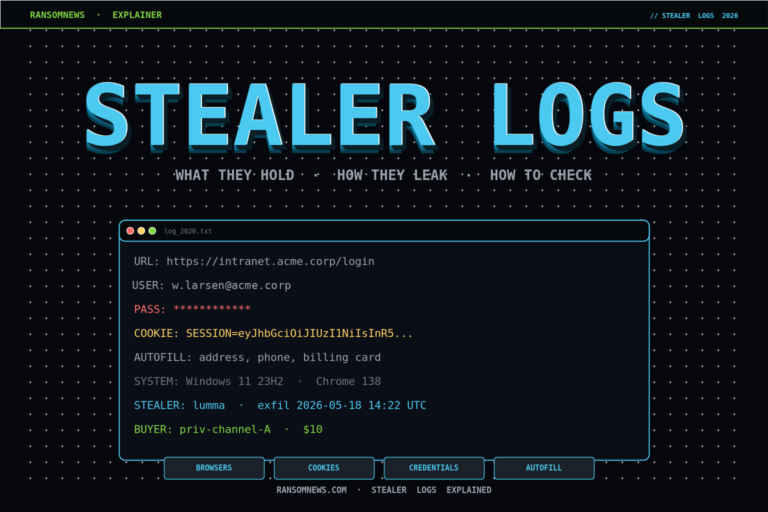
 - Stealer logs explained: what they hold, how they leak, and how to check yoursA stealer log is the data dump that an infostealer malware produces after it compromises a device. It
- MFA bypass via cookie theft: the #1 breach vector of 2026
 Through 2024 and 2025 a quiet rebalancing happened: password-phishing fell, session-cookie theft via infostealers surged, and “we have MFA” stopped meaning what defenders thought it meant. A 2026 field guide to the technique and the controls that actually answer it.
 - What’s inside an infostealer log? A 2026 walkthroughA 2026 walkthrough of the typical infostealer-log archive: what files it contains, what each one means, and how defenders parse them with Python and jq for downstream incident response.
- How to check if you’re in a stealer log: tutorial with Hudson Rock, IntelX, and Have I Been PwnedA practitioner’s tutorial for checking whether your email, your domain, or your employees show up in fresh infostealer logs, using Hudson Rock’s free tools, IntelX, Have I Been Pwned, and a couple of paid options worth the spend.
- Defending against infostealers: tutorial with Defender for Endpoint, CrowdStrike, and browser hardeningA 2026 tutorial on building a layered defence against infostealers: endpoint EDR settings that catch stealer behaviour, browser hardening that protects cookie stores, and the user-side training that closes the actual gap.
- Browser fingerprint markets: how stolen identities get sold in 2026Stolen credentials are only half the package. The other half is the browser fingerprint that lets an attacker impersonate the victim’s session believably. A 2026 look at how fingerprint markets work.
- Inside a ‘cloud of logs’ Telegram subscription tierA practitioner’s look inside the “cloud of logs” subscription model: what attackers pay, what they get, and the operational mechanics that turn raw infostealer output into a productised threat.
- How session-cookie theft replaced password theft in 2026Stealing your password used to be the goal. In 2026 it’s the consolation prize: modern infostealers go for session cookies, which let attackers impersonate authenticated users without needing to defeat MFA. Here’s how the model works.
- Lumma vs RedLine vs Vidar in 2026: market share by infectionsA 2026 comparative profile of the three dominant infostealer families: capabilities, distribution channels, market share by observed infections, and where each is heading after the 2024 takedown actions.
- Stealer log forensics: tracing infections back to the userA practitioner’s forensic playbook for working backwards from a stealer log to the originating infection: what the log file structure tells you, where the malware sits, and how to clean it up properly.
- How to verify a leaked dataset before you write about itNewsroom and researcher checklist for validating a leaked dataset before publishing: five tests that catch fabrication, recycled breaches, and misattributed dumps.
- Detecting and responding to infostealer infections before they become breachesOnce an infostealer has executed, every credential on the device is gone. Detection has to come before that, or detection is too late. A practical guide to catching infostealer infections at the host, network, and identity layer.
- The Telegram stealer-log economy: how stolen credentials are soldTelegram has become the dominant marketplace for stealer-log distribution. Channels with hundreds of thousands of subscribers drop fresh logs continuously, with payment processed in cryptocurrency and a tiered access model that mirrors the SaaS industry. Here is how that economy works.
- Session cookie theft: why MFA stops logins, not replaysMulti-factor authentication protects the moment a user logs in. It does nothing once they are authenticated. Modern infostealers steal the resulting session cookie and replay it from anywhere, bypassing MFA entirely. Here is how the attack works and what actually defends against it.
- How stealer logs power modern ransomware attacksA dollar-per-log credential-theft economy now feeds the multi-million-dollar ransomware economy. The pipeline from a teenager’s pirated game download to enterprise extortion is shorter than most security teams realise.
- Redline, Lumma, Vidar, Raccoon: the major infostealer families of 2026A handful of malware-as-a-service operations supply the bulk of the world’s stealer logs. Knowing which families are active, what they steal, and how they have changed in response to law-enforcement pressure is foundational threat-intelligence work.
- What are stealer logs? A field guide to the credential-theft economyInfostealer malware quietly extracts saved passwords, session cookies, and crypto wallets from infected machines, packages them into “logs”, and sells them on Telegram for a few dollars. Here is what those logs actually contain, who buys them, and why they have become the dominant precursor to modern breaches.









Every stealer-log article
Every article we have published in this section, newest first.
- Top infostealer families in 2026: Lumma, RedLine, Vidar, StealC, and the new entrants
- Stealer logs explained: what they hold, how they leak, and how to check yours
- MFA bypass via cookie theft: the #1 breach vector of 2026
- What’s inside an infostealer log? A 2026 walkthrough
- How to check if you’re in a stealer log: tutorial with Hudson Rock, IntelX, and Have I Been Pwned
- Defending against infostealers: tutorial with Defender for Endpoint, CrowdStrike, and browser hardening
- Browser fingerprint markets: how stolen identities get sold in 2026
- Inside a ‘cloud of logs’ Telegram subscription tier
- How session-cookie theft replaced password theft in 2026
- Lumma vs RedLine vs Vidar in 2026: market share by infections
- Stealer log forensics: tracing infections back to the user
- How to verify a leaked dataset before you write about it
- Detecting and responding to infostealer infections before they become breaches
- The Telegram stealer-log economy: how stolen credentials are sold
- Session cookie theft: why MFA stops logins, not replays
- How stealer logs power modern ransomware attacks
- Redline, Lumma, Vidar, Raccoon: the major infostealer families of 2026
- What are stealer logs? A field guide to the credential-theft economy