SURVEILLANCE
Privacy
GDPR, data brokers, encryption, fingerprinting, VPNs, the surveillance economy and its limits.
The surveillance economy and how to push back: data brokers, trackers and fingerprinting, the state of encryption, and the law that is meant to govern all of it. Start with who sells your data and how to opt out, why fingerprinting beats cookies and end-to-end encryption explained.
Start here
- Data brokers: who sells your data, and how to opt out
- How to disappear from data broker sites
- VPNs in 2026: what they hide and what they don’t
- End-to-end encryption explained
- The GDPR at eight: what actually changed
Latest privacy coverage
- Codename Morgan: inside Morocco’s Pegasus machine
 Forbidden Stories names Morocco as NSO’s client “Morgan”: a 2017 Rabat demo, an Emirati broker, roughly 12,000 targets, and Pegasus traces on seven French ministers’ phones.
 - Inside Pegasus: NSO’s own files reveal the machineUnsealed NSO Group court files, analysed by Amnesty’s Security Lab and Forbidden Stories, expose how Pegasus really works: a vendor-run spyware service, not a weapon sold and forgotten.
- Stealer logs bypassing MFA in 2026 [Field Guide]Multi-factor authentication was supposed to end the credential-theft era. In 2026, it hasn’t, because adversaries skip the credential entirely and steal the session cookie that the authentication produced. Here’s how the attack works, why MFA doesn’t stop it, and the four controls that do.
- SEC 4-day cyber rule: 2.5 years in, what CISOs learned
 A 2026 retrospective on Item 1.05 of Form 8-K, the SEC’s four-day cyber-incident disclosure rule. How filings have actually played out, what the enforcement signals look like, and the practical playbook the better-prepared CISOs now run.
 - Audit your digital footprint 2026: Sherlock, Holehe, WhoxyA 2026 self-doxxing tutorial: run the same OSINT tools attackers use, on yourself, to find every account, leaked credential, and broker entry tied to your identity. With remediation steps for each finding.
- How to disappear from data broker sites: a 2026 step-by-step removal tutorialA practical 2026 walkthrough for removing your name, address, and phone from the major data broker sites, using DeleteMe, Optery, and the manual fallback for the holdouts.
- Build the 2026 privacy stack: Mullvad Browser, GPC, uBlock Origin, and SimpleLogin tutorialA step-by-step setup of the four-layer 2026 privacy stack: a hardened browser, Global Privacy Control, ad-and-tracker blocking, and email aliasing. Free or near-free. Twenty minutes. Real privacy gain.
- How to check if you’re in a stealer log: tutorial with Hudson Rock, IntelX, and Have I Been PwnedA practitioner’s tutorial for checking whether your email, your domain, or your employees show up in fresh infostealer logs, using Hudson Rock’s free tools, IntelX, Have I Been Pwned, and a couple of paid options worth the spend.
- Browser fingerprint markets: how stolen identities get sold in 2026Stolen credentials are only half the package. The other half is the browser fingerprint that lets an attacker impersonate the victim’s session believably. A 2026 look at how fingerprint markets work.
- What the EU AI Act actually requires from US companies in 2026The EU AI Act’s enforcement window is open in 2026. Here’s what US companies actually need to do, ranked by risk tier and deadline, in plain English.
- How data brokers reassemble your identity from public scrapsA walk-through of how data brokers stitch your real identity back together from public records, breach datasets, and behavioural signals, and the four steps that make their job harder.
- The browser extensions stealing your data right now (and how to spot them)Browser extensions are the soft underbelly of personal privacy in 2026. Here’s how the malicious ones operate, the warning signs that catch most of them, and the audit you should run today.
- A 30-minute monthly privacy audit for normal humansA repeatable, low-effort monthly privacy audit you can finish in half an hour. No threat model required, no specialist tools, just the six checks that catch most of what matters.
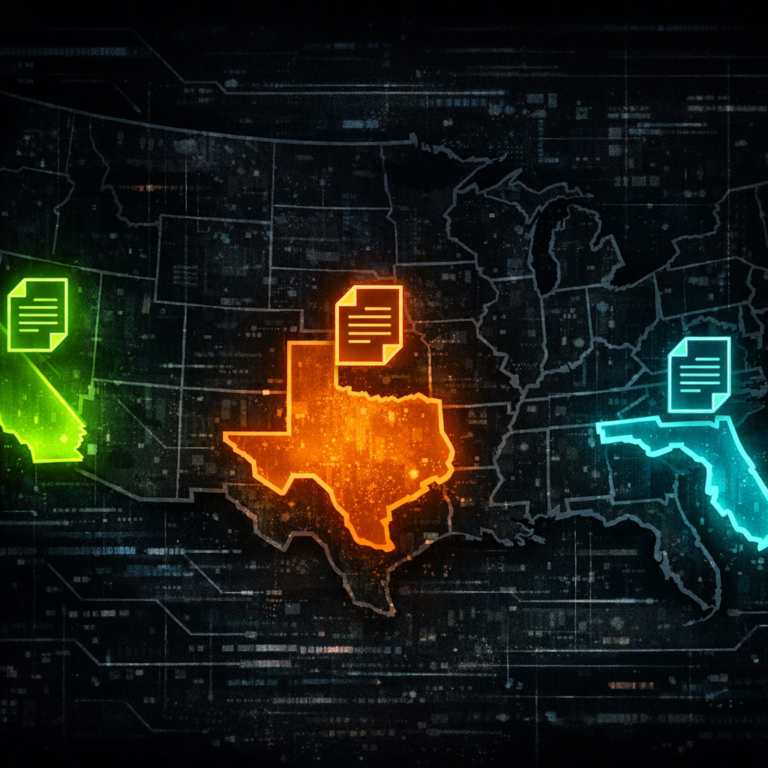
- California vs Texas vs Florida: the 2026 state privacy law raceThree states, three approaches, one compliance headache. A 2026 comparison of California, Texas, and Florida privacy laws: what they require, who’s exempt, and how to comply across all three at once.
- How shadow AI is leaking your company’s secrets, and how to find itShadow AI (the AI tools your employees use without IT’s blessing) is the 2026 version of shadow IT, and it’s leaking proprietary code, customer data, and internal strategy at a pace most security teams aren’t measuring.
- OPSEC for OSINT investigators: not contaminating what you researchHow journalists and OSINT analysts keep their personal accounts, devices, and identity separate from the investigations they run. Defensive opsec, not evasion.
- Reverse image search beyond Google: when to reach for Yandex, TinEye, and the restGoogle Lens isn’t always the right tool. Here’s when each of the major reverse-image-search engines wins, and the ethics line on face-search services.
- Differential privacy: how Big Tech studies you without studying youDifferential privacy is the mathematical technique that lets a company compute aggregate statistics over its users while provably bounding what can be learned about any individual. Apple, Google, and the US Census Bureau use it. Here is how it actually works, where the guarantee holds, and where it fails.
- Privacy on mobile: iOS vs Android in 2026The two mobile operating systems have arrived at recognisably different privacy postures over the past five years. Apple’s App Tracking Transparency, Google’s Privacy Sandbox, and the steady accretion of features in both have produced a comparison that is still close, but no longer symmetric.
- The DNS privacy wars: DoH, DoT, ECH, and who sees your lookupsEvery connection on the internet starts with a DNS lookup, and for most of the internet’s history those lookups have been completely unencrypted. The shift to encrypted DNS (DoH, DoT, ECH) is one of the quieter but most consequential privacy upgrades of the decade.
- VPNs in 2026: what they actually hide, what they don’t, and which ones to trustVirtual Private Networks are aggressively marketed as solving privacy and security problems they often do not solve. Here is what a VPN actually does, the realistic threat model where it helps, and how to evaluate which providers are credible in 2026.
- Browser fingerprinting: why cookies are not even the worst partEven with all cookies blocked and all trackers disabled, the browser leaks enough information to be uniquely identified across the web. Browser fingerprinting is the surveillance technology that makes “private browsing” much less private than the name suggests.
- The right to be forgotten: how to remove yourself from search enginesThe Right to Be Forgotten gives EU residents a real and unevenly applied power to remove search-engine results about themselves. Here is what the law actually allows, what Google approves and rejects, and the practical steps for filing a delisting request.
- Tracking pixels, cookies, and the modern web surveillance stackThe web tracks you in ways that have outgrown the simple cookie. Tracking pixels, postback URLs, server-side conversion APIs, identity graphs, and CNAME cloaking all live alongside browser fingerprinting and the dying third-party cookie. A field guide.

















Every privacy article
Every article we have published in this section, newest first.
- Codename Morgan: inside Morocco’s Pegasus machine
- Inside Pegasus: NSO’s own files reveal the machine
- Stealer logs bypassing MFA in 2026 [Field Guide]
- SEC 4-day cyber rule: 2.5 years in, what CISOs learned
- Audit your digital footprint 2026: Sherlock, Holehe, Whoxy
- How to disappear from data broker sites: a 2026 step-by-step removal tutorial
- Build the 2026 privacy stack: Mullvad Browser, GPC, uBlock Origin, and SimpleLogin tutorial
- How to check if you’re in a stealer log: tutorial with Hudson Rock, IntelX, and Have I Been Pwned
- Browser fingerprint markets: how stolen identities get sold in 2026
- What the EU AI Act actually requires from US companies in 2026
- How data brokers reassemble your identity from public scraps
- The browser extensions stealing your data right now (and how to spot them)
- A 30-minute monthly privacy audit for normal humans
- California vs Texas vs Florida: the 2026 state privacy law race
- How shadow AI is leaking your company’s secrets, and how to find it
- OPSEC for OSINT investigators: not contaminating what you research
- Reverse image search beyond Google: when to reach for Yandex, TinEye, and the rest
- Differential privacy: how Big Tech studies you without studying you
- Privacy on mobile: iOS vs Android in 2026
- The DNS privacy wars: DoH, DoT, ECH, and who sees your lookups
- VPNs in 2026: what they actually hide, what they don’t, and which ones to trust
- Browser fingerprinting: why cookies are not even the worst part
- The right to be forgotten: how to remove yourself from search engines
- Tracking pixels, cookies, and the modern web surveillance stack
- End-to-end encryption explained: Signal, iMessage, WhatsApp, and the limits of E2EE
- Data brokers: who sells your personal information and how to opt out
- The GDPR at eight: what has actually changed