
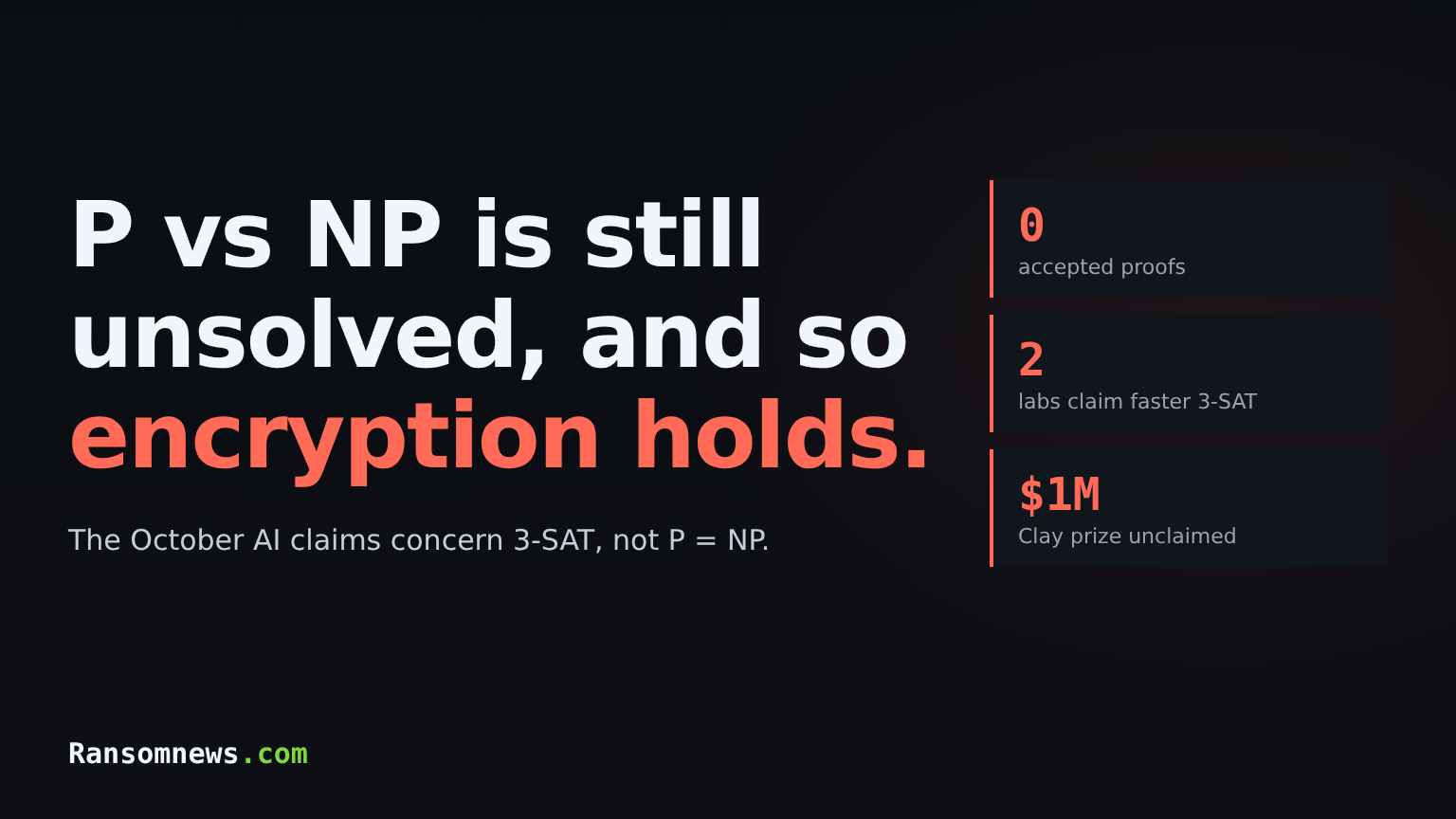
P vs NP is still unsolved, and neither OpenAI nor Anthropic has claimed to solve it. In October 2026 each lab said a model had found a way to solve 3-SAT faster than a long-standing conjecture, the Exponential Time Hypothesis, allowed. Outside researchers are still checking both proofs. The method only overtakes older ones on formulas too large to write down, so RSA, AES and password hashes are unaffected.
In brief
- The Clay Mathematics Institute still lists P vs NP as unsolved.
- OpenAI and Anthropic released separate papers on 26 and 27 October 2026 claiming the Exponential Time Hypothesis is false. Neither paper claims that P = NP.
- Both proofs pass the Lean proof checker. The review led by the conjecture’s authors has reported no flaw and has not certified the result.
- The lowest published estimate of where Anthropic’s method overtakes earlier ones is a formula with about 2^420 clauses, a 127-digit number.
- A proof of P = NP that came with a practical algorithm would break RSA, elliptic-curve and AES keys. The October papers are not such a proof.
Has AI solved P vs NP?
No AI system has solved P vs NP, and the Clay Mathematics Institute lists the problem as unsolved. The question asks whether every problem whose answer is quick to check is also quick to solve. The talk of a breakthrough comes from a narrower result about one such problem, 3-SAT, and from a month of commentary that followed it.
| Date | Event |
|---|---|
| 16 October 2026 | Models at OpenAI and at Anthropic each find the core argument, according to the two labs |
| 26 and 27 October | OpenAI releases “The Exponential Time Hypothesis is False”. Anthropic releases “A 2^o(n) Time Algorithm for 3-SAT”, with Claude as the listed author |
| 26 October | Ramamohan Paturi, a co-author of the hypothesis, opens a public blog to examine the claim |
| 30 and 31 October | Outside readers replay both Lean proofs. Ruhollah Majdoddin publishes estimates of when the new method becomes faster |
| 17 November | Emanuele Viola, a complexity theorist, restates his minority view that P = NP |
| 19 November | UC San Diego describes the independent review organised by Impagliazzo, Paturi and Williams |
| 22 November | Brilliant starts a public fleet of AI agents working on P vs NP |
What did OpenAI and Anthropic claim?
Both labs claim a deterministic algorithm that solves 3-SAT in subexponential time, which would make the Exponential Time Hypothesis false. 3-SAT asks whether a logic formula built from three-variable clauses can be made true. The hypothesis, proposed in the late 1990s by Russell Impagliazzo and Ramamohan Paturi, says no algorithm can do that without a running time that grows exponentially in the number of variables.
OpenAI says its model found the disproof on 16 October and that it was formalised in the Lean proof checker a day later. Anthropic’s preprint says an internal Claude research model found its algorithm the same day “with 14M output tokens and no human input”. Scott Aaronson, a complexity theorist at the University of Texas at Austin, put OpenAI’s running time at roughly 2 to the power of n divided by the square root of log n.
P = NP would need the last step in that chart: a running time that is n raised to a fixed power. Aaronson wrote on the day of the announcement that “refuting the ETH is still a long way from P=NP”, and that a weaker form of the hypothesis has not fallen. OpenAI describes the hypothesis as related to P vs NP and makes no claim about P vs NP itself.
Have the AI proofs been verified?
Both proofs pass a machine proof checker, and human experts have neither confirmed nor refuted the mathematics. Outside readers replayed both Lean proofs by 31 October, according to a tracker that links their logs. A Lean check shows that a formal statement follows from its axioms. People still have to confirm that the formal statement is the hypothesis researchers mean, a point DataCamp’s explainer makes about both papers.
The human review is led by Impagliazzo and Paturi of UC San Diego and Ryan Williams of MIT. UC San Diego reported on 19 November that the group plans one or more conferences on the verification work and gave no dates, and it reported no flaw. The review blog’s opening post says the organisers’ involvement “should not be taken as certification of the claim”.
Could the new 3-SAT algorithm break encryption?
The new algorithm cannot break any cipher in use, because it is slower than existing methods on every formula that could be written down. Ruhollah Majdoddin worked out the crossover points, the formula sizes at which the new bound becomes the faster one. He cites a remark in Anthropic’s paper that its method beats trying every combination only on formulas with more than 2^8000 clauses.
Majdoddin’s tightened analysis brings the crossover against the best earlier methods down to about 2^420 clauses, and he describes his figures as lower bounds on the true values. For OpenAI’s main algorithm he estimates no difference from exhaustive search on formulas with fewer than 2 to the power of 10.9 billion variables. His paper says none of the running times in it is usable.
Journal du Coin reported on 28 October that crypto users on X had misread the paper’s title, taking its abbreviation ETH for ether, whose price stayed near $2,350. The same article points out that Ethereum signatures rest on the elliptic-curve discrete logarithm problem, which a faster way to count 3-SAT solutions does not touch. Aaronson, asked in his comments, said he had no news about breaking cryptographic codes. DataCamp reports that OpenAI tested the algorithm against real cryptosystems and was fairly confident it breaks none, and that a follow-up attack on elliptic curves gives no advantage against the curves in use today.
Free tool
How does your own site score?
Run the same forty passive checks against your own domain: TLS and certificates, security headers, SPF and DMARC, cookies before consent, and what your stack quietly reveals. A grade out of 100 in about fifteen seconds.
No signup. Nothing installed. We only request what your site already serves publicly.
What would a proof of P = NP break?
A proof of P = NP that came with a fast, practical algorithm would break every cipher whose key can be checked quickly once guessed, which covers RSA, elliptic curves, AES and password hashes. Stephen Cook’s official statement of the problem for the Clay Mathematics Institute says internet security depends on assumptions such as the difficulty of factoring, and adds: “If P = NP, these assumptions are all false.” He gives an example: a 3-SAT algorithm that ran in n squared steps could factor a 200-digit number in a few minutes.
| Protection | If P = NP came with a practical algorithm | After the October 2026 claims |
|---|---|---|
| RSA and elliptic-curve keys, used in HTTPS, signatures and crypto wallets | Broken. Private keys could be computed from public ones | No change |
| AES and other ciphers | Broken. A key could be found from known plaintext and ciphertext | No change |
| Password hashes | Broken. A matching password could be computed from the hash | No change |
| A password or session cookie already stolen by malware | Already in the attacker’s hands | No change |
Cook notes that a proof could be nonconstructive, establishing that fast algorithms exist without supplying one, and Lance Fortnow’s 2009 survey in Communications of the ACM adds that P = NP could hold without practical algorithms for most of the hard problems. Both authors record that most complexity theorists believe P does not equal NP.
Why are people saying P = NP is close?
An essay, a public AI project and a run of explainer posts in November turned a technical result into talk of broken encryption. On 17 November Emanuele Viola of Northeastern University restated his long-held belief that P = NP and called the hypothesis result the “biggest blow of all”. The same essay says the AI results did not prove that P equals NP and that nearly all researchers believe the opposite.
On 22 November the design-software company Brilliant put a fleet of AI agents to work on the problem in public, according to a tracker of the claims. The project’s own page carries the line “Verdict: open, being worked on now.” Explainers on X followed, written for readers worried about P = NP. One of them noted that nobody has proved the question either way and warned that, in the worst case, “every lock on the internet opens at once”.
Aaronson wrote that a subexponential algorithm for CircuitSAT, a more general problem than the 3-SAT covered by the October papers, would raise his estimate of P = NP to between 20 and 30 per cent. We covered the same question for the claimed Riemann hypothesis proof on 20 November.
What puts passwords and keys at risk today?
Stolen credentials are the risk that exists today, and using them requires no attack on encryption. In the November 2026 snapshot of our infostealer dataset, 1,663 of 1,856 large organisations (89.6%) had at least one staff email address with a password captured by infostealer malware. The most common passwords in those logs need no computation to guess, and stolen session cookies skip the password altogether. Any organisation can check its own domain with StealerCheck.
Frequently asked questions
Is P vs NP solved?
No. The Clay Mathematics Institute lists P vs NP as unsolved as of 23 November 2026, and neither OpenAI nor Anthropic has claimed a proof.
Did OpenAI or Anthropic prove that P = NP?
No. Both labs claim that the Exponential Time Hypothesis is false, which concerns how fast 3-SAT can be solved. A subexponential algorithm for 3-SAT is still far slower than the polynomial algorithm P = NP would require.
What is the Exponential Time Hypothesis?
The Exponential Time Hypothesis is a conjecture from the late 1990s by Russell Impagliazzo and Ramamohan Paturi that 3-SAT cannot be solved in subexponential time. It is a stronger assumption than P does not equal NP, so it can be false while P vs NP stays open.
Does a false Exponential Time Hypothesis threaten Bitcoin or Ethereum?
No. Wallet signatures rest on the elliptic-curve discrete logarithm problem, which the 3-SAT result does not address, and the claimed algorithm is slower than existing methods at any practical size.
Would P = NP break all encryption?
A proof with a practical algorithm would break RSA, elliptic-curve keys, AES and password hashes, because their keys can be checked quickly once guessed. A proof could also be nonconstructive or give an algorithm too slow to use.
Who is checking the AI proofs?
Russell Impagliazzo and Ramamohan Paturi of UC San Diego and Ryan Williams of MIT are organising the independent review. Outside readers have also replayed both Lean proofs.
What is 3-SAT?
3-SAT is the problem of deciding whether a logic formula made of clauses with three variables each can be satisfied. It is NP-complete, so a fast algorithm for it would give fast algorithms for every problem in NP.
Sources and further reading
- Clay Mathematics Institute, P vs NP, and Stephen Cook, The P versus NP problem
- OpenAI, Building scientific understanding with academic communities
- Claude (Anthropic), A 2^o(n) time algorithm for 3-SAT, 27 October 2026
- UC San Diego Today, report on the independent review of the OpenAI and Anthropic result, 19 November 2026
- ETH: Community Examination and Discussion, the review blog opened by Ramamohan Paturi
- Ruhollah Majdoddin, Lowered crossover points of Anthropic’s subexponential 3-SAT algorithm, 30 October 2026
- Scott Aaronson, Shtetl-Optimized, 26 October 2026
- Emanuele Viola, What happened in fall 2026: AI and P vs NP, 17 November 2026
- Lance Fortnow, The status of the P versus NP problem, Communications of the ACM, 2009
- Gabriel Montaut, Journal du Coin, report on the ETH confusion, 28 October 2026
- DataCamp, AI refutes the Exponential Time Hypothesis, 6 November 2026
- Ransomnews, Riemann hypothesis proof would not break encryption
The Ransomnews Monthly
One email a month. Original leak-site data, victim census updates, and the findings that did not make the articles. No spam, unsubscribe any time.
Double opt-in. We store your email, signup time, and IP for consent records (GDPR Art. 7). See our privacy policy.