
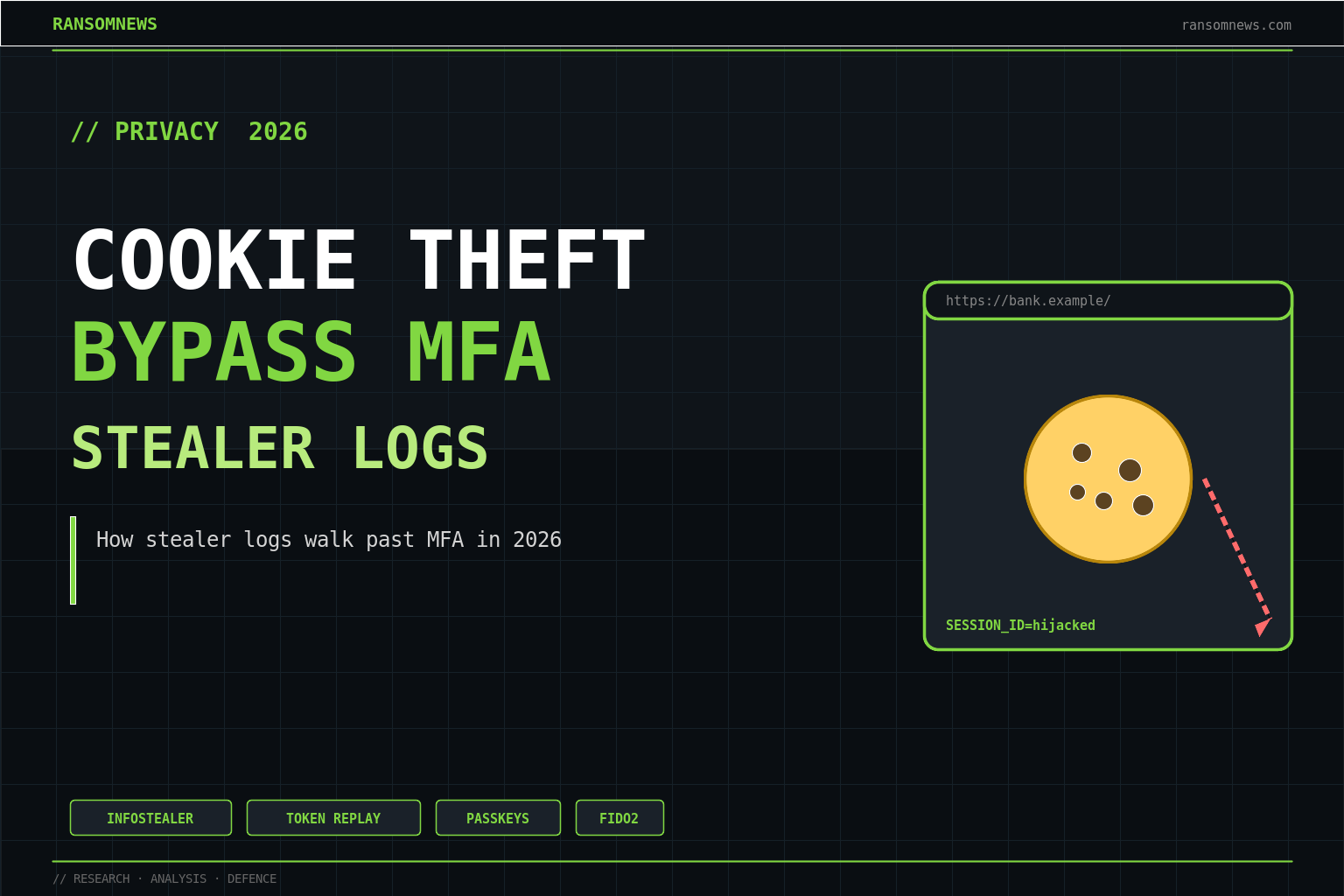
The pitch every IT vendor sold for the last decade, “turn on MFA and you’re safe”, broke quietly some time around 2023, and by 2026 the data is unambiguous. Mandiant’s incident-response reporting, CrowdStrike’s threat reports, and our own observations across the Ransomtracker victim corpus all converge on the same conclusion: the modal modern intrusion does not crack a password and does not bypass MFA. It bypasses authentication entirely by stealing the session cookie that authentication produced.
This is the privacy story most users have never been told. Your password is no longer the asset. The browser cookie that says “this user already logged in, with MFA, on this device, two hours ago” is the asset. It bypasses everything you and your IT team are doing to protect access, because the system was designed to honour that cookie precisely so users wouldn’t have to MFA every five minutes.
The attack chain, end to end
1. Infection
An infostealer family, most commonly Redline, Lumma, Vidar, Stealc, or Raccoon in 2026, lands on the target machine. The delivery is rarely targeted at a specific corporate identity. The standard pattern is a cracked-software lure (“Photoshop 2026 cracked”), a fake browser update, a malicious Steam Workshop file, or a “free Roblox skin” download. The malware doesn’t need admin rights. User-level access to the browser profile directory is enough.
2. Harvest
Within seconds, the stealer reads %LOCALAPPDATA%\Google\Chrome\User Data\Default\Network\Cookies (or the Edge / Firefox equivalent). The cookies are stored as DPAPI-encrypted SQLite, but the key required to decrypt them is sitting in Local State in the same profile folder. The stealer reads that, decrypts every cookie, and packages the lot, along with saved passwords, autofill data, crypto-wallet files, and a system fingerprint, into an archive. The whole operation, from execution to exfiltration, completes in under a minute on a typical machine.
3. Market
The archive, typically called a “log”, gets uploaded to a Telegram channel or a dedicated stealer-log marketplace. Logs are sold by the bundle (1,000 logs for $50) or individually for high-value targets. A corporate session cookie for a Fortune 500 SaaS account can fetch $500+; a generic gaming-account session might be 50¢. Alerts.bar’s index covers most of this ecosystem.
4. Replay
The attacker imports the cookie into their own browser using an extension like Cookie Editor or a tool like EditThisCookie. They visit the SaaS URL. The application sees a valid session cookie that was authenticated within the cookie’s lifetime, by a user who passed MFA. It serves the dashboard. The MFA check does not fire, the user already authenticated.
The attacker is now in. No password was cracked. No MFA was bypassed. No vulnerability was exploited. The system worked exactly as designed. That’s the whole problem.
Why this attack scales
Three structural factors explain the scale of this in 2026:
- The browser is the OS. All meaningful corporate work, email, code, customer data, finance, runs in a browser tab. Compromising the browser compromises the work. There is no “second layer” the way there was when applications were on-premises.
- Sessions are intentionally long. Users hate re-authenticating. So IT teams set session lifetimes to 7, 14, 30 days. That’s a 30-day window in which a stolen cookie continues to work.
- The supply chain is massive. The infostealer-log economy delivers fresh credential bundles measured in the millions per day. The attackers don’t need to compromise your specific user, they buy a job lot and search it for credentials matching their target list.
The four controls that actually stop it
1. Token-bound passkeys (FIDO2)
The decisive control. When a session is established with a passkey backed by a hardware-bound credential (a TPM, a YubiKey, an iCloud Keychain key with platform attestation), the issued session cookie can be cryptographically bound to that device. Replaying it from a different machine fails because the binding doesn’t match. This is the only widely-deployed protection that addresses the attack at the root.
Free tool
How does your own site score?
Run the same forty passive checks against your own domain: TLS and certificates, security headers, SPF and DMARC, cookies before consent, and what your stack quietly reveals. A grade out of 100 in about fifteen seconds.
No signup. Nothing installed. We only request what your site already serves publicly.
Practical wins in 2026: Google Workspace, Microsoft Entra ID, Okta, and most major SaaS vendors now support token-binding or device-binding for sessions issued from passkey logins. The configuration is buried in their admin consoles; turn it on.
2. Short session lifetimes
If a session cookie is valid for 30 days, an attacker has 30 days to use it. If it’s valid for 4 hours, they have at most 4 hours from the moment the user’s machine was infected. The trade-off is user friction, users have to MFA more often. Most teams find 8 hours for regular users and 4 hours for admin-tier roles is the right balance. The number that matters: how many of your active sessions today were authenticated more than 24 hours ago?
3. Continuous-access evaluation
Microsoft’s Continuous Access Evaluation and Google’s equivalent re-check session validity in near-real-time against signals like geo-change, IP-range change, or detected anomaly. A cookie that was valid when issued from London becomes invalid the moment someone tries to use it from Lagos. This won’t stop the first request, but it’ll stop the second one, which is usually enough.
4. Endpoint detection that catches stealers before exfiltration
The entire chain depends on the stealer running on the endpoint without being blocked. A behavioural-detection AV, see our 2026 antivirus picks, catches the stealer at execution time, before the cookie database is read. Microsoft Defender on a recent Windows 11 build does this competently for known families. Malwarebytes and Bitdefender’s behaviour engines catch more of the long tail.
What individuals can do today
- Stop installing cracked software. Single biggest source of infostealer infections in our data. Modern stealers are now bundled with almost every cracked-software installer on the open internet.
- Use passkeys where they’re offered. Apple, Google, Microsoft, and most password managers all support passkeys. Switching from a password + TOTP combo to a passkey isn’t just incremental security, it changes the attack class.
- Run a quarterly browser-cookie cull. Clear cookies for any service you don’t actively use. The attack surface for cookie theft is every cookie you’ve ever accumulated.
- Check your company’s domain exposure. Free tool: Stealercheck. If staff_total is non-zero, your IT team needs to know.
- Don’t share browser profiles across personal and work. If your work browser has access to your gaming and email and crypto sites, one bad download compromises all of it. Use separate profiles, or better, separate machines.
FAQ
Is MFA still worth turning on if it doesn’t stop this attack?
Absolutely yes, MFA still stops the dominant attack class of credential reuse from breach corpuses, and a session cookie can only be stolen after a successful authentication. MFA narrows the window in which a cookie can exist. It’s not sufficient on its own, but removing it makes everything worse.
What’s the difference between FIDO2, passkeys, and WebAuthn?
WebAuthn is the protocol. FIDO2 is the broader specification family (WebAuthn + CTAP). Passkeys are the consumer-facing branding for credentials that follow that spec, Apple, Google, and Microsoft each ship passkey implementations that interoperate. All three are token-bound by design and resistant to cookie-theft replay when configured correctly.
Does clearing my cookies regularly help?
Yes, cookies you’ve cleared can’t be stolen. The cost is re-authentication friction. For high-sensitivity accounts (banking, primary email, work admin), a “log out at end of day” habit meaningfully reduces the steal-and-replay window.
Can the attacker still get in if I rotate my password after infection?
Not for the stolen cookie’s lifetime, if the platform invalidates all sessions on password change. Many do; some don’t. Force-revoke active sessions in the admin console too, don’t just rotate the credential.
How long does a typical session cookie remain valid after theft?
Depends entirely on the platform’s session policy. Google Workspace: up to 30 days by default. Microsoft 365: 90 days for “remember me” sessions. Most SaaS: 14–30 days. Banking apps: hours. The platform-default is the attacker’s runway.
Related Ransomnews coverage
- Stealercheck, free domain-level stealer-log exposure check.
- Alerts.bar review, the dark-web monitoring platform that tracks the cookie-theft economy at scale.
- Best antivirus 2026, endpoint protection that catches stealers before they exfiltrate cookies.
- Stealer Logs category, investigative coverage of the infostealer-log economy.
Keywords: session cookie theft 2026, stealer logs MFA bypass, infostealer cookie hijack, Redline Lumma Vidar 2026, browser cookie theft attack, FIDO2 passkey session binding, token-bound passkeys, continuous access evaluation, MFA bypass session replay, EvilProxy alternative.
The Ransomnews Monthly
One email a month. Original leak-site data, victim census updates, and the findings that did not make the articles. No spam, unsubscribe any time.
Double opt-in. We store your email, signup time, and IP for consent records (GDPR Art. 7). See our privacy policy.