
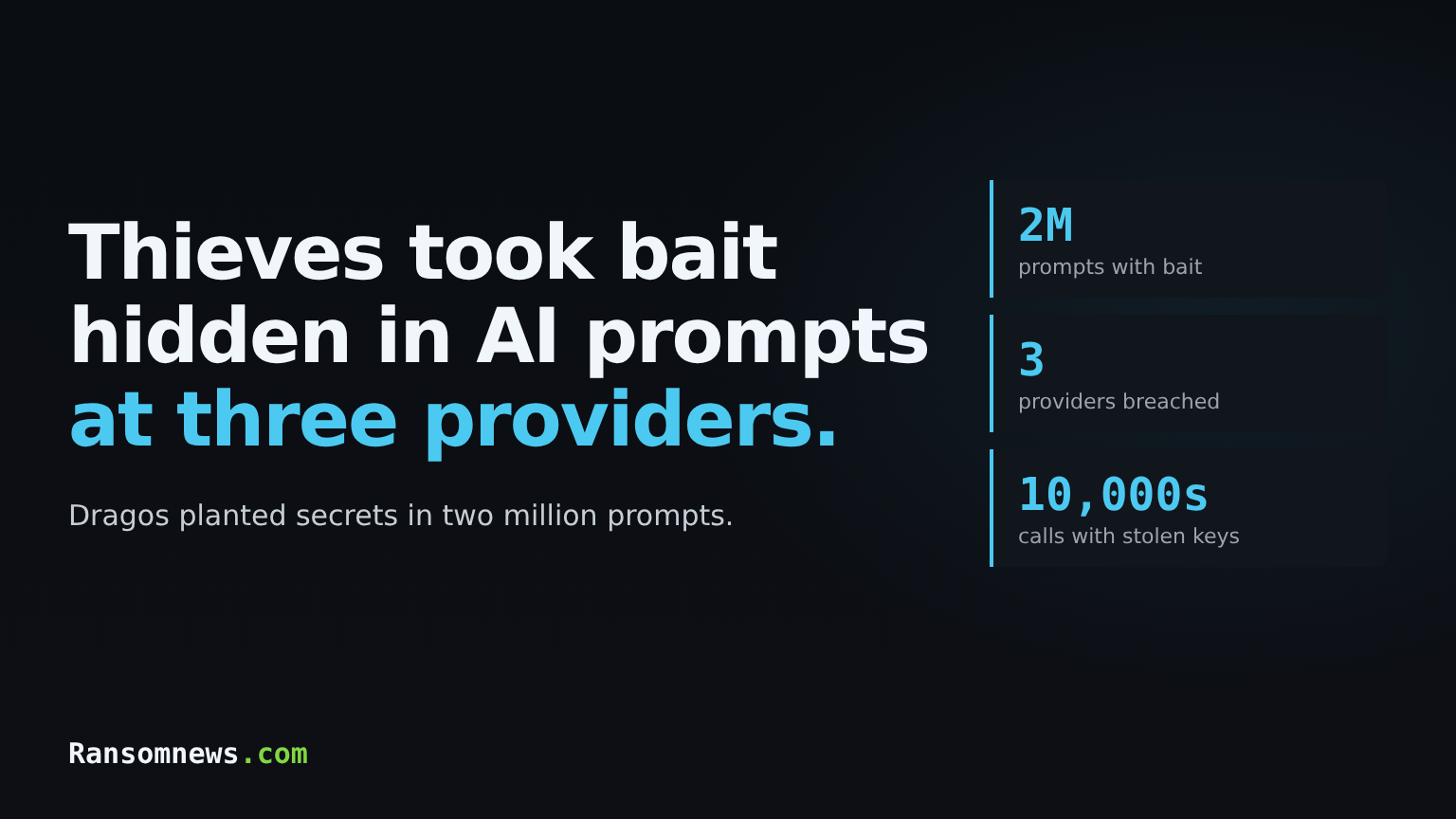
Dragos researcher HD Moore hid unique, trackable secrets in about two million prompts sent to AI services between July and November 2026 and published what happened to them on 19 November. The secrets were stolen in breaches at three AI providers, read by marketplace resellers who had switched on request logging, and fetched by providers from prompts marked Zero Data Retention. Dragos names none of the three.
In brief
- None of the three breached providers knew about its breach until Dragos told it. One has since published a preliminary security notice.
- In the largest breach, every request sent to one provider during several windows in late October was copied, including requests the provider rejected before a model ran.
- Some stolen AWS keys were tested within hours, and the keys were used in tens of thousands of AWS API calls. On 1 November the attacker added ARTEX, the AI penetration testing tool named in the FBI advisory of 13 November.
- Sellers on an AI inference marketplace read customer prompts by listing models cheaply and turning on standard logging. No exploit was involved.
- A Chinese AI lab fetched secret links from more than half of the prompts sent to its models, including about two-thirds of those marked for no data collection.
What did the Dragos canary study test?
The study tested what happens to the contents of an AI prompt after the service has answered it, by planting secrets that raise an alarm when anyone uses them. Each prompt carried canary tokens: unique web links and DNS names, passwords, Git repository addresses, and AWS keys tied to empty accounts with full logging. Every token traced back to one prompt, one model, one route and one privacy setting, so a login attempt or a fetched link identified the request it came from.
Moore, who is chief research officer at Dragos and the creator of Metasploit, also built a way to trace the path a request takes. Of about 2,000 routes traced, several hundred passed through systems the researchers could not identify. Dragos has notified about a dozen providers and expects that number to grow.
A canary shows that a prompt leaked, without showing which company in the chain leaked it, a limit Dragos acknowledges. It describes the three breaches as activity indicating exposure and does not name the providers, so nobody outside Dragos and those companies can check the findings yet.
How many companies see an AI prompt?
A single prompt can pass through three or four companies before it reaches a model, and each of them can read the prompt and the answer in full. Many applications send requests to a router, a service that offers one API address and forwards each request to one of many models. A router can hand the request to a second router, which hands it to a hosting provider, which runs the model. Inference marketplaces are open routers where the seller with the lowest price gets the request.
A customer can mark an account, a key or a single request for no data collection, and Zero Data Retention (ZDR) is the strictest setting. Dragos found that the flag binds only the first company to receive the request, and that routers often forward flagged requests to providers that do not apply the same control.
Researchers at UC Santa Barbara used planted credentials against routers in April. Of the 428 AI API routers they tested, nine injected malicious code into responses and 17 used AWS credentials the researchers had planted.
| Where the prompt leaked | What Dragos saw | How it got out |
|---|---|---|
| Three AI hosting providers | Stolen AWS keys used in tens of thousands of AWS API calls | Attackers inside the provider copied customer requests |
| Resellers on an inference marketplace | Secret links opened about a day and a half later, and passwords tried over SSH | Sellers turned on standard request logging |
| A Chinese AI lab, including through US hosts that resell its models | Links fetched from more than half of prompts, usually two or three days later | The lab’s own scraper |
| Two large US providers | Links crawled days, and in one case more than two months, after the request | The providers’ crawlers |
What happened at the three breached AI providers?
Attackers inside three AI hosting providers copied customer requests, and none of the three knew until Dragos told them. The earliest breach began in mid-July. That provider first blamed a misconfiguration in its internal tooling, then a partner that processes data for it, and then found that its own internal credentials had been compromised. It had not disclosed the incident publicly by late October, and data stolen from it was still producing login attempts then.
The largest breach took a couple of hundred AWS keys, each of which Dragos had sent in a single request to a single provider during a few short windows in late October. Every request in those windows was stolen. Some had been rejected before any model ran, which tells Dragos the attacker was copying requests as they arrived. One adversary appears to have been inside two of the providers at once, working from a single rented server. Some of the stolen requests in the other two breaches were marked ZDR, which limits what a provider stores and offers no defence once an intruder is inside its systems.
A key planted on 21 October was first used the next day and was still in use three weeks later. With the keys, the attacker listed S3 storage buckets, searched AWS Secrets Manager and Parameter Store, tried to switch on hosted models in Amazon Bedrock, created Bedrock API keys and added new IAM users.
The tooling changed over time, from a script posing as Chrome on Windows to the AWS command line on Kali Linux. On 1 November the attacker added ARTEX. Here it made only a handful of calls, to confirm that keys the attacker already held still worked. Dragos says two of the user-agent strings ARTEX left in the AWS logs appear on no public indicator list and recommends adding them to detections.
How did marketplace resellers read customer prompts?
Resellers on an AI inference marketplace read customer prompts by listing popular models at the lowest price, switching on standard request logging and waiting for traffic. They exploited no vulnerability and bypassed no control. Dragos describes the sellers as individuals on home internet connections, and says the shadier marketplaces commonly bill the inference itself to stolen AWS credentials or consumer API keys.
About a day and a half after two prompts went through one seller, someone on home broadband opened both secret links in a desktop browser and began guessing usernames. Prompts sent to the same model through a different seller were never touched. In another case, a person in France using a Mac took passwords from two prompts and typed root SSH login attempts by hand, trying one password four times in two minutes. The same Mac later tested several AWS keys.
Free tool
How does your own site score?
Run the same forty passive checks against your own domain: TLS and certificates, security headers, SPF and DMARC, cookies before consent, and what your stack quietly reveals. A grade out of 100 in about fifteen seconds.
No signup. Nothing installed. We only request what your site already serves publicly.
Route tracing also showed that one seller adds about 1,000 hidden tokens to every prompt, and that one router was quietly forwarding some of its traffic to the marketplace. The router told Dragos it stopped after being notified.
Did providers honour Zero Data Retention?
Some providers kept and used prompts that customers had marked Zero Data Retention or no data collection, according to Dragos. The clearest case is a Chinese AI lab. From July to October its systems fetched the secret links in more than half of the prompts sent to its models, including about two-thirds of the requests that carried a privacy flag. The scraper usually arrived two or three days after the request. US hosting providers that resell the lab’s models set off the same scraper, so prompts sent to a US company flowed back to the lab. A Git client on another cloud also tried to clone private repositories named only in prompts sent to this lab’s models.
Two large US providers also came back for links long after answering. One was still crawling a secret link more than two months after a single call to its search endpoint. The other’s scraper returned days after each request, whichever router carried it.
Twenty-four days after one request was sent, its secret link was posted in a chat on Feishu, the workplace messaging app, and opened within two minutes from three desktops and three phones in Beijing and Shanghai. The Dragos post describes that request in one place as going to a Chinese provider and in another as sent to a US-based provider with the ZDR flag set.
Which AI providers were breached?
Dragos has not named the three breached providers, the marketplace or the Chinese lab. The few companies named in its post appear in examples of how requests are routed, and none is described as breached. One of the three has published a preliminary security notice, Dragos says, without identifying it. Customers of AI hosting providers and routers therefore have no public way to tell whether their prompts were among those copied, beyond watching for a notice from their own supplier.
How else do AI prompts reach criminals?
Infostealer malware is a second route to the same data, and it needs no breach at the provider. A stealer copies the passwords and session cookies saved in the browsers on an infected computer, and whoever buys that stealer log can often sign in to the victim’s AI account and read its history. The 1 November 2026 snapshot of the Ransomnews infostealer dataset holds 4,008 OpenAI logins registered with work email addresses at 319 large organisations, 442 of them at 20 government bodies, according to the November report. Ransomnews covered that route in its piece on shadow AI and stealer logs.
Attackers also search for the keys themselves: Microsoft reported on 5 November that they were using AI agents to search public GitHub repositories for exposed secrets, API keys for AI services among them.
What should organisations do?
Dragos advises shortening the chain between the user and the model and planting canaries in whatever AI agents can read. Its post also says: “None of this means that you should stop using AI services.” Its recommendations, in order, with two from Ransomnews at the end:
- Host the model yourself if you can afford the hardware. Dragos calls this the only option where nobody else reads your prompts, and prices suitable machines from $6,950 for a desktop unit to $570,000 or more for an eight-GPU server.
- Otherwise go directly to a first-tier provider, which leaves one contract and one privacy policy to review.
- If you use a router, choose the upstream providers yourself, check that privacy settings change where requests go, and avoid reseller marketplaces.
- Put canary credentials into the context your agents and pipelines send, and treat any use of one as an incident. AI agents will send any credential they can read, which is one of the ways agentic AI widens an attack.
- Turn on the secret-filtering features providers offer, knowing they miss sensitive data that is not shaped like an API key.
- If you do host a model yourself, put it behind a login. A September count by Mysterium VPN found 36,769 self-hosted AI endpoints open to the internet, 2% of which asked for one.
- Check whether employee logins for AI services are already in stealer logs with StealerCheck, then reset those passwords and end the sessions.
Frequently asked questions
Which AI providers were breached?
Dragos has not named them. It says three AI hosting providers were compromised between July and November 2026, that none knew until it was told, and that one has published a preliminary security notice.
What is a canary token?
A canary token is a fake secret, such as a web link, password or cloud access key, that has no legitimate use and alerts its owner when anyone touches it. Dragos put a different one in each prompt so that any use pointed to the exact request that leaked.
What is Zero Data Retention?
Zero Data Retention, or ZDR, is a setting under which an AI provider agrees not to store a customer’s prompts and responses after answering. Dragos found it binds only the first company that receives a request, and other companies further along the route may not apply it.
Does Zero Data Retention protect prompts in a breach?
No. ZDR limits what a provider stores after answering. In the Dragos study, requests marked ZDR were among those stolen from two of the breached providers.
Is it safe to put passwords or API keys in AI prompts?
No. Some AWS keys stolen from the Dragos prompts were tested within hours, and one was still being used three weeks later. Dragos also warns that AI agents will include any credential they can read in the prompts they send.
What is an AI router?
An AI router is a service that gives developers one API address and forwards each request to one of many models, often hosted by other companies. Every company a request passes through can read the full prompt and the response.
Should companies stop using AI services?
Dragos says no. It recommends sending prompts to as few companies as possible, avoiding reseller marketplaces, and planting canary credentials so that a leak is noticed.
Sources and further reading
- HD Moore, Dragos, Three breaches, endless leaks: your AI supply chain needs canaries, 19 November 2026
- HD Moore, summary of the findings on X, 19 November 2026
- Liu and others, UC Santa Barbara, Your Agent Is Mine: Measuring Malicious Intermediary Attacks on the LLM Supply Chain, April 2026
- Microsoft Threat Intelligence, report on agentic AI tooling used to find and abuse exposed secrets, 5 November 2026
- Ransomnews, ARTEX: the AI hacking tool behind the FBI warning
- Ransomnews, Shadow AI is the new stealer-log jackpot in 2026
Reporting by the Ransomnews Research Team, from the Dragos research and the other sources listed above, read on 20 November 2026. Ransomnews did not run the canary tests and cannot verify them independently, because the providers are not named. OpenAI login figures are aggregate counts from the 1 November 2026 snapshot of the Ransomnews Infostealer Exposure Dataset, which is built on the Alerts.bar index.
The Ransomnews Monthly
One email a month. Original leak-site data, victim census updates, and the findings that did not make the articles. No spam, unsubscribe any time.
Double opt-in. We store your email, signup time, and IP for consent records (GDPR Art. 7). See our privacy policy.