
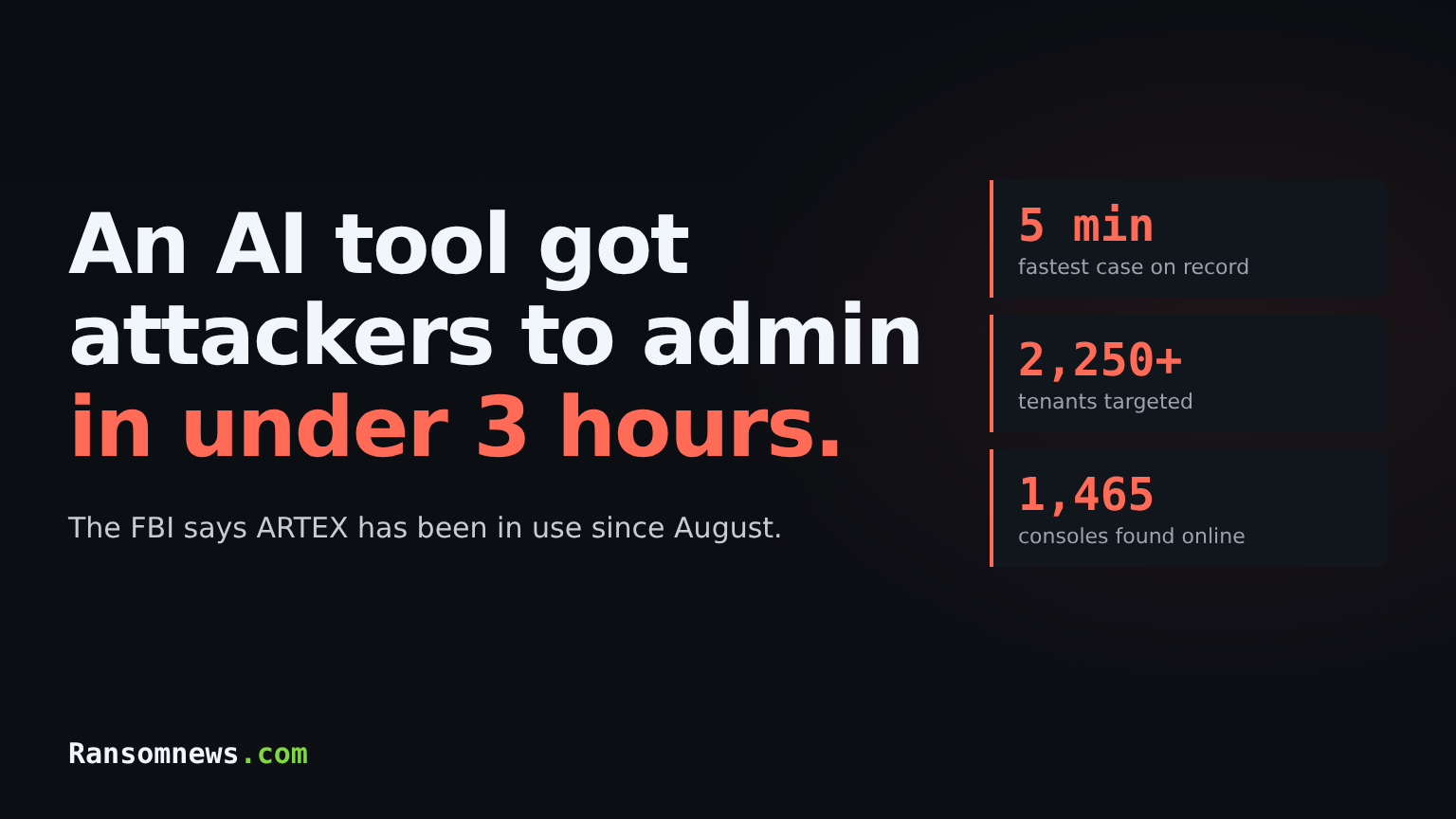
ARTEX is an open-source penetration testing platform that uses AI agents to find and exploit weaknesses with little human input. The FBI warned on 13 November 2026 that criminals and state-aligned groups have used it against organisations worldwide since at least August, in some cases reaching privileged access in under three hours. Its developer made the project closed-source on 8 October, but copies remain online.
In brief
- No agency or company has linked ARTEX to the outages at Microsoft 365, the FAA and US banks in mid-November. The FBI has said the advisory dates from 13 November and is not a new announcement.
- ARTEX has no AI model of its own. Operators connect it to commercial or open models, and Chinese models were the most common in the attacker set-ups researchers have read.
- Microsoft says the China-aligned group Storm-0940 used ARTEX after the ConnectWise Cloud Backup compromise to attempt sign-ins at more than 2,250 Microsoft 365 tenants.
- The intrusions described so far began with leaked credentials, secrets left in public code repositories and ordinary web application flaws.
- Employee logins already sit in stealer logs for 89.6% of the 1,856 large organisations in the Ransomnews infostealer dataset.
What is ARTEX?
ARTEX is a platform written in Go that takes a goal typed in plain language and has AI agents plan and run the commands of a penetration test. A developer using the handle Autumn-27 published it on GitHub in July 2026, according to the FBI, and Censys dates the release to 26 July. Censys also reports the author’s position that the tool was meant for testing inside an authorised scope.
The platform has no AI model of its own. Operators connect it to outside providers, and the FBI lists Anthropic’s Claude, OpenAI’s GPT, DeepSeek, GLM, Grok and Kimi among the models it works with. An analysis of ten exposed operator consoles published by SentinelOne found the DeepSeek Flash family in use more than any other, with American models on three of the ten. On one of those three, the safety guardrails of Anthropic’s Opus 5.5 stopped the work and the operator switched to a Chinese model.
The developer made the project closed-source on 8 October 2026, a day after CrowdStrike tied it to attacks on South Korean banks. The FBI says forks, archived copies and a paid edition have kept it in circulation. The advisory uses the abbreviation SI, for super intelligence, where the research it cites says AI.
What does the FBI advisory on ARTEX say?
The FBI advisory, FLASH-20261113-001, says multiple threat actors have used ARTEX since at least August 2026 to automate an intrusion from reconnaissance through to data theft. It names ten targeted sectors: financial services, government, technology, defence, semiconductors, energy, healthcare, manufacturing, telecommunications and legal services. On speed, it describes “some intrusions progressing from initial targeting to privileged access in under three hours”.
The document runs to 13 pages and includes indicators of compromise from known campaigns, BleepingComputer reported. It is marked TLP:CLEAR, so it can be shared without restriction. The FBI addresses it to any organisation with internet-facing applications, self-service portals, cloud infrastructure or connections to partners and suppliers, and asks victims to report ARTEX activity to a field office or the Internet Crime Complaint Center.
Which attacks have been tied to ARTEX?
Six sets of activity have been publicly tied to ARTEX since August 2026, two of them attributed to China-aligned groups and the rest to criminals or unnamed actors.
| Activity | Dates in 2026 | Reported by | What is documented |
|---|---|---|---|
| Searches of public GitHub repositories for secrets, then sign-ins to Azure and Microsoft 365 | From August | Microsoft | No named actor. In one case an agent took data from Azure Key Vault five minutes after it began searching |
| South Korean financial institutions | Late September to early October | CrowdStrike, Zscaler, FBI | Data on about 67,000 people taken, according to the FBI |
| ConnectWise Cloud Backup supply chain compromise | ARTEX use from September, made public 15 October | Microsoft | Storm-0940 attempted sign-ins at more than 2,250 tenants |
| VAPOR PANDA espionage campaign | 11 days from 17 October | CrowdStrike, via SentinelOne | More than 200 organisations in at least 14 countries targeted, with follow-on activity confirmed at nine |
| Storm-3358 | 19 October to 4 November | Microsoft, via SentinelOne and the FBI | Financial institutions in Southeast Asia targeted |
| Criminal campaigns by a Cambodia-based cluster | October, reported 5 November | Check Point Research, via SentinelOne | Apple app-signing certificates stolen and more than 190,000 gaming credentials harvested |
CrowdStrike reported on 7 October that it had found open directories on the servers behind the South Korean campaign, holding ARTEX configuration files and session histories from the Claude Code coding assistant. The ARTEX instance ran on a DeepSeek model, and other sessions pointed the coding assistant at GLM and Grok models. CrowdStrike has not named the actor and assesses with moderate confidence that the person is “likely a Chinese speaker and financially motivated”. Zscaler ThreatLabz reached the same assessment. CrowdStrike says the number of affected organisations is unconfirmed, and press reports citing South Korean investigators put the number of people affected at 68,000, a thousand more than the FBI’s figure.
The large numbers in the ConnectWise case count sign-in attempts. Microsoft said on 21 October that Storm-0940, a China-state-aligned group active since 2021, took control of the identities of several ConnectWise cloud applications and used ARTEX for scanning, password spraying and abuse of OAuth applications against the customers downstream. Microsoft does not say how the group obtained the application credentials. One password-spraying run from 10 to 14 October hit 327 accounts at eight organisations, produced more than 151,000 failed sign-ins and peaked at 2,900 failures a minute, without a single successful login. Microsoft gives no count of tenants where the group got in. It does describe follow-on activity in several customer environments, including an application that assigned itself the Global Administrator role, and adds that a successful sign-in does not by itself mean customer data was taken. A supplier with access to many customers at once is the same structure that makes managed service providers a target for ransomware crews.
How fast does an ARTEX intrusion move?
The fastest ARTEX-linked intrusion on record took five minutes, and both the FBI and Microsoft describe others that reached privileged access in under three hours. The five-minute case comes from a Microsoft report of 5 November: an agent searched GitHub for an application’s client secret, signed in with it and was exfiltrating data from Azure Key Vault five minutes later. Microsoft presents it as one observed case and gives no average.
SentinelOne puts the cost of the criminal campaigns it reviewed at between $145 and $1,500 in model time each, with ARTEX left in its default configuration. In several of them nobody prompted the agents again after the operator set the first goal. Microsoft advises treating any secret that has appeared in a public repository as compromised, even after the content has been removed.
How do ARTEX attackers get in?
Most documented ARTEX intrusions began with a credential or secret the victim had already lost, or with a common web application flaw. The FBI lists leaked credentials, stolen VPN configurations, credentials belonging to third-party vendors, administrator passwords hardcoded in JavaScript files and weak administrator passwords. SentinelOne adds flaws such as command injection, anonymous file upload and server-side request forgery, and Microsoft adds secrets committed to public GitHub repositories.
The FBI does not say where the leaked credentials came from. One large supply is stealer logs, the bundles of saved passwords and session cookies that infostealer malware takes from infected computers. The Ransomnews infostealer dataset tracks 1,856 large organisations in 36 countries. In the snapshot of 1 November 2026, 1,663 of them (89.6%) had at least one employee credential in stealer logs. The total was 344,017 employee credentials, and 28,473 of those were added in the previous 30 days, according to the November report.
Free tool
How does your own site score?
Run the same forty passive checks against your own domain: TLS and certificates, security headers, SPF and DMARC, cookies before consent, and what your stack quietly reveals. A grade out of 100 in about fifteen seconds.
No signup. Nothing installed. We only request what your site already serves publicly.
A stealer takes the passwords saved in the browsers on an infected machine, so the same log that holds a company email login often holds that person’s logins to the company’s cloud services. The categories below are the ones closest to what ARTEX agents have been seen using.
| Type of service | Employee logins in stealer logs | Organisations affected |
|---|---|---|
| Identity and access management | 6,850 | 129 |
| Source control and DevOps | 5,824 | 310 |
| Networking and security | 5,641 | 222 |
| AI models and APIs | 3,997 | 312 |
| Cloud infrastructure | 2,090 | 181 |
| All service categories | 145,677 | 713 |
Nothing in the public reporting says an ARTEX operator bought or used stealer logs. The figures describe how much working access to large organisations is already in circulation, at a time when an agent can test a credential and act on it within minutes.
How many ARTEX servers are online?
Between about 815 and 1,608 ARTEX control consoles were reachable from the public internet in early November 2026, depending on who counted and how.
| Source | Count | When | What was counted |
|---|---|---|---|
| Censys | 1,465 | 3 to 4 November | Hosts showing an ARTEX console to the internet |
| Censys | About 815 | Same scan | Distinct deployments, after setting aside two blocks of identically configured hosting |
| FBI, citing Check Point Research | More than 1,600 | Early November | Publicly exposed consoles |
| SentinelOne | 1,608 live, at least 2,500 in total | Published 13 November | Systems hosting a console, or that had hosted one |
Censys found 726 of the hosts in the United States, 387 in Hong Kong and 177 in China. On 155 of them, 10.6%, it also detected other attack tooling such as command-and-control frameworks. An exposed console is not proof of an attacker, because Censys expects some of the hosts to belong to authorised testers. The real number of deployments is likely higher than any of these counts, since the console works without being reachable from the internet.
Is ARTEX linked to the US outages in November 2026?
No agency or affected company has linked ARTEX to the outages that hit Microsoft 365, the FAA and several US banks between 12 and 17 November 2026. The FBI published the advisory on Friday 13 November. It spread widely four days later, after the FBI’s Dallas office shared it on social media during the outages, and the FBI then said on X that the advisory dated from the previous week, Newsweek reported.
The organisations involved have given technical causes. Microsoft blamed a network capacity upgrade for the Microsoft 365 outage, Chase blamed a software bug for its banking outage, and the FAA cited faulty networking equipment, according to Newsweek.
How does ARTEX compare with earlier AI-assisted attacks?
ARTEX differs from the AI-assisted operations Ransomnews covered earlier in 2026 mainly in scale: it is one tool in the hands of several unrelated groups, where JadePuffer and n0n were single operations. In every campaign described so far a person still set the goal.
| Case | Reported by | What the AI did | What people did |
|---|---|---|---|
| JadePuffer, July 2026 | Sysdig | Ran one intrusion end to end: exploited a Langflow server, collected credentials and encrypted 1,342 configuration items | Chose the victim, built the infrastructure and supplied stolen database credentials |
| n0n, September to November 2026 | SOCRadar | An AI coding agent wrote and debugged hundreds of attack scripts | Directed the operation. SOCRadar saw no autonomous attack system |
| ARTEX campaigns, August to November 2026 | FBI, Microsoft, CrowdStrike, SentinelOne | Agents planned and ran reconnaissance, exploitation and data theft across many targets | Set the goal and, in several campaigns, did not prompt the agents again |
What should security teams do about ARTEX?
The FBI’s advice is to reduce what is exposed to the internet, harden identity and access, strengthen application protections, and preserve evidence before cleaning up. In practice, drawing on the FBI, Microsoft and SentinelOne guidance:
- Take administrator interfaces, test systems and forgotten partner portals off the public internet, or put them behind a VPN.
- Search public GitHub and Azure DevOps for your own secrets and rotate every one you find. Deleting the file does not make the secret safe again.
- Apply least privilege to multi-tenant and vendor applications, and review what each service principal can read.
- Add rate limits, alert on lookups that walk through records in sequence, and stop applications returning stack traces to visitors.
- If your tenant used the affected ConnectWise applications, keep them disabled until ConnectWise issues restoration instructions, review sign-in and audit records back to 1 October 2026, and record the evidence before deleting anything.
- Check whether employee logins for your domain are already in stealer logs with StealerCheck. Reset those passwords and revoke the sessions, because a stolen session cookie gets past multi-factor authentication.
- Hunt for behaviour as well as addresses: one IP address authenticating to several service principals, or a failed sign-in followed minutes later by a success.
Teams that run ARTEX for authorised testing should check their own copy. SentinelOne lists backdoored builds of the tool among its indicators, and Zscaler advises treating any open-source testing harness as hostile code: isolate it from production, keep production credentials out of it, and review a fork before running it. The FBI’s indicators of compromise are in the advisory itself.
Frequently asked questions
What is ARTEX?
ARTEX is an open-source penetration testing platform, released in July 2026, in which AI agents plan and run an attack from a goal written in plain language. The FBI says criminals and state-aligned groups have used it for real intrusions since at least August 2026, which is why press coverage calls it an AI hacking tool.
Did ARTEX cause the Microsoft, FAA or bank outages?
No link has been reported. The FBI advisory on ARTEX was published on 13 November 2026 and was widely shared during the outages four days later. Microsoft, Chase and the FAA have each given a technical cause for their own incident.
Who made ARTEX, and is it still available?
A developer using the handle Autumn-27 published ARTEX on GitHub in July 2026 and made the project closed-source on 8 October 2026. The FBI says forks, archived copies and a paid edition are still in circulation.
Which AI models does ARTEX use?
ARTEX has no model of its own and connects to whichever provider the operator configures. The FBI lists Claude, GPT, DeepSeek, GLM, Grok and Kimi. In ten attacker consoles analysed by SentinelOne, DeepSeek Flash models were the most common.
How many organisations has ARTEX been used against?
Nobody has published a total. Microsoft counted sign-in attempts at more than 2,250 tenants in one campaign, and SentinelOne reports more than 200 organisations targeted in another. Those are targets, and confirmed break-ins are far fewer: SentinelOne reports follow-on activity at nine of the 200.
Is ARTEX illegal?
ARTEX is a security testing tool, and using it on systems you own or are authorised to test is generally lawful. Using it against anyone else’s systems is unauthorised access, which is a crime under laws such as the US Computer Fraud and Abuse Act and the UK Computer Misuse Act.
How can I tell if ARTEX was used against my organisation?
Start with the indicators in FBI advisory FLASH-20261113-001. Then review service principal and non-interactive sign-in logs for one address authenticating to several applications, bursts of failed sign-ins, and a failure followed shortly by a success.
Sources and further reading
- FBI, FLASH-20261113-001: Threat Overview of ARTEX Autonomous Penetration Testing Framework, 13 November 2026
- Microsoft Threat Intelligence, report on Storm-0940, ARTEX and the ConnectWise supply chain compromise, 21 October 2026
- Microsoft Threat Intelligence, report on agentic AI tooling used to find and abuse exposed secrets, 5 November 2026
- CrowdStrike, Unknown threat actor uses AI-driven ARTEX to target South Korean finance, 7 October 2026
- Zscaler ThreatLabz, Threat actor abuses agentic AI pentesting framework to target South Korean financial institutions, 14 October 2026
- Censys, ARTEX: Agentic Asbestos, 5 November 2026
- SentinelOne, ARTEX unmasked: the rise of AI-powered ARTEX in cybercrime and espionage, 13 November 2026
- BleepingComputer, FBI warns ARTEX AI hacking tool is powering global cyberattacks, 15 November 2026
- Newsweek, What is ARTEX? What to know about the FBI’s recent AI warning, 17 November 2026
- Cyber Magazine, CrowdStrike: how a cyber attacker hit South Korean banks
- SOCRadar, n0n ransomware: inside an AI-assisted extortion operation
- Ransomnews, How stealer logs power modern ransomware attacks
Reporting by the Ransomnews Research Team, from the FBI advisory and the vendor research listed above, read on 19 November 2026. Ransomnews did not run ARTEX or access any attacker infrastructure. Stealer-log figures are aggregate counts from the 1 November 2026 snapshot of the Ransomnews Infostealer Exposure Dataset, which is built on the Alerts.bar index. No copies of the tool are linked.
The Ransomnews Monthly
One email a month. Original leak-site data, victim census updates, and the findings that did not make the articles. No spam, unsubscribe any time.
Double opt-in. We store your email, signup time, and IP for consent records (GDPR Art. 7). See our privacy policy.