
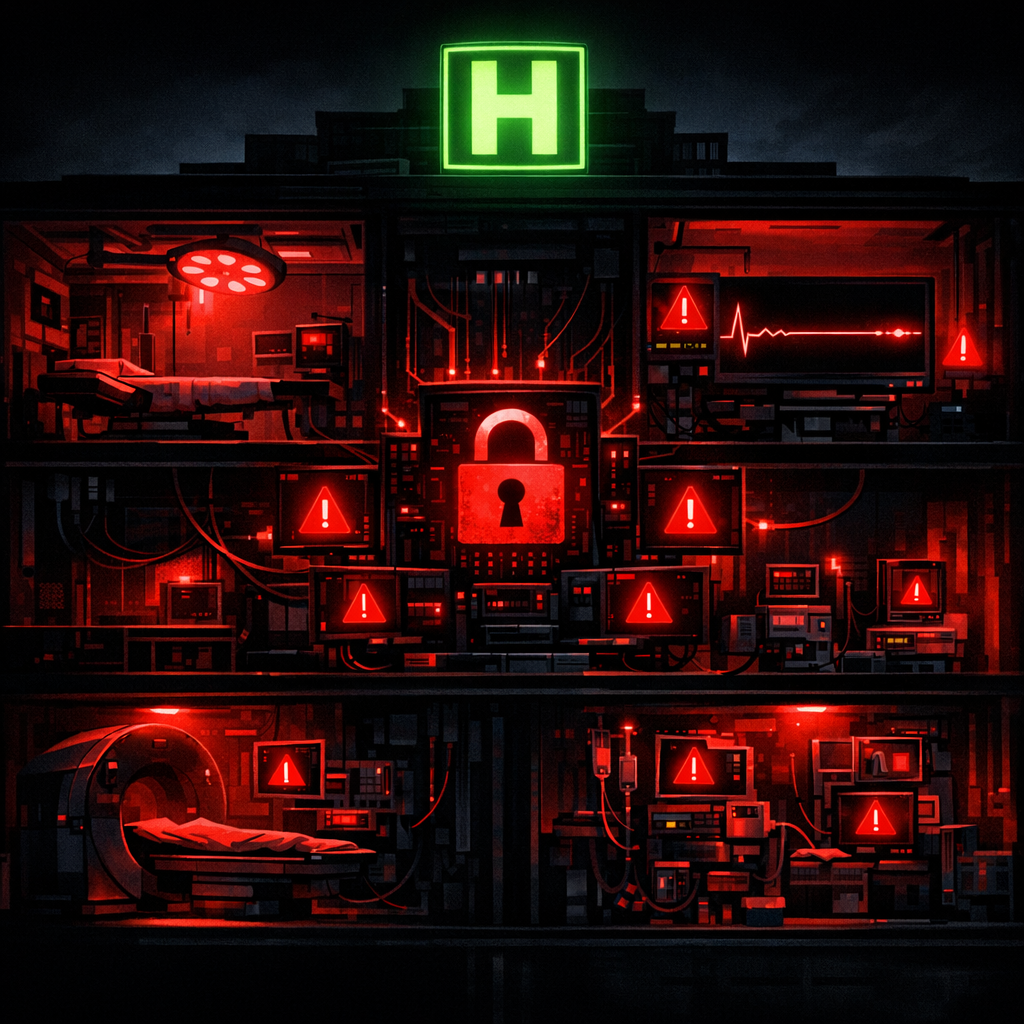
The healthcare sector has been the worst ransomware target for half a decade. Patient mortality data following ransomware events at hospitals is a small but real research area at this point. The attacks keep coming, the consequences keep getting worse, and the structural reasons for both are well understood. What’s finally starting to help is also clear, and most hospitals haven’t done it.
Why hospitals are the worst targets
Three structural reasons. The cost of downtime is unique. A factory that loses a day of production loses revenue. A hospital that loses a day of EMR access cancels surgeries, diverts ambulances, and degrades care for patients whose conditions don’t pause for IT recovery. The pressure to pay is correspondingly higher.
The IT environment is genuinely hard to secure. Hospitals run a sprawl of legacy clinical systems, IoT-connected medical devices that vendors won’t allow to be patched, decade-old radiology workstations that can’t run modern endpoint controls, and EMR vendors with their own cadence. The realistic security posture for the average hospital is significantly weaker than for a comparable-revenue corporate.
The budget structure is wrong. Most hospitals operate on margins that don’t permit the level of security spend that the threat actually requires. A 200-bed community hospital cannot afford the security team a 200-employee tech company runs, and the threat is the same.
What attacks actually look like
The 2025-2026 hospital incidents we’ve reviewed run a familiar script. Initial access through a phishing email or stealer-log credential. Lateral movement through Active Directory because the segmentation between clinical and administrative networks isn’t actually enforced. EMR encryption alongside encryption of pathology, radiology, and lab systems, chosen specifically because those systems’ downtime is medically immediate.
Recovery time runs three to six weeks for a typical mid-sized hospital, sometimes longer for critical specialties. The financial damage averages tens of millions per incident, and that’s before the regulatory follow-up, civil liability, and the longer tail of patients who delay care because they don’t trust the systems.
Free tool
How does your own site score?
Run the same forty passive checks against your own domain: TLS and certificates, security headers, SPF and DMARC, cookies before consent, and what your stack quietly reveals. A grade out of 100 in about fifteen seconds.
No signup. Nothing installed. We only request what your site already serves publicly.
What’s finally starting to help
Three things are moving the needle for the hospitals that adopt them.
1. Network segmentation actually enforced. Not “we have VLANs,” but “the lab system cannot reach the EMR without going through a firewall, and we know what’s allowed through that firewall, and we audit it.” Hospitals that have done this work see attacks contained at the first segment instead of spreading hospital-wide.
2. Sector-shared SOC services. Several state-level health systems and the H-ISAC have set up shared SOC offerings priced for the actual hospital budget. The economics are right and the coverage works. Hospitals that won’t pay for in-house security buy into shared SOC at a fraction of the cost.
3. Federal and state HHS-tier mandates. The HHS cybersecurity performance goals (CPGs) have moved from “voluntary” to “linked to Medicare reimbursement” in several state implementations. The financial incentive is finally aligned with what’s required, and compliance investment is rising as a result.
The honest reality
Hospital ransomware will not be solved by any single intervention. It’s a problem of structural under-investment, vendor ecosystem complexity, and a budget reality that lags the threat. The improvements that work are slow, expensive, and unglamorous. The hospitals that have done the work are seeing measurably better outcomes.
For everyone else, the threat keeps compounding. The most useful policy lever in 2026 is making federal reimbursement conditional on baseline cyber hygiene. The most useful operational lever is sector-level shared services. Both are happening, slowly. Patients whose surgeries get cancelled tomorrow because the hospital’s IT is down don’t have time for slowly. That gap is the ongoing cost of the structural problem.
The Ransomnews Monthly
One email a month. Original leak-site data, victim census updates, and the findings that did not make the articles. No spam, unsubscribe any time.
Double opt-in. We store your email, signup time, and IP for consent records (GDPR Art. 7). See our privacy policy.