
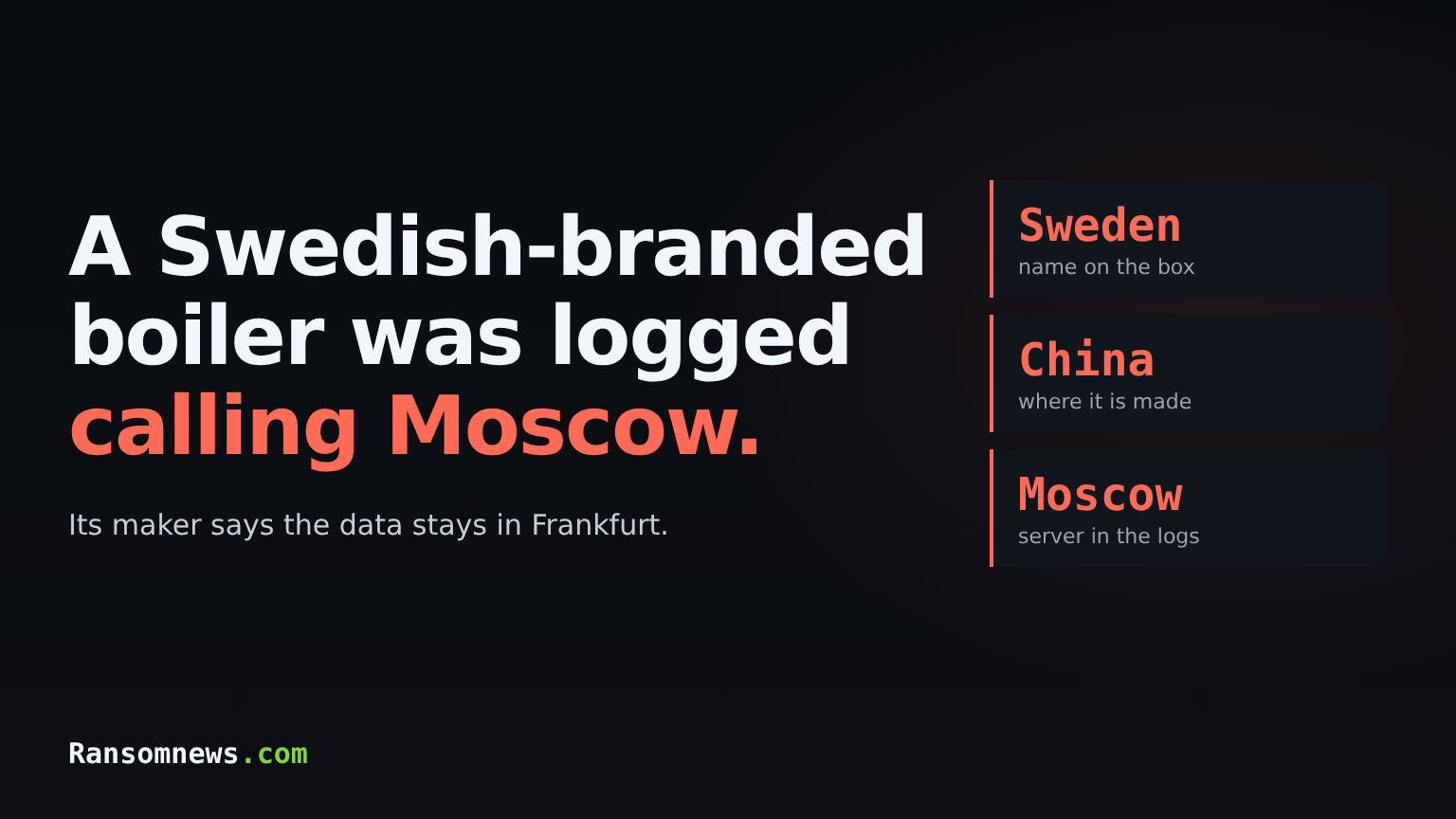
An Electrolux-branded Wi-Fi boiler bought in Ukraine was logged connecting to a server in Moscow, and the Russian app behind the connection lists the model sold in EU shops by name, research published by Mysterium VPN shows. The boiler is made under licence by a Swiss company whose own app says it keeps data in Frankfurt.
In brief
- The owner’s router recorded his Electrolux EWH 80 looking up mqtt.cloud.rusklimat.ru on 23 November 2026 and trying to connect to it.
- Mysterium VPN traced that name to 130.193.49.173, an address registered to Yandex.Cloud LLC in Moscow.
- The owner had set the boiler up with Hommyn, an app from the Russian appliance group Rusklimat. The manual names a different app, ClimatOn.
- Hommyn’s Google Play page shows an Electrolux boiler, and its privacy policy says user data is stored in Russia.
- Owners can search their router’s log for the word rusklimat and block the address. The boiler heats water without Wi-Fi.
What did Mysterium VPN find?
Mysterium VPN found that the same boiler works with two apps, and the app decides which country it reports to. The researchers started from a Facebook post by Alexander Unger, who bought an Electrolux EWH 80 water heater from the Ukrainian retailer Rozetka in 2025. His router logged the boiler looking up mqtt.cloud.rusklimat.ru at 18:00 on 23 November 2026 and trying to connect to it.
The researchers repeated the lookup on 25 November and got the same address, 130.193.49.173. RIPE, the registry that assigns internet addresses in Europe and Russia, lists it under Yandex.Cloud LLC in Moscow. The server name sits on the domain of Rusklimat, which describes itself as the leader of Russia’s climate-equipment market.
Unger told the researchers he had set the boiler up with Hommyn, Rusklimat’s app. Hommyn’s Google Play page shows an “Electrolux SmartInverter” boiler in its first screenshot. Mysterium VPN examined version 1.20.2 of the Android app and reports that its built-in device list includes a model called “Electrolux SI (SE/BE) EEC”, the series sold in EU shops.
Who makes the Electrolux boiler?
Electrolux does not make it. The manual for the EWH SI EEC series names CladSwiss AG of Zug, Switzerland, as the manufacturer and says the boiler is made in China. It says the Electrolux name is used under licence from AB Electrolux, the Swedish parent, and that the remote-control app it names, ClimatOn, is not provided by Electrolux. The range is sold online in Poland, Lithuania and Serbia.
| What | What the records show | Where it comes from |
|---|---|---|
| Brand | Electrolux, used under licence from AB Electrolux of Sweden | User manual |
| Manufacturer | CladSwiss AG, Zug, Switzerland | User manual |
| Made in | China | User manual |
| App named in the manual | ClimatOn, from CladSwiss AG, data stored in Frankfurt | User manual, ClimatOn Data Act declaration |
| App the owner used | Hommyn, from Rusklimat of Moscow | Owner’s account to Mysterium VPN |
| Server in the owner’s logs | mqtt.cloud.rusklimat.ru on Yandex Cloud, Moscow | Owner’s router records, Mysterium VPN lookup |
Why would a boiler sold in Europe contact a Russian server?
It contacted the Russian server because it was set up with the Russian app. CladSwiss says ClimatOn’s cloud data sits on a server in Frankfurt, and Mysterium VPN found a ClimatOn server at an address registered to Amazon in Germany. A boiler paired with Hommyn reports to Rusklimat’s server in Moscow.
The two apps appear to come from one codebase. Mysterium VPN reports that the Hommyn app is written under the name of Syncleo, a smart-home platform company that names Rusklimat among its customers, and that it contains connection settings for both the Rusklimat server and the ClimatOn one. The researchers did not examine the ClimatOn app.
Mysterium VPN could not say why a buyer in Ukraine ended up on the Russian app when the manual names ClimatOn. A buyer of another Electrolux model in the range wrote on Rozetka in June 2026 that the Wi-Fi worked properly only through the Russian app.
What can the Russian app and server see?
The server sees when the boiler is on, its temperature and its mode, and it can send commands back. A record of when a household heats water shows when people are at home. The privacy policy bundled in Hommyn names R-Klimat LLC of Moscow as the operator and says users’ personal information is stored “exclusively within the territory” of Russia, Mysterium VPN reports.
Free tool
How does your own site score?
Run the same forty passive checks against your own domain: TLS and certificates, security headers, SPF and DMARC, cookies before consent, and what your stack quietly reveals. A grade out of 100 in about fifteen seconds.
No signup. Nothing installed. We only request what your site already serves publicly.
The researchers say the app is written to send sign-in details and the name and room of each device to Rusklimat servers, to keep device history on Yandex Cloud and to send the phone’s location to a Hommyn weather service. They read the app’s code without running it, so this describes what the app contains and not what it was seen sending. Russia is not among the countries the European Commission recognises as protecting personal data adequately.
This is one owner’s boiler. Mysterium VPN did not test a unit, and it found no public record of who owns CladSwiss AG or how the company is tied to Rusklimat. The website named in the range’s English manuals, home-comfort.com, gives CladSwiss as its contact and asks visitors to consent to data processing by a Moscow company under Russian law.
How can owners check their own boiler?
The router’s log shows which server a boiler contacts. Open the router’s admin page or app, find the DNS or traffic log and search it for rusklimat.
- If the router keeps no log, a DNS filter such as Pi-hole, AdGuard Home or NextDNS records every name a device looks up.
- Blocking mqtt.cloud.rusklimat.ru in the router or the filter stops the connection, and remote control from outside the home stops with it.
- The boiler heats water without Wi-Fi.
- The same check works for other appliances that use Hommyn or ClimatOn, including Ballu and Zanussi heaters and air conditioners.
A VPN on a phone or laptop does not change where an appliance sends its data. Mysterium VPN, which sells one, says as much: “the fix here sits at the router.” Ransomnews covers how exposed devices are found in its guide to attack surface mapping and tracks exposed cloud services in the Cloud Exposure Index.
What do Electrolux, CladSwiss and Rozetka say?
Mysterium VPN says it put questions to AB Electrolux, CladSwiss AG and Rozetka and had received no reply when it published. AB Electrolux sold its Russian business in 2022 and said then that it had no production in Russia and would not supply the company it had sold. Rusklimat’s Russian shop sells heaters under the Electrolux name today.
Frequently asked questions
Is my Electrolux boiler sending data to Russia?
Not necessarily. The manual points Wi-Fi models to the ClimatOn app, which says it stores data in Germany. The boiler in this case was set up with Hommyn, an app from the Russian group Rusklimat. Your router’s log shows which server your boiler uses.
Does Electrolux make these water heaters?
No. The manual names CladSwiss AG of Switzerland as the manufacturer and says the product is made in China. The Electrolux name is used under licence from AB Electrolux of Sweden.
What is mqtt.cloud.rusklimat.ru?
It is the server that Hommyn, the smart-home app of the Russian appliance group Rusklimat, uses to reach heaters and air conditioners. On 25 November 2026 it pointed to an address registered to Yandex.Cloud LLC in Moscow.
What is the Hommyn app?
Hommyn is a smart-home app published by Rusklimat. Its Google Play page shows Electrolux and Ballu devices, and its privacy policy says user data is stored in Russia.
Will the boiler still work if I block the server?
Yes. The boiler heats water without Wi-Fi. Blocking the server stops remote control from outside the home.
Does a VPN stop a smart appliance from sending data abroad?
A VPN app on a phone or laptop does not, because the appliance connects through the home Wi-Fi on its own. Blocking the server name at the router stops the connection.
Sources and further reading
- Mysterium VPN, Your “Swedish” Electrolux Boiler May Be Calling Moscow: A Mysterium VPN Research
- CladSwiss AG, user manual for the EWH SI EEC series, hosted by Hornbach Austria
- ClimatOn, Data Act declaration
- Google Play, Hommyn app listing
- AB Electrolux, statement on leaving Russia, 2 September 2022
- European Commission, adequacy decisions
- Ransomnews, Attack surface mapping and Cloud Exposure Index
The Ransomnews Monthly
One email a month. Original leak-site data, victim census updates, and the findings that did not make the articles. No spam, unsubscribe any time.
Double opt-in. We store your email, signup time, and IP for consent records (GDPR Art. 7). See our privacy policy.