
No single service replaces VirusTotal, so the working answer is a stack: OPSWAT MetaDefender Cloud or Jotti’s Malware Scan for multi-engine verdicts, ANY.RUN for interactive detonation, CAPE Sandbox where samples cannot leave your infrastructure, Intezer Analyze for code-family attribution, MalwareBazaar and AlienVault OTX for community intelligence, and AbuseIPDB for IP reputation. The differentiator to check first is not detection ratios. It is what each free tier does with your upload.
What are the best VirusTotal alternatives in 2026?
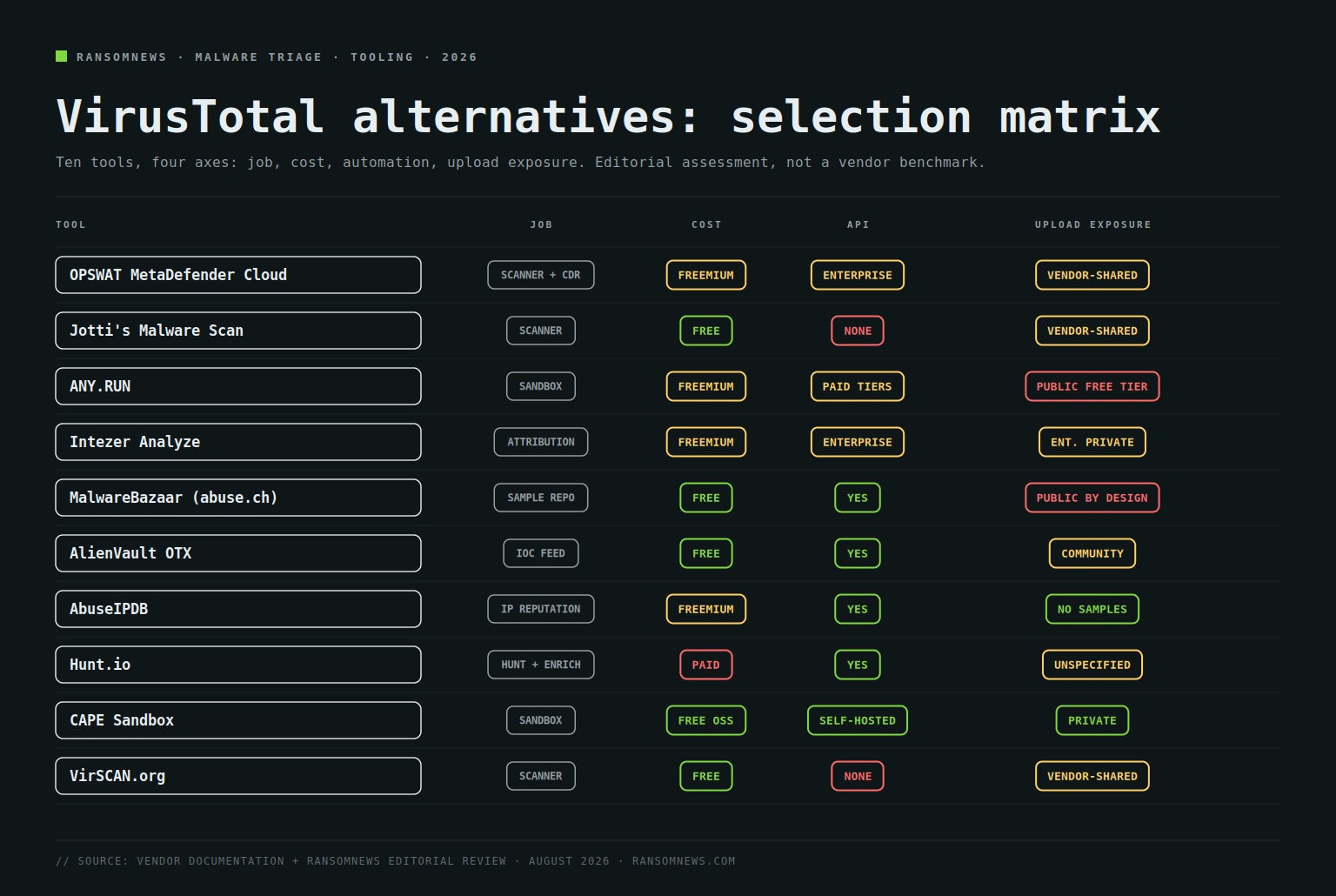
Ten tools cover the jobs VirusTotal is usually asked to do: fast verdicts, behavioural evidence, sample acquisition, indicator context, and attribution. The table is organised by what each one is actually for, what it costs, and the question most buyer’s guides skip: what happens to a sample after you submit it.
| Tool | Best for | Cost | Access | What your upload leaks |
|---|---|---|---|---|
| OPSWAT MetaDefender Cloud | Prevention-focused triage with CDR | Freemium | Web and API (enterprise) | Free-tier uploads may be shared; enterprise ingestion is private |
| Jotti’s Malware Scan | Zero-friction second opinion | Free | Web only | Uploads shared with engine vendors |
| ANY.RUN | Interactive detonation | Freemium | Web and API (paid) | Free-tier reports are public to every user |
| Intezer Analyze | Code-family attribution | Freemium | Web and API (enterprise) | Private ingestion is an enterprise feature |
| MalwareBazaar | Fresh sample acquisition | Free | Web and API | Everything is public by design |
| AlienVault OTX | Pulse-based IOC enrichment | Free | Web and DirectConnect API | Pulses are community-shared |
| AbuseIPDB | IP reputation triage | Freemium | Web and API | Community-reported data; no file uploads at all |
| VirSCAN.org | Backup multi-engine check | Free | Web only | Uploads shared with engine vendors |
| Hunt.io | Automated hunting pipelines | Paid | Web, API, SIEM/SOAR | Data-sharing terms not published; ask in writing |
| CAPE Sandbox | Self-hosted behavioural analysis | Free, open source | Self-hosted API | Nothing; the sample never leaves your network |
What does each tool actually do?
OPSWAT MetaDefender Cloud
MetaDefender Cloud runs a submission through a bank of AV engines and adds the two things VirusTotal does not offer at the same depth: Content Disarm and Reconstruction, which rebuilds documents into clean copies before delivery, and vulnerability scanning of the software components inside an installer. That makes it the pick for prevention pipelines rather than pure detection. The web tier handles ad-hoc triage; the REST API, throughput guarantees and private analysis sit in the enterprise tiers. Free-tier uploads are processed and may be shared with the security community, so treat the public tier as public.
Jotti’s Malware Scan
Jotti’s Malware Scan does one thing with no friction at all: upload a file, get verdicts from roughly 14 engines in seconds, no account required. There is no API, no hash lookup and no sandbox, which is exactly why it survives in every analyst’s bookmarks as the fast second opinion on a suspicious attachment. Uploaded files are shared with the engine vendors, so nothing sensitive goes in.
ANY.RUN
ANY.RUN is an interactive sandbox: the analyst drives the virtual machine in real time, clicks the link in the lure, types the password from the phishing email, and watches the process tree and network callbacks appear as they happen. Automated sandboxes run a fixed script; ANY.RUN lets you meet the sample’s conditions, which is what defeats execution guards that time out or wait for user input. The community tier caps session length and publishes every report to all users. Paid tiers exist precisely to make sessions private and add the API.
Intezer Analyze
Intezer Analyze answers a different question: not whether the file is malicious, but whose code is inside it. It maps code blocks in a binary against a genome of known malware and legitimate software, then attributes reused segments to specific families and actors. When a sample looks novel but shares modules with a known family, that match is the shortcut into the reverse-engineering work. The community tier limits analyses per month; the API, YARA rule generation and private ingestion are enterprise features. Pair it with a sandbox rather than replacing one. Code reuse tells you where a sample came from; execution tells you what it does.
MalwareBazaar (abuse.ch)
MalwareBazaar is a sample repository, not a scanner. Researchers submit tagged samples; everyone else queries by hash, family, tag or YARA rule through a documented free API. For detection engineering it is the most active public source of fresh artifacts, and it carries much of the load in our tutorial on tracking ransomware affiliates across rebrands. Every submission is public by design. Never upload anything you are not prepared to hand the entire internet.
AlienVault OTX
AlienVault OTX packages community threat intelligence into pulses: IOC sets with context, MITRE ATT&CK mappings and source attribution, pulled into SIEMs and custom tooling through the DirectConnect API. Coverage spans files, URLs, IPs, domains and CVEs. Pulse quality tracks pulse authors, so treat OTX as a high-volume enrichment layer rather than a ground-truth verdict source.
AbuseIPDB
AbuseIPDB does IP reputation only: community members report abusive addresses, the platform aggregates confidence scores and category tags, and a free API tier covers a meaningful daily query volume. For network-level triage it is faster and more focused than asking a general-purpose scanner about an IP. It never touches files, which also makes it the one tool on this list with no sample-exposure question to answer.
VirSCAN.org
VirSCAN.org is the backup scanner: free multi-engine checks, no API, no sandbox, modest file-size limits. It earns its place the day your primary is down or you want one more opinion on a single engine’s verdict. Like Jotti, uploads are shared with engine vendors. Do not build a pipeline on it.
Hunt.io
Hunt.io sells the pipeline rather than the verdict: enrichment-first workflows that aggregate indicator context across sources and surface it inside the hunting loop, with the API and SIEM/SOAR integrations doing the heavy lifting. It is a paid product aimed at teams automating at volume, not at the ad-hoc analyst. Its data-sharing terms are not published on the site, so ask for them in writing during evaluation and treat the answer as part of the product.
CAPE Sandbox, and the self-hosted stack
CAPE Sandbox is the actively maintained descendant of Cuckoo: an open-source sandbox that detonates samples in virtual machines you own and captures network traffic, registry changes, process trees and, its speciality, unpacked payloads and extracted configs. Self-hosting costs real infrastructure and maintenance time, and it buys the one property no cloud tier can match: the sample never leaves your network. Our home malware-sandbox tutorial covers the Cuckoo-lineage build step by step. Malice, a containerised multi-scanner, extends the same self-hosted logic to the scanning layer.
How do you choose a VirusTotal alternative?
Match the tool to the artifact, the sensitivity and the pipeline, in that order. Six questions settle most shortlists before a single trial account exists:
- Which IOC types do you actually triage? Files and hashes only, or URLs, IPs and domains too? Half the tools above only handle files.
- Can this sample be public? If it came from a live engagement, the answer is no until someone senior says otherwise.
- What throughput does the workflow need? Ad-hoc uploads and API-driven volume are different products, sometimes from the same vendor.
- What does the output feed? A SIEM, a SOAR, or the business EDR stack. A tool without an export path stays manual forever.
- Do you need a verdict or evidence? Detection ratios answer “is it bad”; process trees and unpacked payloads answer “what did it do”.
- Can the team run a self-hosted sandbox, and keep running it? CAPE is free the way a puppy is free.
Four answers should end an evaluation early: no documented API rate limits, public publication switched on by default with no opt-out, no private-ingestion option for organisations with data-classification rules, and a sandbox that records no network activity for samples known to beacon on execution.
Free tool
How does your own site score?
Run the same forty passive checks against your own domain: TLS and certificates, security headers, SPF and DMARC, cookies before consent, and what your stack quietly reveals. A grade out of 100 in about fifteen seconds.
No signup. Nothing installed. We only request what your site already serves publicly.
One caveat belongs in every triage runbook. Multi-scanner platforms run SDK or command-line engine variants, and the AVAMAT research from City, University of London documented how materially those can differ from the same vendor’s endpoint agent. A clean multi-scanner verdict does not mean the endpoint product would pass the file, and the reverse holds too. Treat detection ratios as a probability signal, not a clearance.
For enterprise purchases, get the private-ingestion SLA, retention windows and deletion timelines in writing, and load-test the API before signature. A vendor that cannot produce those terms is a community tool wearing enterprise pricing.
What does a malware triage workflow look like in practice?
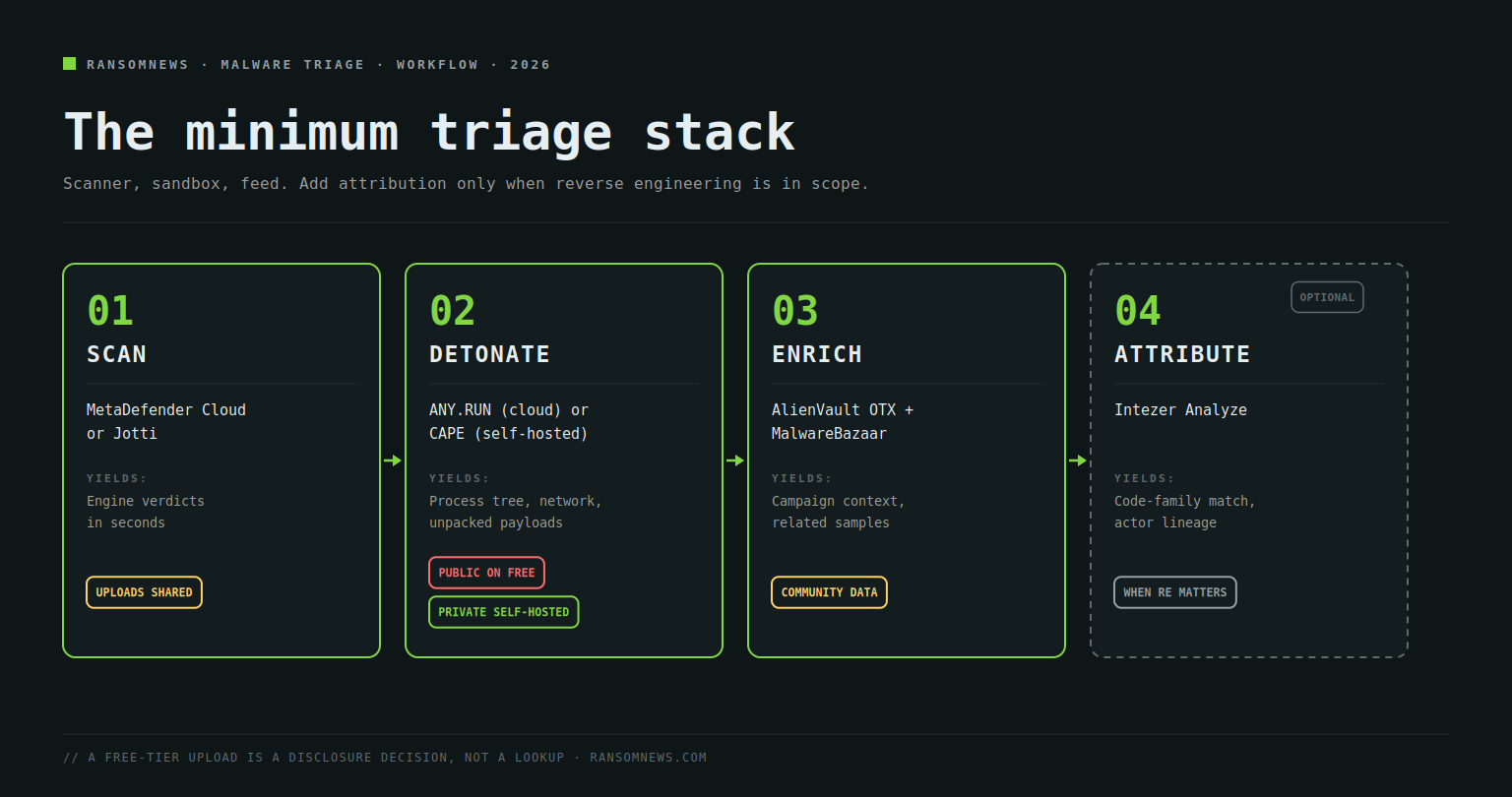
The minimum stack is three layers: a multi-engine scanner for the first sixty seconds, a sandbox for behavioural evidence, and one community feed for context. Most teams need nothing more, and the fourth layer, code attribution, joins only when reverse engineering is part of the job.
| Step | Layer | Tools | What it yields | What the submission exposes |
|---|---|---|---|---|
| 01 | Scan | MetaDefender Cloud or Jotti | Engine verdicts in seconds | Free-tier uploads shared with vendors |
| 02 | Detonate | ANY.RUN (cloud) or CAPE (self-hosted) | Process tree, network callbacks, unpacked payloads | Public reports on the free tier; private when self-hosted |
| 03 | Enrich | AlienVault OTX and MalwareBazaar | Campaign context, related samples | Queries and pulses are community-visible |
| 04 | Attribute (optional) | Intezer Analyze | Code-family match, actor lineage | Private ingestion is an enterprise tier |
Pilot every candidate against the same structured set: known-clean files, known-malicious samples across at least three families, and a handful of low-prevalence binaries. Record verdict latency, artifact quality and the false-positive rate on the clean set. In automated triage, false positives burn analysts faster than the occasional miss. Then smoke-test the API against your real integration targets before anyone signs anything.
What does submitting a sample actually leak?
Every upload is a disclosure decision, not a lookup. On most free tiers the sample, the report, or both become someone else’s data: MalwareBazaar publishes by design, ANY.RUN’s community tier publishes reports, Jotti and VirSCAN forward files to engine vendors, and MetaDefender’s free tier may share submissions with the security community.
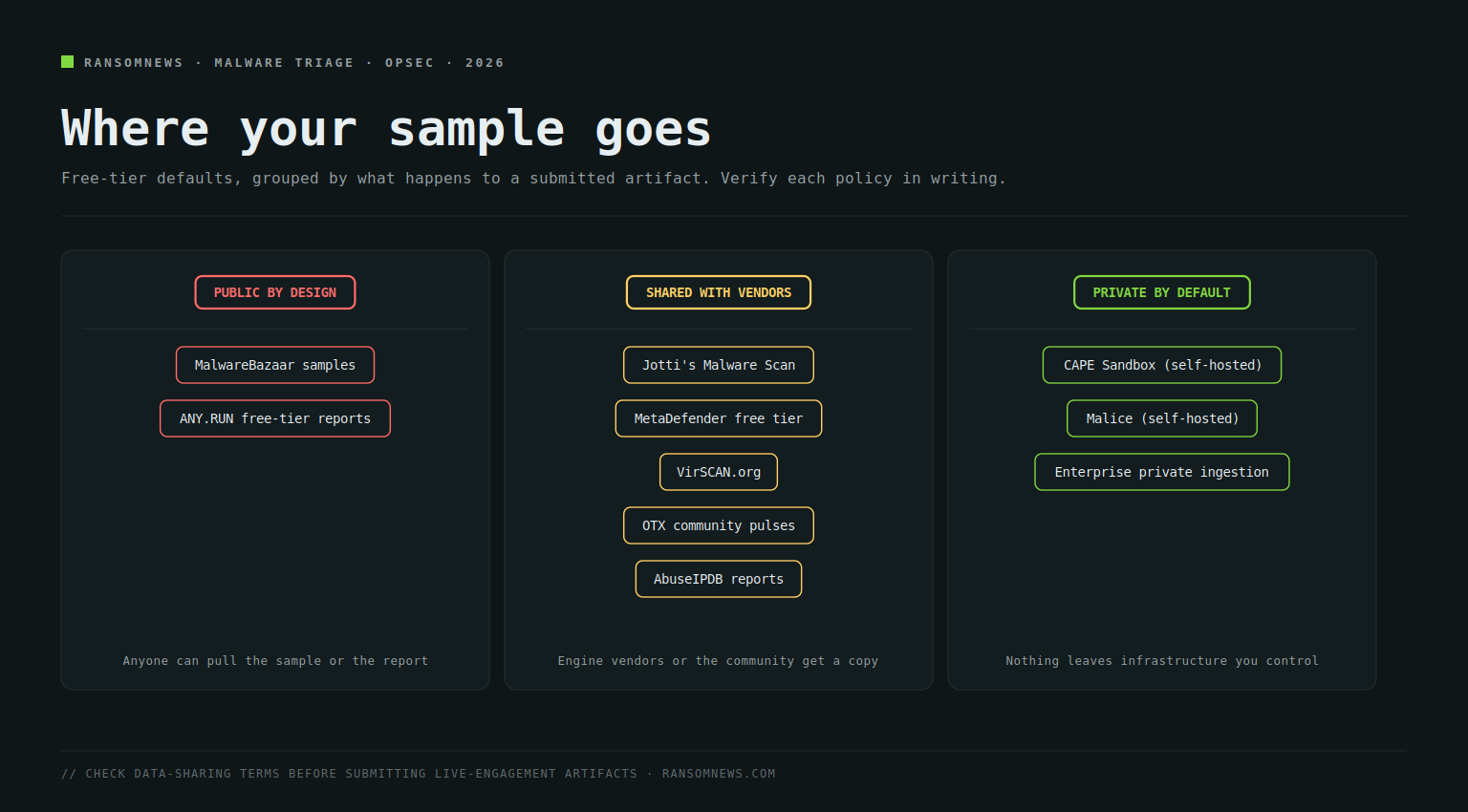
For incident-response artifacts the constraint is operational, not theoretical. A sample named after the client, an internal tool, or a config with infrastructure baked in tells an attacker, or anyone watching the public feeds, that the engagement exists. Three practices cover most of the risk:
- Read the data-sharing policy before the first upload and keep a copy. Policies change; your audit trail should show what you agreed to at the time.
- Route live-engagement samples through self-hosted CAPE or an enterprise private-ingestion tier with the SLA in writing. Free tiers are for commodity malware.
- Strip or defang anything carrying internal hostnames, credentials or customer data before it goes near a shared platform. Our OPSEC guidance for investigators applies unchanged to sample handling.
How we evaluated these tools
We weighted seven criteria, in order: feed freshness, IOC coverage breadth, API maturity, privacy and data-sharing posture, sandbox fidelity, community activity, and throughput. The test set combined known-malicious families, known-clean files and low-prevalence samples, submitted identically wherever a public API allowed, and every privacy claim was read from vendor documentation rather than marketing copy.
Two limitations are worth naming. Engine counts advertised by multi-scanners refer to SDK variants, not endpoint agents, so our comparisons treat them as directional. And the sample set is sized to verify API behaviour and artifact quality, not to rank detection rates. Academic measurement work such as TIPCE, a longitudinal comprehensiveness analysis of threat-intelligence platforms, keeps finding that coverage varies across platforms and indicator types. That is the standing argument for measuring candidates against your own samples instead of trusting anyone’s league table, ours included.
What we left out, and why
VirusTotal itself is the baseline, not a casualty. For single-indicator triage it remains the default first stop, and our best OSINT tools roundup covers it in that role. The rule that pushes teams toward this article is unchanged: anything submitted becomes visible to other subscribers, and for a live incident that is a disclosure you may not be able to afford.
Hybrid Analysis, Joe Sandbox and tria.ge all turn up on lists like this one, and all three are capable. Their community tiers publish submissions or reports publicly, which means they solve availability without touching the privacy problem this article keeps circling back to. Nothing against them; they do not change the calculus.
Enterprise threat-intelligence platforms are a procurement cycle, not a tool swap. Anyone in a position to run one already has people whose job is that evaluation, and nothing in a ten-tool roundup helps them.
What we run ourselves
Ransomtracker is our own leak-site feed, StealerCheck answers whether a domain shows up in infostealer logs, and the threat-group profiles hold the actor context. They pick up where the tools above stop: a scanner verdict tells you what the file is, the profiles tell you who runs it and how they behave. The methodology behind all three is in our piece on tracking ransomware infrastructure.
Frequently asked questions
What is the best free alternative to VirusTotal?
Jotti’s Malware Scan is the fastest free multi-engine check, with verdicts in seconds and no account. MalwareBazaar is the best free source of samples, and AlienVault OTX the best free indicator context. None of the free tiers keeps your upload private.
Is there a VirusTotal alternative that keeps samples private?
Self-hosted CAPE Sandbox or Malice keeps everything inside your own infrastructure. In the cloud, private analysis is an enterprise feature: MetaDefender and Intezer both sell private ingestion, and the retention terms belong in the contract, not in a support ticket.
Can one tool replace VirusTotal completely?
No. VirusTotal bundles scanning, sandboxing, hunting and a sample corpus behind one interface, and no single alternative covers all four. Replace it by function: a multi-engine scanner, a sandbox, and at least one community feed.
Do free malware scanners share uploaded files?
Most do by default. Jotti and VirSCAN share uploads with engine vendors, MetaDefender’s free tier may share with the security community, ANY.RUN’s community tier publishes reports, and MalwareBazaar publishes everything by design. Treat any free-tier upload as a disclosure decision.
Which sandbox should threat hunters pick, ANY.RUN or CAPE?
ANY.RUN when you need to interact with the sample in real time and cloud execution is acceptable. CAPE when samples cannot leave your infrastructure or volume justifies the maintenance. Mature teams usually run one of each.
Does a clean multi-scanner result mean a file is safe?
No. Multi-scanner platforms run SDK or CLI engine variants that can behave differently from the same vendor’s endpoint product, as the AVAMAT research documented. A clean sweep is a probability signal; behavioural evidence from a sandbox is what clears a file.
Is AbuseIPDB reliable enough for blocking decisions?
It is reliable enough for triage and prioritisation, with community confidence scores and a usable free API. For automated blocking on critical infrastructure, corroborate against a second source first; community-reported data carries false reports by nature.
Sources and further reading
- AVAMAT: AntiVirus and Malware Analysis Tool, City Research Online, City, University of London
- TIPCE: A Longitudinal Threat Intelligence Platform Comprehensiveness Analysis, ACM CODASPY 2024
- MalwareBazaar, abuse.ch
- OTX DirectConnect API, AlienVault OTX
- CAPEv2, kevoreilly, GitHub
- Malice, maliceio, GitHub
Related Ransomnews coverage
- How to investigate a phishing kit: urlscan.io, PhishTank and Sublime Security
- Ransomware leak-site OSINT: 2026 investigation walkthrough
- Shodan, Censys and the internet-wide scanners compared
- Multi-tool OSINT search: IntelX, SpiderFoot and Maltego
The Ransomnews Monthly
One email a month. Original leak-site data, victim census updates, and the findings that did not make the articles. No spam, unsubscribe any time.
Double opt-in. We store your email, signup time, and IP for consent records (GDPR Art. 7). See our privacy policy.