
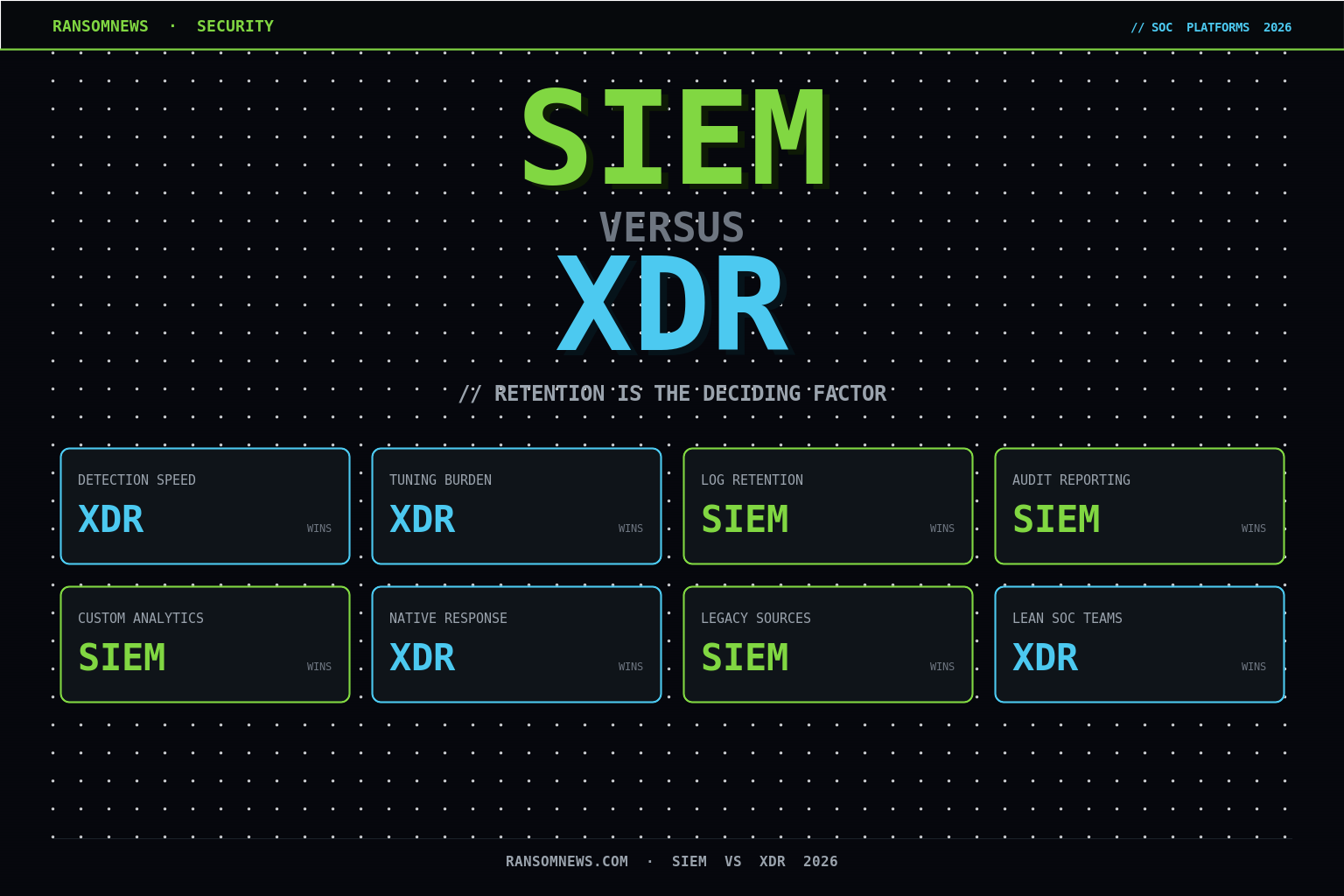
XDR detects faster and needs less tuning. SIEM stores longer and answers to auditors. In 2026 the decision is no longer about detection quality, which has largely converged, but about how long you must be able to prove what happened. PCI DSS requires twelve months of audit history. Most XDR platforms do not hold it, which is why most regulated SOCs run both.
What is the actual difference between SIEM and XDR?
SIEM ingests any log source you can forward, stores it, and lets analysts write their own correlation logic against the whole set. XDR ingests a vendor-selected slice of telemetry across endpoint, identity, network, cloud and email, then ships pre-built correlation that fires with little tuning. Gartner’s SIEM definition is deliberately broad on data sources, and that breadth is the whole distinction.
Everything else follows from it. Open ingestion means you own the schema, the parsers and the tuning burden. Curated ingestion means the vendor owns all three, which is faster to stand up and harder to bend. Forrester’s Q2 2025 Security Analytics Platforms Wave found the market split along exactly that axis, with SIEM vendors selling openness and XDR vendors selling pre-integration.
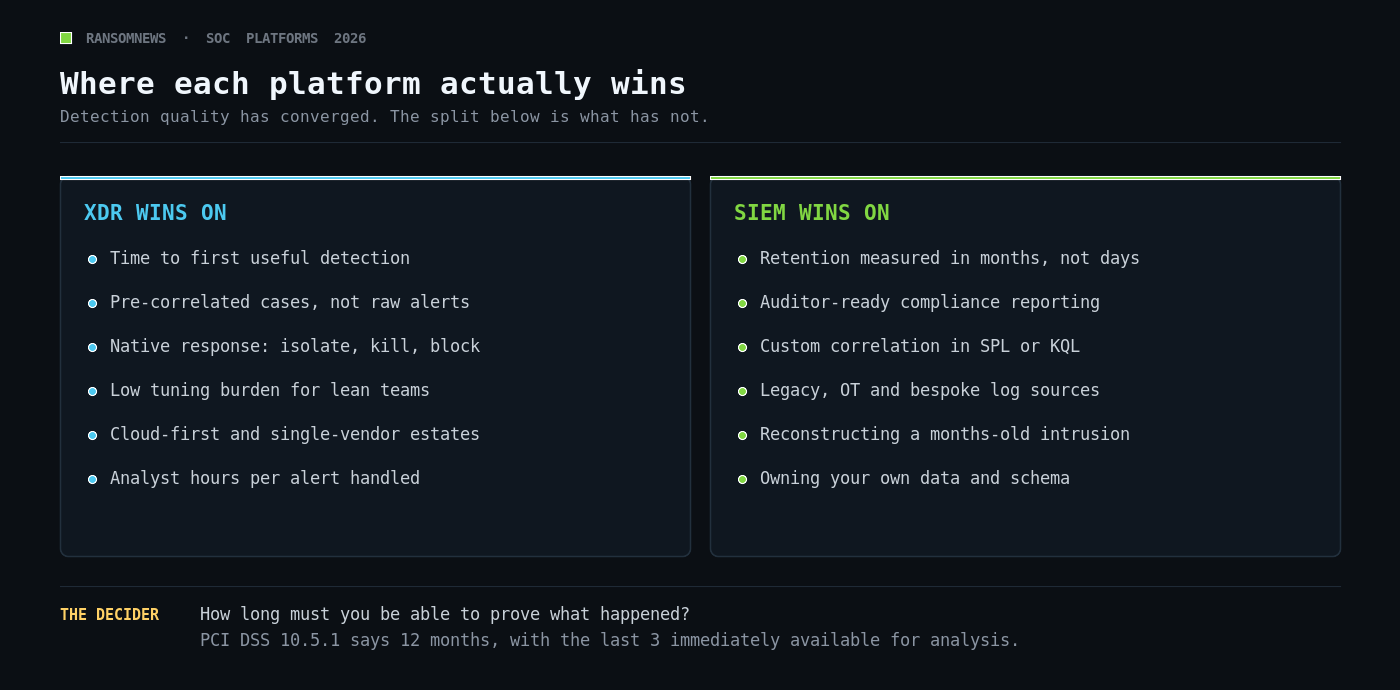
| Capability | Which platform wins |
|---|---|
| Time to first useful detection | XDR |
| Pre-correlated cases rather than raw alerts | XDR |
| Native response: isolate, kill, block | XDR |
| Low tuning burden for lean teams | XDR |
| Cloud-first and single-vendor estates | XDR |
| Analyst hours consumed per alert | XDR |
| Retention measured in months, not days | SIEM |
| Auditor-ready compliance reporting | SIEM |
| Custom correlation in SPL or KQL | SIEM |
| Legacy, OT and bespoke log sources | SIEM |
| Reconstructing a months-old intrusion | SIEM |
| Owning your own data and schema | SIEM |
| Dimension | SIEM | XDR |
|---|---|---|
| Telemetry | Any source you can forward, including legacy and bespoke | Vendor-selected: endpoint, identity, cloud, email, some network |
| Analytics | Your correlation rules, plus a growing behavioural layer | Pre-built behavioural models mapped to MITRE ATT&CK |
| Response | Analyst-driven, automation via integration | Native: isolate, kill, block, from the console |
| Retention | Months to years, tiered hot, warm and cold | Typically shorter, optimised for active cases |
| Compliance reporting | Auditor-ready templates and full search | Limited templates, gaps under most frameworks |
| Time to value | Weeks to months of parser and rule work | Days to weeks with vendor-managed collectors |
| Staffing | Query-language fluency and sustained tuning | Lower floor, but detection engineering still needed |
| Cost model | Ingest volume, which grows unpredictably | Per-host or per-identity, which grows with headcount |
| Lock-in | Data is yours, migration is painful but possible | Detections and response logic are proprietary |
Why retention settles the argument
Detection is a solved-enough problem on both sides. Evidence is not. PCI DSS requirement 10.5.1 asks for at least twelve months of audit log history, with the most recent three months immediately available for analysis. HIPAA’s audit control requirements assume you can demonstrate log integrity over time. NIS2 pushes EU operators in the same direction. None of that is satisfied by a platform that keeps thirty days of correlated cases.
The practical test is one question: if a regulator or an insurer asks what happened on a specific host nine months ago, can you answer? If the answer is no, XDR alone is not a complete programme regardless of how good its detections are. That is the whole reason enterprise SOCs run both rather than treating this as a binary.
The joint Best Practices for Event Logging and Threat Detection guidance from ASD’s ACSC, CISA, the FBI and the NSA makes the same point from the defensive side: logging policy, retention and centralised access are treated as prerequisites for detection, not as an afterthought once a platform is chosen.
Which telemetry catches ransomware first?
Ransomware intrusions run a recognisable sequence, and different stages surface in different places. Mapping the stages against the log source that sees them is more useful than any platform comparison, because it tells you what a coverage gap actually costs.
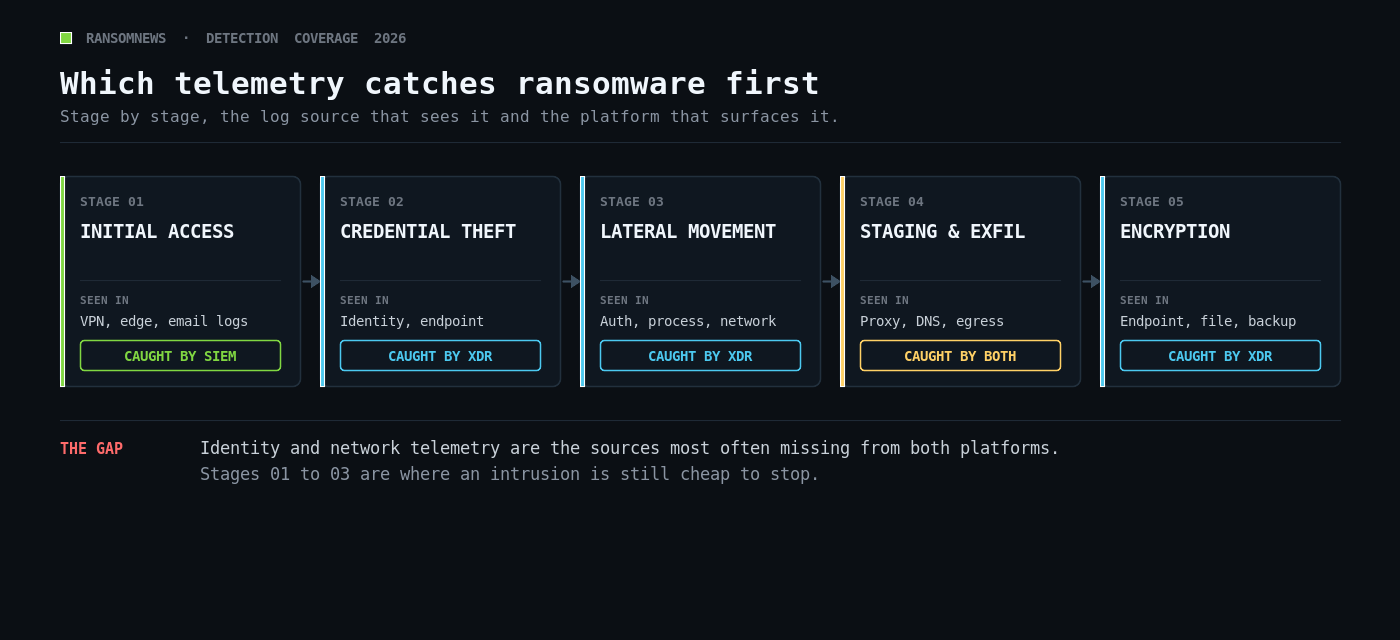
| Stage | Log source that sees it | Caught first by |
|---|---|---|
| 01. Initial access | VPN, edge and email logs | SIEM |
| 02. Credential theft | Identity and endpoint telemetry | XDR |
| 03. Lateral movement | Authentication, process and network telemetry | XDR |
| 04. Staging and exfiltration | Proxy, DNS and egress flow | Both |
| 05. Encryption | Endpoint, file and backup telemetry | XDR |
XDR’s advantage is concentrated in the middle of that chain. When an operator authenticates with a stolen VPN credential, dumps credentials on a jump host and moves to a file server, an XDR with identity and endpoint telemetry connected will usually present one correlated case linking all three within minutes. A SIEM without a pre-authored rule joining those event types will produce three separate alerts and wait for an analyst to notice the pattern.
SIEM’s advantage arrives after the incident. Reconstructing how the operator got in three weeks earlier is retention work, and XDR’s case-centric model is not built for it. This is exactly the pattern we see in stealer-log-driven intrusions, where the credential theft and the ransomware deployment can be separated by weeks. The correlation only exists if the older data still does. Our StealerCheck data and the live listings in Ransomtracker both point the same way: the gap between initial compromise and extortion is long enough that short retention windows lose the beginning of the story.
The more consequential gap in most deployments is not the platform choice at all. It is that identity and network telemetry are missing or misconfigured on both sides. Ransomware crews lean on credential-based lateral movement precisely because authentication logs and flow data are the feeds most often absent from the detection pipeline. A platform label does not fix a feed you never connected.
When can you run XDR on its own?
Three conditions, all of which have to hold. You are not subject to a framework that mandates long-term log retention. Your estate is predominantly cloud-native and covered by the vendor’s connector set, with no significant OT, legacy or bespoke logging. And your team is small enough that sustained SIEM tuning would consume more analyst time than it returns.
Free tool
How does your own site score?
Run the same forty passive checks against your own domain: TLS and certificates, security headers, SPF and DMARC, cookies before consent, and what your stack quietly reveals. A grade out of 100 in about fifteen seconds.
No signup. Nothing installed. We only request what your site already serves publicly.
That describes a lot of startups and mid-market companies honestly, and for them managed XDR is the right first move. It stops describing them the moment a customer contract, an insurer or an auditor asks for evidence. Plan for that transition rather than being surprised by it, because retrofitting retention does not recover the logs you never kept.
If the choice you are actually making is between endpoint tiers rather than between analytics platforms, our EDR, XDR and MDR tiebreaker covers that decision, and the state of endpoint defence in 2026 covers where those categories now sit.
What each platform gets wrong
XDR fails quietly at the edges of its connector set. Anything the vendor does not collect is invisible, and living-off-the-land techniques that blend into normal endpoint behaviour are a known evasion path. Proprietary detection logic also means a migration is a rebuild, and a vendor cloud outage is a detection outage.
SIEM fails loudly and then gets ignored. Untuned correlation produces false positives at a rate that erodes analyst trust within a quarter. Ingestion costs outrun budgets when log volume grows faster than forecast. Worst of all, parsers break silently when an upstream system changes its log format, and a feed that stopped ingesting three months ago looks identical to a feed with nothing to report.
Both failure modes have the same mitigation: a telemetry validation job that confirms every source is still ingesting and parsing, run on a schedule rather than after an incident. Keep audit logs backed up somewhere separate from the platform as well, since security infrastructure is itself a ransomware target.
How to test this before you sign
Vendor claims of full coverage are untestable by design. Replace them with a proof of concept that produces evidence:
- Demand a telemetry coverage matrix mapped to MITRE ATT&CK before the POC starts, so you are testing against a written claim.
- Connect every planned log source and verify parsing against known-good events. Coverage gaps found now cost hours; found later they cost months.
- Run a simulated lateral movement scenario using real techniques, not synthetic test data, and record whether the platform produces one correlated case or several unlinked alerts.
- Ask for the specific compliance report your auditor requires, generated from your data, during the POC.
- Measure detection and response times against that scenario, and track the false positive rate across a full 30 days rather than a demo week.
A vendor that cannot surface a correlated case against a realistic scenario in a controlled POC will not do better in production, under load, at 3am. Where automation fits on top of either platform is a separate decision, and one with its own sequencing trap: see our companion piece on SOAR vs SIEM. For where machine learning is genuinely earning its place in this stack, AI in the SOC covers what is working and what is still demo-ware.
Frequently asked questions
Can XDR replace a SIEM?
Only if you have no long-term log retention obligation. XDR platforms optimise for detection speed and active-case data, not for the twelve months of searchable audit history that frameworks like PCI DSS expect. Where retention is mandated, XDR complements a SIEM rather than replacing it.
Is XDR faster at detecting ransomware than SIEM?
Usually yes, in the credential theft and lateral movement stages, because the correlation is pre-built and the identity and endpoint telemetry is already joined. SIEM can match it, but only with correlation rules somebody wrote and maintains.
How long do you need to retain security logs?
It depends on your framework, and you should confirm against the current standard text rather than a vendor summary. PCI DSS requirement 10.5.1 asks for twelve months, with the most recent three months immediately available for analysis. Many organisations retain longer because insurers and litigation both reach back further.
What does XDR not see?
Anything outside the vendor’s connector set: legacy OT, custom applications, niche SaaS and most bespoke logging. It also struggles with techniques that deliberately mimic normal endpoint behaviour, since those generate no anomalous signal to correlate.
Which should a small security team buy first?
Managed XDR, in almost every case. It delivers usable detection in weeks rather than months and does not require query-language fluency to operate. Add log retention when a compliance obligation or a customer contract forces the question.
Do SIEM and XDR overlap?
Increasingly. Next-generation SIEM platforms have added behavioural analytics and automated playbooks, while XDR vendors have extended retention and log ingestion. The convergence is real, but open-schema search and long retention remain SIEM territory.
Sources and further reading
- The Forrester Wave: Security Analytics Platforms, Q2 2025, Forrester
- Best Practices for Event Logging and Threat Detection, ASD’s ACSC with CISA, FBI and NSA
- Security information and event management (SIEM), Gartner glossary
- PCI DSS standard text and supporting documents, PCI Security Standards Council (requirement 10.5.1 covers audit log retention)
- MITRE ATT&CK
Related Ransomnews coverage
- SOAR vs SIEM 2026: tune before you automate
- Detecting and responding to infostealer infections
- The pivot from encryption to data theft: pure-extortion gangs in 2026
- Best ransomware protection for business
The Ransomnews Monthly
One email a month. Original leak-site data, victim census updates, and the findings that did not make the articles. No spam, unsubscribe any time.
Double opt-in. We store your email, signup time, and IP for consent records (GDPR Art. 7). See our privacy policy.